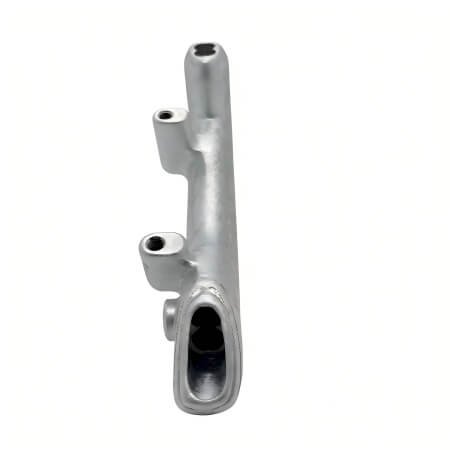

Aluminum Forging Components for Robotics: The Stronger Alternative to Die Casting
Hello everyone, I am “Old Wang the Forging”.
In my decades at XinPingFu, I have met countless engineers in the robotics and automation industry. They come to me with a common frustration. They say, “Old Wang, our robot arms are breaking. We are fighting with die casting porosity issues. The surface finish is full of bubbles after anodizing. Is there a better way?”
I smiled and told them, “Friends, you’ve asked the right question. What you need isn’t a better casting, but a stronger alternative process than cast aluminum.”
The Hidden Weakness: Common Aluminum Casting Defects in Robotics
Let’s be frank about the problems you face. You chose die casting because it seems cheap and easy. However, the drawbacks of aluminum castings cannot be ignored in high-performance automated production.
Porosity (Air Bubbles): When you inject liquid aluminum into a mold, air gets trapped inside. These microscopic bubbles are weak points. Under the constant rapid movement of a robot arm, these weak points lead to fatigue failure in cast parts.
Brittle Failure: Cast aluminum has a random grain structure. It is brittle. If a robot arm crashes or carries a heavy load, a cast part might snap instantly. This is why many engineers search for how to improve cast aluminum strength, only to find they have reached the material’s limit.
Surface Issues: If you want your robot to look high-tech, you likely anodize the parts. But when you anodize cast aluminum, the internal porosity often reveals itself as ugly pits. Anodizing die cast aluminum problems are a headache for quality control.
For a toy, this might be okay. But for industrial automation equipment that must run 24/7 with extreme precision? It is a risk you cannot afford.
Why Aluminum Forging is the Perfect Solution
Aluminum forging solves every single one of these problems. It is the answer to your search for high strength aluminum parts for robotics.
Superior Strength and Toughness
At the “Old Wang the Forging” factory, we don’t melt the metal. We heat the aluminum alloy to soften, then forge it into shape using a forging machine with thousands of tons of pressure.
The forging process ensures that the aluminum’s “grain flow” remains consistent.
Strength: A forged part is typically 20-30% stronger than a cast part.
Toughness: Forging gives the metal “ductility.” If your robot arm hits something, a forged part will absorb the impact (it might bend slightly) rather than shattering like glass. This protects your expensive motors and gears.
Zero Porosity for Perfect Anodizing
Because we squeeze the metal under high pressure, there are absolutely no air bubbles inside. The material density is 100%.
If you’re tired of the challenges of anodizing die-cast aluminum parts, forging will be your savior. “Old Wang the Forging” forging plant produces aluminum forgings with a smooth, uniform surface and a deep, rich color after anodizing.
Lightweight Design
Because forged aluminum is so strong, I can redesign your parts to be thinner and lighter.
In robotics, weight is the enemy. A lighter arm has lower inertia. This means:
Faster Acceleration: Your robot can move quicker.
Less Vibration: It stops precisely without wobbling.
Case Study: Replacing Casting with Forging
I remember a client who makes “Pick and Place” robots. They were using a die-cast Z-axis arm and struggling with aluminum die casting tolerances.
The Solution from XinPingFu:
I analyzed their design. I proposed switching to 6061-T6 Aluminum Forging. We created a forging die that optimized the shape.
The Result:
Weight Reduction: The new forged arm was 25% lighter. The robot speed increased by 15%.
Zero Failures: The forged parts were solid. No more breakage during assembly.
Cost Savings: By eliminating the high scrap rate caused by aluminum casting defects, they saved huge money in the long run.
XinPingFu: Your Partner in Automation Forging
At Xinpingfu, we are more than just a factory; we are solutions experts who translate casting designs into forging results.My team understands the unique needs of the automation industry. We know you need:
Precision: We offer high-precision cold and hot forging services, ensuring strict tolerance control.
Material selection: From versatile 6061 aluminum alloy to ultra-strong 7075 aluminum alloy suitable for heavy-duty robotic arms, and the more durable 6082 aluminum alloy, we have it all..
“Old Wang the Forging” invites you to upgrade your robots. Don’t limit yourself to die-casting processes anymore. Send us your drawings today. Let us show you how aluminum forgings can make your automation equipment faster, stronger, and more reliable.