

Aluminum Forging vs. CNC Machining: Advantages and Disadvantages of Structural Aluminum Parts
If you are manufacturing structural aluminum parts, choosing the right production process is crucial. Many purchasing managers and engineers initially choose CNC machining due to its flexibility and wide applicability.
When parts need to withstand loads, have high fatigue resistance requirements, or require medium to high batch production, aluminum forging can offer significant advantages.
“Old Wang the Forging” will compare aluminum forging and CNC machining in terms of strength, cost, fatigue resistance, surface properties, and production efficiency.
What Is CNC Machining for Aluminum Parts?
CNC machining is a subtractive manufacturing process. A solid aluminum billet is cut and milled into the desired geometry using computer-controlled tools.
It is commonly used for:
- Prototypes
- Low-volume production
- Complex precision geometries
Advantages of CNC Machined Aluminum Parts
- High dimensional accuracy
- Fast prototyping
- No tooling cost for molds
- Suitable for small batch production
Limitations of CNC Machining for Structural Components
While CNC machining provides precision, it does not improve the internal grain structure of the material.
Key limitations include:
- High material waste
- Longer machining time for large parts
- No improvement in fatigue resistance
- Higher cost for medium to high volume production
When producing structural aluminum parts from billet, up to 50–70% of material may be removed during machining.
What Is Aluminum Forging?
Aluminum forging is a forming process where aluminum is shaped under high pressure using dies.
Instead of cutting material away, forging reshapes it, compressing the internal grain structure and aligning it along the geometry of the part.
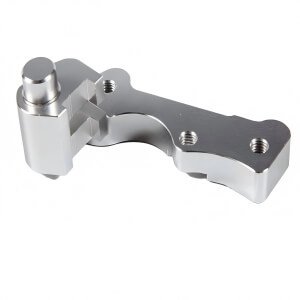
Forging is commonly used for:
- Suspension components
- Load-bearing structural parts
- Aerospace brackets
How Grain Flow Improves Strength
One of the biggest advantages of forged aluminum is controlled grain flow.
During forging:
- The grain structure follows the contour of the part
- Internal voids are minimized
- Density increases
This improves mechanical properties significantly compared to machined billet parts.
Why Forging Enhances Fatigue Resistance
Structural components often fail due to repeated stress rather than one-time overload.
Forged aluminum typically offers:
- Higher fatigue strength
- Better crack resistance
- Improved impact performance
This makes forging more suitable for safety-critical applications.
Strength Comparison – Forged vs CNC Machined Aluminum
When comparing aluminum forging vs CNC machining for structural parts, strength performance is a major factor.
| Property | CNC Machined Billet | Forged Aluminum |
| Grain Structure | Linear, unchanged | Directionally aligned |
| Fatigue Resistance | Moderate | High |
| Impact Resistance | Moderate | High |
| Structural Reliability | Good | Excellent |
Because forging compresses and refines the grain structure, it typically provides superior performance under dynamic loading conditions.
For components exposed to vibration, repeated load, or shock, forged aluminum is generally more reliable.
Cost Comparison Between Forging and Machining
Cost evaluation depends heavily on production volume.
Tooling Cost vs Material Waste:
| CNC Machining | Forging |
| No mold tooling required | Requires die tooling investment |
| No mold tooling required | Near-net shape reduces waste |
| High material waste | Shorter cycle time in volume production |
For small quantities, CNC machining may appear cheaper.
For medium to large volumes, forging often becomes more cost-efficient due to reduced material removal and faster throughput.
Best Production Volume for Each Process
Best Production Volume for Each Process
- 1–100 pcs → CNC machining preferred
- 500+ pcs → Forging becomes competitive
- 1000+ pcs → Forging usually more economical
Surface Finish and Post Processing
Both forged and CNC machined aluminum parts typically require finishing operations.
Forged parts usually undergo CNC machining on critical tolerance surfaces.
Compared to die casting, forged aluminum has:
- Higher density
- Fewer internal pores
- Better anodizing performance
Because forged aluminum does not contain gas porosity like die casting, it produces a more uniform anodized surface.
When Should You Choose Forging Over CNC Machining?
- The part is load-bearing
- Fatigue strength is critical
- Production volume exceeds prototype level
- Cost reduction is needed in medium-volume runs
- Structural reliability is required
CNC machining is suitable when:
- Speed to market is priority
- Quantity is very low
- Design changes frequently
- Geometry is extremely complex
Final Decision – Which Process Is Better?
There is no universal answer.
CNC machining: offers flexibility and precision for low-volume projects.
Aluminum forging: offers superior strength, fatigue resistance, and long-term cost advantages for structural applications.
If your aluminum component must withstand repeated stress, vibration, or high load, forging is often the more reliable manufacturing solution.
If your aluminum component is load-bearing, safety-critical, or requires improved fatigue resistance, forging is worth evaluating as a long-term cost-effective alternative to CNC machining