
Aluminum Forging vs. Die Casting: A Comprehensive Guide for Engineers
I am Old Wang the Forging. I have spent the last 20 years in the factory at XinPingFu. I talk to engineers from many countries every day. They often ask me a very big question. They ask, “Old Wang, should I use die casting or aluminum forging for my parts?” This is a very important choice for your project.
I will show you why the choice changes the quality, safety, and cost of your product.
Understanding the Fundamental Differences
we must look at how we make the parts. The two methods are very different.
The Die Casting Process: Pros and Cons
Die casting is like making ice cubes in your freezer. You melt the aluminum until it becomes a hot liquid. Then, you pour or force this liquid into a mold. It cools down and becomes hard.
I admit, this process is fast. It is good for making very complex shapes. However, I see a big problem here. When the metal is liquid, air gets inside easily. This makes the part weak inside.
The Aluminum Forging Process: Why Structural Integrity Matters
The aluminium forging process, is different. In my factory, we do not melt the metal into a liquid. Instead, we heat the aluminum until it is soft, but it is still solid. Then, I use big, powerful machines to press and squeeze it into shape.
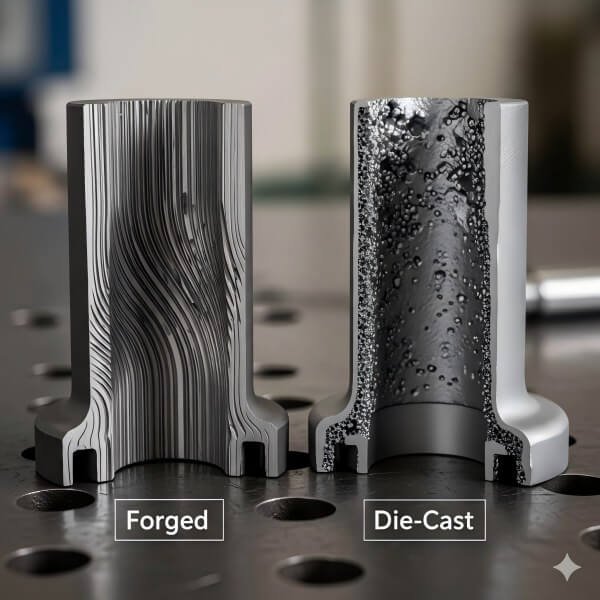
This is the advantage of forging. It moves the metal grain, making it conform to the shape of the part.
Key Performance Comparisons
Porosity Issues: Why Forging Wins on Internal Structure
Die casting often has these air bubbles. You cannot see them on the outside, but they are there. If you cut a cast part, you might see small holes. These holes make the part break when you hit it.
In my forging workshop, we do not have this problem. The high pressure squeezes all the air out. The inside of a forged part is solid and tight. This is why top aluminium forging suppliers like us prefer this method for serious parts.
Strength-to-Weight Ratio Analysis
For cars, racing cars, and robots, your parts must be lightweight yet extremely strong. Forging offers certain advantages.
Forging makes aluminum very dense. Commonly used high-strength materials include alloys such as 6061 T6 and 7075 T6. These materials are well-known in the industry. Alloy 7075 T6 has strength comparable to some steels but is very lightweight. Die casting cannot effectively utilize these high-strength alloys.
Surface Finish and Post-Processing
I know you also care about how the part looks. A cast part often comes out with a rough surface. It is hard to make it look shiny and perfect.
A forged part has a smooth, clean surface. It is easy for my team to polish. Also, if you want to use colors (anodizing), forging is the best choice. The color looks even and bright on alloy 6061 t6. On cast parts, the color can look ugly or uneven.
Cost Analysis: Tooling vs. Unit Price
Die casting molds are very expensive. You need to order many thousands of parts to pay for the mold cost. If you only need 1,000 parts, casting is too expensive for you.
Forging molds usually cost less than die casting molds. Also, the aluminium forging process creates less waste material. For medium orders or high-quality orders, my forging solution is often the smart choice for your budget.
Why XinPingFu Recommends Forging for Safety-Critical Parts
Safety is my number one rule. Some parts must never break, because people’s lives depend on them.
Think about an aluminum crankset on a bicycle. When a person stands up to pedal fast, all their body weight is on that crankset. If this part is made by casting, it might have a hidden air bubble inside. It could snap suddenly. The rider could fall and get hurt.
For components that involve movement, bear weight, or are related to personal safety, forging processes must be used. Cranksets made of 7075 T6 aluminum alloy are not easily broken and are extremely tough. Even under severe impact, they will only bend rather than break, thus ensuring the rider’s safety.
At XinPingFu, I make parts for cars and motorcycles. I know that safety is the most important thing. That is why I trust forging.
If your aluminum components are load-bearing, safety-critical, or require higher fatigue strength, then forging is worth considering as it is a more performance-optimized alternative to die casting.