

“Old Wang the Forging”, founder of Xinpingfu, has focused on the research and production of precision aluminum alloy forging for over two decades. He firmly believes that the future of the automotive industry lies in lighter, stronger, and more reliable components, and aluminum alloy forging is one of the most reliable ways to achieve this goal. Today, Old Wang the Forging shares a practical guide to automotive aluminum alloy forgings with OEMs and supply chain partners in a calm and approachable manner.
Why is the automotive industry increasingly reliant on aluminum alloy forging?
“Old Wang the Forging” often says that the core value of the forging process lies in its ability to align the grains of aluminum alloy in an orderly manner along the direction of stress, forming a dense, pore-free structure. This change in internal structure is fundamental:
Significantly improved strength and fatigue performance: High-performance alloys typically boast tensile strengths exceeding 500–600 MPa, with fatigue life and impact resistance far surpassing that of castings.
Excellent strength-to-weight ratio: Aluminum’s density is only about one-third that of steel, allowing forgings to significantly reduce unsprung mass while maintaining sufficient rigidity and durability.
Suitable for harsh operating conditions: After anodizing or other surface treatments, the corrosion resistance and heat resistance meet the long-term usage requirements of engine components, chassis suspension, and other parts.
More economical for medium to high-volume production: Near-net-shape characteristics reduce subsequent machining and material waste, resulting in more stable overall costs.
Compared to casting (which is prone to porosity and shrinkage) and direct CNC machining from bar stock (which results in more scrap and a higher risk of stress concentration), forging has always been the safest choice for automotive structural parts with high safety requirements.
Aluminum alloy materials commonly used in automotive forging
“Old Wang the Forging” typically recommends the following mature heat-treated alloys to customers based on the actual needs of different parts:
6061-T6: Moderate strength (approximately 310 MPa), good corrosion resistance, excellent weldability, and stable anodizing effect; commonly used in general brackets, mounting seats, and other non-extreme stress components.
6082-T6: Higher strength (≥340 MPa), better fatigue performance; suitable for chassis control arms, crossbeams, suspension links, and other parts requiring high rigidity.
7075-T6: Extremely high strength (up to approximately 572 MPa), excellent fatigue resistance; commonly used in steering knuckles, suspension joints, high-load mounting seats, and other critical stress-bearing components.
These alloys are well-suited to meet the mainstream requirements of the current automotive industry in terms of lightweighting, heat resistance, corrosion resistance, and surface treatment compatibility.
Main application scenarios of forged aluminum alloys in automobiles
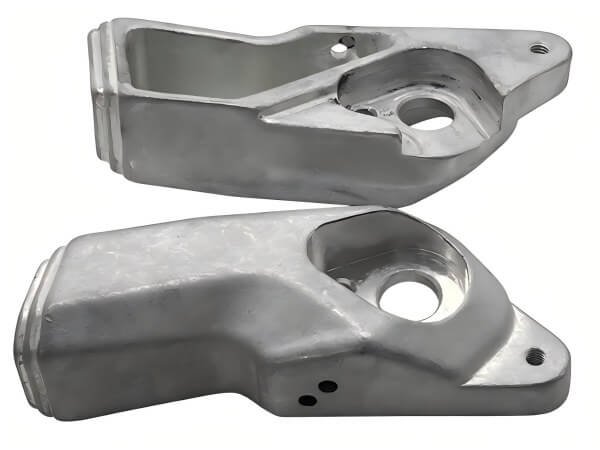
Old Wang the Forging observed that forged aluminum parts are currently widely used in the following components, with the most significant effects:
Calipers and Brakes: Forged aluminum wheels are lighter, more fatigue-resistant, and have lower rolling resistance than cast wheels, directly contributing to improved fuel economy and driving range.
Powertrain Peripherals: Engine mounts, transmission mounts, and some transmission system brackets, requiring a balance between lightweight design and heat and vibration resistance.
Other Structural Reinforcement Components: Brake system mounts, chassis reinforcement beams, subframe connectors, etc.
Many OEMs have reduced the weight of their suspension systems by 30–40% by using forged aluminum components, which is significant for fuel efficiency in gasoline vehicles and range extension in electric vehicles.
Quality requirements for forgings in the automotive supply chain
Old Wang the Forging specifically reminds consumers that forging suppliers entering the automotive supply chain must strictly meet the requirements of IATF 16949:2016. This standard is more stringent than the standard ISO 9001, mainly in the following aspects:
Full traceability: Every batch, from raw materials to finished products, must be clearly recorded.
Complete PPAP documentation submission, including control plans, FMEA, SPC, MSA, etc.
Critical safety components must undergo non-destructive testing (ultrasonic testing, penetrant testing, etc.).
Defect prevention is prioritized; zero defects is the fundamental goal.
Only through suppliers within these systems can OEMs truly entrust safety-related structural components to their forging partners with confidence.
A brief comparison of forging vs. other processes
| Project | Aluminum alloy forging | Die casting | CNC machining from bar stock |
| Strength and fatigue performance | Best | Average (prone to porosity) | Good |
| Weight reduction effect | Best | Good | Good |
| Durability | Excellent | Medium | Good |
| Material utilization rate | High (near net-shape) | High | Low (high waste) |
| Medium to high volume cost | Relatively competitive | Lowest | Higher |
| Most suitable parts | High-stress structural components | Non-critical, high-volume components | Prototypes, small-volume production |
“Old Wang the Forging” believes that aluminum alloy forging is not an “optional” process, but one of the best solutions for balancing lightweighting, safety, and performance in the automotive industry. Whether it’s a gasoline-powered vehicle, a hybrid vehicle, or a pure electric vehicle, forged aluminum parts are helping OEMs achieve lower fuel/electricity consumption, better handling, and higher reliability.
If you are looking for a more reliable lightweight solution for your next-generation vehicle, please feel free to contact Xinpingfu. “Old Wang the Forging” and his team will provide professional advice and customized solutions based on your specific drawings and requirements.
Safe driving starts with every critical component.