
How Much Does Aluminum Forging Cost? A Complete Pricing Guide
When sourcing structural aluminum components, one of the first questions engineers and purchasing personnel ask is:
How much does aluminum forging cost per part?
The answer depends on a variety of factors, including die investment, alloy selection, production scale, machining allowance, and part geometry.
“Old Wang the Forging” will provide a detailed analysis of aluminum forging costs and compare it with CNC machining and die casting to help you choose the most cost-effective manufacturing method.
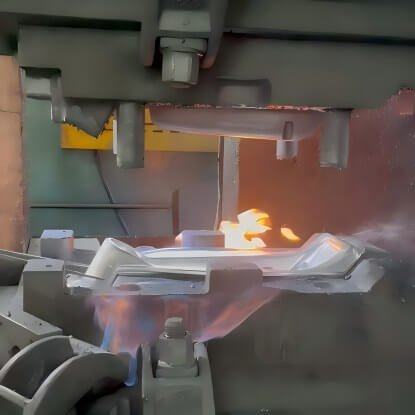
What Factors Affect Aluminum Forging Cost?
Aluminum forging pricing is influenced by five major factors.
1. Raw Material Cost
The aluminum alloy you choose significantly impacts total cost.
Common forging alloys:
6061 aluminum forging
6082 aluminum forging
7075 aluminum forging
High-strength alloys such as 7075 typically cost more than 6061.
2. Forging Tooling Cost
Unlike CNC machining, forging requires steel dies.
Typical tooling cost ranges:
Small parts: $3,000 – $8,000
Medium parts: $8,000 – $20,000
Large structural parts: $20,000+
Tooling is a one-time investment but must be amortized over production volume.
Higher volume = lower per-piece tooling cost.
3. Production Volume
Production volume is the most important cost driver
Example cost trend:
| Volume | Estimated Cost Per Piece |
| 100 pcs | High (tooling impact heavy) |
| 500 pcs | Moderate |
| 1,000 pcs | Competitive |
| 10,000 pcs | Very cost efficient |
Forging becomes highly competitive when production exceeds 500–1000 pieces.
4. Part Geometry and Complexity
Complex shapes may require:
Multi-step forging
Additional trimming
Increased machining allowance
Design optimization can significantly reduce forging cost.
Near-net-shape design lowers machining time and material waste.
5. Secondary Machining and Finishing
Most forged aluminum parts require CNC machining for:
Precision holes
Bearing surfaces
Tight tolerance areas
Additional finishing such as:
Heat treatment
Anodizing
Shot blasting
All contribute to total cost.
Aluminum Forging Cost Per Piece (Realistic Estimate)
While exact pricing depends on specifications, here is a general market reference:
Small forged part (0.5–1 kg):
100 pcs → $18–$35 per piece
1,000 pcs → $8–$15 per piece
10,000 pcs → $4–$9 per piece
Medium structural part (2–5 kg):
500 pcs → $25–$60 per piece
2,000 pcs → $15–$35 per piece
These estimates vary depending on alloy and machining requirements.
Forging vs CNC Machining Cost Comparison
Many buyers compare forging with billet CNC machining.
Here is the key difference.
| CNC Machining Cost Characteristics | Forging Cost Characteristics |
| No tooling cost | Requires tooling investment |
| High material waste (up to 50–70%) | Reduced material waste |
| Long machining cycle | Faster production cycle |
| Higher cost at volume | Lower per-piece cost at scale |
If your part removes large amounts of billet material, forging can reduce raw material consumption significantly.
For medium-volume structural parts, forging often lowers total manufacturing cost by 15–35%.
Forging vs Die Casting Cost Comparison
Die casting is often considered for high-volume aluminum parts.
| Die Casting Cost Structure | Forging Cost Structure |
| Very high mold cost ($20,000–$80,000+) | Lower tooling cost than die casting |
| Extremely low cost at 50,000+ volume | Better suited for 500–20,000 pieces |
| Lower material strength | Superior mechanical properties |
If structural reliability matters, forging reduces risk of failure-related costs.
For ultra-high volume decorative or thin-wall parts, die casting may be cheaper.
How to Reduce Aluminum Forging Cost
Smart design decisions can significantly lower cost.
Optimize Part Design
Avoid sharp transitions and excessive machining allowance.
Design for near-net-shape forging.
Choose the Right Alloy
Select alloy based on actual performance requirements.
Over-specifying material increases unnecessary cost.
Increase Production Batch Size
Larger batch production spreads tooling investment across more units.
Combine Forging + Precision Machinin
Use forging for structural strength and CNC only where tolerance is critical.
This hybrid strategy maximizes cost efficiency.
When Is Aluminum Forging the Most Cost-Effective Choice?
Forging is ideal when:
The part is load-bearing
Medium to high volume production
Fatigue resistance required
CNC material waste is high
Long-term reliability is critical
Forging is not ideal when:
Prototype stage
Very low quantity
Extremely thin-wall geometry
Frequently Asked Questions
At low quantities, CNC machining may be cheaper because no tooling is required. However, at medium to high volumes, forging usually becomes more cost-effective due to reduced material waste and faster production cycles.
Most forging manufacturers require 500–1000 pieces to justify tooling investment.
Forging dies must withstand extreme pressure and temperature. They are made from hardened tool steel and require precision machining, increasing initial cost.
Yes. Forging forms material close to final shape, significantly reducing waste compared to billet machining.
Final Thoughtsukn
Aluminum forging cost depends on tooling, alloy, design, and volume.
While initial investment may appear higher than CNC machining, forging often provides lower long-term cost for structural components.
If your application demands strength, fatigue resistance, and cost efficiency at scale, aluminum forging is often the smarter manufacturing solution.