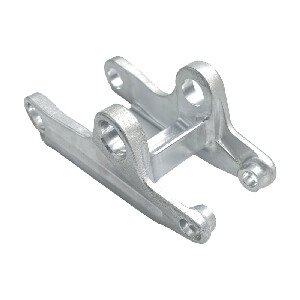

Why CNC Machined Aluminum Parts Fail Under Fatigue
Introduction–Fatigue Failure Is a Structural Issue
CNC machining is widely used to produce aluminum parts with high precision and excellent dimensional accuracy.
However, many manufacturers encounter the same problem after parts enter real-world service:
CNC machined aluminum parts meet design specifications,but crack or fail prematurely under repeated load or vibration.
In most cases, these failures are not caused by poor machining quality or incorrect material selection.They are caused by fatigue, and more importantly, by choosing a manufacturing process that does not match the structural demands of the application.
“Old Wang the Forging” will explain why CNC-machined aluminum parts fail under fatigue, and what factors engineers should consider when designing fatigue-critical components.
Understanding Fatigue Failure in Aluminum Components
What Is Fatigue Failure?
Fatigue failure occurs when a material is subjected to repeated or cyclic stress below its ultimate tensile strength.
Instead of breaking immediately, microscopic cracks form and slowly grow over time until sudden failure occurs.
Fatigue is common in:
- Automotive structural parts
- Motorcycle and bicycle components
- Robotic arms and automation equipment
- Industrial machinery under vibration
Why Fatigue Is Critical for Structural Aluminum Parts
Unlike static load failure, fatigue damage is:
- Hard to detect
- Progressive
- Highly dependent on internal material structure
This makes fatigue resistance one of the most important factors in structural aluminum components.
Why CNC Machined Aluminum Parts Are Prone to Fatigue Failure
Linear Grain Structure from Aluminum Billet
CNC machined aluminum parts are typically produced from:
- Rolled aluminum plate
- Extruded aluminum bar
These materials have a linear grain structure formed during rolling or extrusion.
When CNC milling aluminum:
- Material is removed
- Grain structure remains unchanged
- Grain direction often does not follow part geometry
As a result, stress may be applied across grain boundaries, which accelerates crack initiation.
Stress Concentration from Machining Geometry
CNC machining allows complex geometry aluminum machining, but it can also introduce:
- Sharp internal corners
- Thin wall transitions
- Local stress concentration zones
Even with perfect machining, these features become fatigue crack initiation points under cyclic load.
Material Waste Does Not Equal Structural Optimization
Many CNC designs rely on leaving extra material to compensate for uncertainty.
This approach:
- Increases weight
- Does not improve fatigue resistance
- Raises machining cost
Fatigue performance is determined by grain flow and internal structure, not just external dimensions.
How Aluminum Forging Solves Fatigue Problems
Forging Aligns Grain Flow with Load Paths
Aluminum forging reshapes material under compressive force, forcing grain flow to follow the part geometry.
This creates:
- Directional grain alignment
- Reduced internal stress concentration
- Improved resistance to crack propagation
Forged aluminum behaves more like a fiber-reinforced structure compared to billet-machined parts.
Higher Density, Fewer Defects
Forged aluminum typically has:
- Higher material density
- Fewer internal voids
- Minimal microstructural defects
This significantly improves fatigue life, especially in components subjected to vibration or alternating load.
Real-World Fatigue Performance Comparison
In many structural applications, forged aluminum components demonstrate:
- 30–50% longer fatigue life
- More predictable failure behavior
- Improved safety margin
This is why forging is widely used for:
- Automotive suspension components
- Motorcycle triple clamps
- Aerospace brackets
- High-load industrial parts
CNC Machining vs Forging for Fatigue-Critical Applications
| Factor | CNC Machined Aluminum | Forged Aluminum |
| Grain Structure | Linear | Aligned with geometry |
| Fatigue Resistance | Moderate | High |
| Crack Initiation | Easier | Delayed |
| Structural Reliability | Medium | Excellent |
| Weight Optimization | Limited | Superior |
When CNC Machining Still Makes Sense
It is important to be objective.
CNC machining remains the right choice when:
- Production volume is very low
- Rapid prototyping is required
- Geometry is extremely complex
- Load is static or minimal
Cost-effective aluminum CNC solutions are ideal for early-stage development.
However, CNC machining should be carefully evaluated when fatigue resistance becomes a key requirement.
Key Takeaway: Fatigue Failure Is a Process Selection Issue
CNC machined aluminum parts fail under fatigue not because CNC machining is poor, but because fatigue performance is governed by internal material structure.
When parts are subjected to repeated or dynamic loading, selecting the right manufacturing process early in the design stage is critical.
Ignoring fatigue considerations often leads to:
- Premature failure
- Increased cost
- Delayed product launches
The Hybrid Solution: Forging + CNC Machining
For many custom aluminum components, the best solution is a hybrid approach.
Typical workflow:
- Forging creates the near-net structural shape
- CNC machining finishes precision features
This approach delivers:
- Structural strength from forging
- Dimensional accuracy from CNC
- Reduced machining time
- Lower material waste
This hybrid model is commonly used in automotive aluminum parts manufacturing and automation equipment.
How to Identify Fatigue Risk in Your Current CNC Parts
You should consider forging if:
- Cracks appear after repeated use
- Parts fail earlier than design life
- Extra material does not solve the problem
- Weight reduction is required
- Safety or warranty risk exists
Fatigue problems rarely disappear by changing only machining parameters.
Frequently Asked Questions
Because CNC machining does not improve grain structure, stress is often applied across grain boundaries, accelerating crack formation under cyclic load.
Answer: No process can completely eliminate fatigue, but forging can significantly extend fatigue life and improve reliability in structural applications.
Answer: Yes. Forged parts typically undergo subsequent CNC machining to achieve complex geometric features.
Final Conclusion
Why CNC machined aluminum parts fail under fatigue ultimately comes down to material structure and process selection.
For fatigue-critical, load-bearing, and safety-sensitive applications, relying on CNC machining alone often leads to premature failure.