
Many buyers focus only on “can this be made” during quoting, but part design directly decides the yield rate and downstream cost of a forged component. With a 3,000㎡ plant in Shenzhen and six precision forging presses ranging from 2,500T to 300T, plus two cold forgers and twelve CNC machining centers, Guangdong Xinpingfu Die Forging and Pressing Co., Ltd. has learned one thing over two decades: ten minutes of design review up front saves a whole batch of scrap in production.
1. Draft Angle: Let the Part Come Out First
Aluminum forging mostly uses open-die and closed-die forging. Parts need a draft angle to eject from the die — typically 1°~3° for external surfaces and 3°~5° for internal cavities. Too small, and the surface gets dragged or the part sticks; too large, and you add unnecessary machining stock. Our tooling team sizes the optimal draft angle by part geometry and press tonnage to avoid rework and scrap.

2. Fillet Radius: Don’t Let Stress Concentrate at Corners
Never design sharp internal or external corners on a forging. Sharp angles block metal flow, cause laps, and trigger cracks through stress concentration. A common rule is a fillet radius of 0.2~0.5 times the wall thickness, with thin-wall parts taking the upper end. Proper fillets let the grain flow follow the contour, boosting fatigue resistance — a key reason forged parts outlast machined billets.
3. Wall Thickness and Rib Height: Uniform Means Fewer Cracks
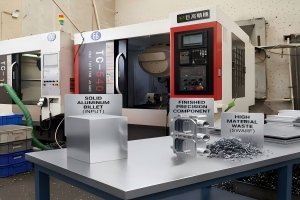
Keep wall thickness as uniform as possible; abrupt thick-thin transitions cause uneven cooling and warping. Rib height should not exceed three times its width, or filling becomes difficult. For long, slender parts like new-energy and automotive structural components, we simulate filling before cutting steel, then fix the parting line and preform shape to minimize trial runs.
4. Parting Line: It Decides Flash and Machining Stock
The parting line should sit at the part’s largest contour so cavities stay shallow and flash stays symmetric. A skewed parting line means more flash, more waste, and possible mismatch. Our engineers join the drawing review at the tooling stage and flag risks early.
5. Conclusion: Good Forgings Are Forged and Calculated
Seven tenths of forging quality lives in the die and the design. Guangdong Xinpingfu Die Forging and Pressing Co., Ltd. offers one-stop service from drawing review and tooling to precision forging and CNC machining, backed by ISO9001 and AAA certification. If you are selecting a process or fighting a high scrap rate, send us your drawing — we calculate first, then forge.