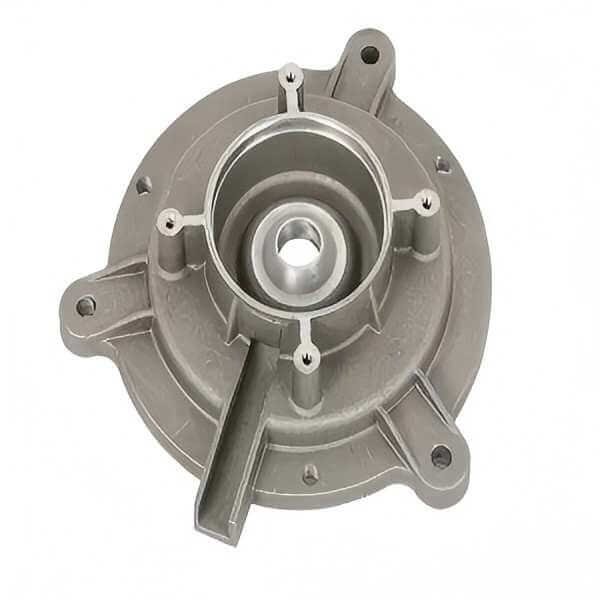
Looking for aluminum die casting?

    Die casting is commonly used for producing complex aluminum parts with good surface finish

      However, for components requiring higher strength, structural integrity, and long-term reliability, aluminum forging often delivers superior performance.

Before choosing a process, make sure your part does not require higher strength, better fatigue resistance, stable anodizing, or long-term structural reliability.

Die casting is widely used for:

  • Complex shapes 
  • Thin-walled members 
  • Mass production 

XinPingFu helps manufacturers evaluate whether die casting, full CNC machining, or aluminum forging + CNC finishing is the most cost-effective solution.
23 years

Our own research and development factory

10+

Flexible Payment Methods

31+

Global Co-Branding Partners

3100+

Customized mold manufacturing

Comparison

Internal structure
Porosity risk
Strength
Fatigue resistance
Structural reliability

Die Casting

Cast
Possible
Medium
Lower
Moderate

Aluminum Forging

Continuous grain flow
Minimal
High

Excellent

High

When to Replace Die Casting with Aluminum Forging?

  • Aluminum forging is the preferred solution when component failure is not acceptable.
  • For parts subjected to dynamic loads, vibration, or safety requirements, forged aluminum parts provide unmatched consistency and durability.

When Die Casting Is a Suitable Option?

     Die casting is well suited for high-volume production of thin-walled aluminum parts with complex shapes.

It offers good dimensional consistency and relatively low unit cost for non-structural applications.

Why Forged Aluminum Provides Higher Structural Strength?

  • Aluminum forging eliminates internal porosity and aligns the grain structure with the part shape.
  • This results in significantly higher mechanical strength, improved fatigue resistance, and better performance in safety-critical applications.

No internal porosity,refined grain structure

Superior fatigue and impact resistance

Better anodizing and surface treatment results

Higher reliability for structural parts

Applications Requiring Forged Aluminum

Explore our high-performance forged aluminum components designed for various industries

Automotive Aluminum Forging Parts

High-performance parts for automotive components like suspension and structural part

Industrial Aluminum Forging Parts

Forged components designed for heavy machinery, hydraulics, and industrial automati

Motorcycle Powersports Forging Parts

Durable and lightweight forged parts for motorcycles, ATVs, and UTVs

Bicycle & Ebike Forged Components

Premium aluminum forged parts for bicycles and e-bikes

Robotics & Automation Forged Components

Precision-forged parts for robotics and automation applications

Custom Aluminum Forging Solutions

Tailored forging solutions for your specific needs

Share your part drawings or requirements with our engineering team to evaluate whether aluminum forging is the right solution.

Our approach combines;CNC machining ensures:

  • Dimensional accuracy
  • Complex geometric features
  • Strict tolerances

Engineering Decision Guide

Manufacturing Need

Thin wall complex parts
High strength structural components
High precision small batch
 
Balanced cost + strength
 

Send us your part drawings or requirements. Our engineers will help determine whether aluminum forging is the right solution.

Q1.Is forged aluminum stronger than die cast aluminum for load-bearing structural parts?
Yes. Forged aluminum is usually stronger and more reliable for load-bearing parts.
Forging creates a denser internal structure and better grain flow, which helps improve strength, fatigue resistance, and impact resistance. Die casting is suitable for housings and complex shapes, but for structural parts that carry load, torque, or repeated stress, forged aluminum + CNC machining is often a better choice.
Choose aluminum forging when your part needs higher strength, better fatigue resistance, or long-term reliability.
Die casting works well for complex, thin-wall, and non-load-bearing parts. But if your part must resist impact, vibration, torque, or repeated load, forging is usually more suitable. Forging is also better when stable anodizing and CNC precision are required.
Die cast aluminum can be anodized in some cases, but the result may be unstable.
Die cast aluminum often contains higher silicon content and may have porosity or uneven surface structure. These factors can cause color variation, dark spots, or uneven anodized finishes. For premium anodized surfaces, forged aluminum is usually a better choice.
Porosity is usually caused by trapped gas, shrinkage, or filling issues during die casting.
Small porosity may be acceptable for some housings, but it can reduce strength, fatigue life, and surface quality in structural parts. It may also create problems during machining or anodizing. Forged aluminum has a denser structure and much lower porosity risk.
Forging may cost more at the blank stage, but it can reduce total cost for structural parts.
For load-bearing parts, total cost includes machining time, scrap rate, surface treatment quality, failure risk, and after-sales problems. Forging can reduce hidden defects, improve strength, and reduce CNC machining time when using near-net-shape blanks.
Yes, aluminum forging can replace die casting for many high-strength or safety-critical parts.
Forging is more suitable when the part needs strength, fatigue resistance, impact resistance, and better material consistency. However, die casting may still be better for complex housings, thin-wall shells, and very high-volume non-structural parts.
Die casting is usually not the best choice for bicycle and e-bike load-bearing parts.
Crank arms, stems, brackets, and structural components must handle repeated force, vibration, and impact. Forged aluminum provides better strength and fatigue resistance, making it more suitable for these safety-related bicycle and e-bike parts.
XinPingFu can review your drawing and help recommend the most suitable process.
Based on your part structure, material, strength requirement, surface treatment, quantity, and cost target, we can help evaluate whether die casting, full CNC machining, or aluminum forging + CNC finishing is the better option.
Scroll to Top
Old Wang the Forger

Aluminum Forging Manufacturer

specializing in high-strength, anodizable forged aluminum parts