

Bicycle weight reduction is no longer a slogan — it is a hard performance target. Whether it is the stiffness a road frame demands or the impact resistance a mountain bike needs, the load-bearing parts are steadily moving to aluminum. Among the available processes, aluminum forging for bicycles stands out for its density and batch-to-batch consistency, and has become the mainstream choice for crank arms, frame joints and dropouts. This article explains, from process and material selection to production capability, why core bike parts should be forged.
What Bicycle Aluminum Forging Actually Is
Forging shapes heated aluminum billet inside a die under pressure, rather than pouring molten metal into a cavity to cool. As the aluminum is compressed, internal porosity is closed and the grain flow is elongated along the direction of load. On a bicycle, that means a forged crank arm or bottom-bracket joint can absorb more pedaling torque and landing impact at the same weight, and is far less likely to develop hidden fatigue cracks.
Compared with casting, a forging has no shrinkage-porosity risk from the gating system. Compared with milling a part straight from bar stock, forging first creates a near-net shape, leaving less material to remove and less scrap. For production bicycle parts, it is the more balanced path between strength, cost and consistency.

Why Load-Bearing Parts Favor Forging Over Casting
The parts that really “do the work” on a bike — crank arms, chainrings, bottom brackets, dropouts and suspension links — see cyclic loads every day, and any internal defect is magnified over time.
Forged aluminum has a continuous grain flow that follows the part contour, with no weak seam across the load path. This is why, in applications that demand high-cycle fatigue life, the part is usually routed to forging first. When buyers compare forging and casting, the practical conclusion is consistent: choose forging for load-bearing, fatigue-critical parts, and reserve casting for non-structural covers.
Crank Arms, Frames, Dropouts: Which Bike Parts Suit Forging
- Crank arm: pedaling torque acts directly on the crank, making it one of the classic forged aluminum bike parts — forging balances low weight with high stiffness.
- Frame bottom bracket and joints: high-end aluminum frames often start from forged blanks, then finish with CNC, to guarantee connection rigidity.
- Dropout: the rear axle load point. A forged dropout resists deformation and knocks, holding alignment over long use.
- Suspension links and stem: complex, high safety-factor small parts where forging clearly helps.
Conversely, cosmetic parts and non-structural covers are better served by extrusion or sheet forming, and do not need forging.
Material Choice: 6061 vs 7075
Common alloys for bicycle forging sit in the 6xxx and 7xxx families. 6061 welds well, is tough and cost-effective, and fits most crank arms and frame joints. 7075 is stronger and used in high-end race parts, but is more sensitive to welding and stress corrosion. The decision should follow the process window described in our guide to 6061 aluminum forging, not just the nominal strength number.
One reminder: the alloy grade is only a starting point. What really decides performance is the forging ratio, heat-treat condition and machining accuracy. The same alloy grade, with different forging and heat-treating combinations, can show a meaningful gap in fatigue life.
One-Stop Capability From Billet to Finished Part
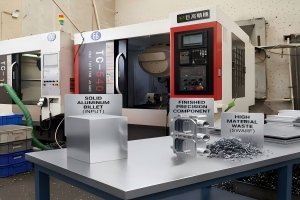
Bicycle parts are often “low volume, high mix”, and the hand-off from prototyping to production is where factories are tested. Our work on the aluminum forging process steps covers cutting, heating, die forging, heat treatment, straightening and CNC finishing in one line, so irregular small parts like dropouts and crank arms are produced consistently.
For a brand, fewer suppliers means one less place for the dimensional chain to break — which is exactly the value of keeping forging and CNC under one roof, as outlined in our design guidelines.
About Guangdong XinPingFu
Guangdong XinPingFu is an aluminum precision forging and CNC machining manufacturer based in Guangming District, Shenzhen, China. The plant covers about 3,000 m² and runs 6 forging presses from 300T to 2500T, 2 cold-forging machines and 12 CNC machining centers, with a key-process yield held steady at 99.7% and certifications including ISO9001 and AAA credit rating. From bicycle crank arms and dropouts to aluminum forgings for new-energy, medical and automation applications, Guangdong XinPingFu delivers from prototype to volume production. Contact Guangdong XinPingFu for a forging plan and quote tailored to your part.