FORGED ALUMINIUM APPLICATIONS
Aluminum Forging for Gear and Transmission Components: Strength, Precision, and Weight Savings
Drivetrains live or die by their mechanical parts. Gears, synchronizer hubs, differential carriers and transmission shafts must survive millions of load cycles while keeping weight and cost under control. Forged aluminum turns those requirements into a mainstream engineering choice.
Drivetrains live or die by their mechanical parts. Gears, synchronizer hubs, differential carriers, and transmission shafts must survive millions of load cycles while keeping weight and cost under control. That is why aluminum forging for gear and transmission components has moved from a niche experiment into a mainstream engineering choice for automotive, e‑commerce, and industrial equipment makers who need strength without the mass penalty of steel.
Why Forged Aluminum Wins for Gears and Transmission Parts
Cast or machined aluminum parts start from a granular structure that is inherently weaker at the grain boundaries. Forging changes the game: under high pressure the metal flows and the grain structure aligns with the part’s outline, following the load paths where stress concentrates. The result is a component with superior fatigue resistance, better impact toughness, and a density of defects near zero.
For gear and transmission applications, this matters because the parts see alternating bending and torsional loads. A forged blank gives a continuous fiber flow around teeth and hubs instead of cut‑through grains, so cracks have a much harder time starting. Compared with die casting, forging also eliminates the internal porosity that weakens thin sections and threaded bosses.
Best Aluminum Alloys: 6061, 7075, and 6082
Alloy selection sets the ceiling on what a forged transmission part can do. Our aluminum alloy selection guide covers the trade‑offs in detail, but the three workhorses for drivetrain parts are:
- 6061 – the all‑rounder. Good strength, excellent corrosion resistance, and easy to anodize. Ideal for housings, brackets, and moderately loaded gears. See our notes on 6061 aluminum forging.
- 7075 – the high‑strength option. Used where fatigue life is critical, such as performance transmission shafts and heavily loaded同步 hubs, often in the T6 condition.
- 6082 – a European favorite with a balance of strength and machinability, common in industrial gearbox components.
All three respond well to heat treatment, which lets us tune hardness and ductility after forging.

From Billet to Precision Gear Blank: The Forging Process
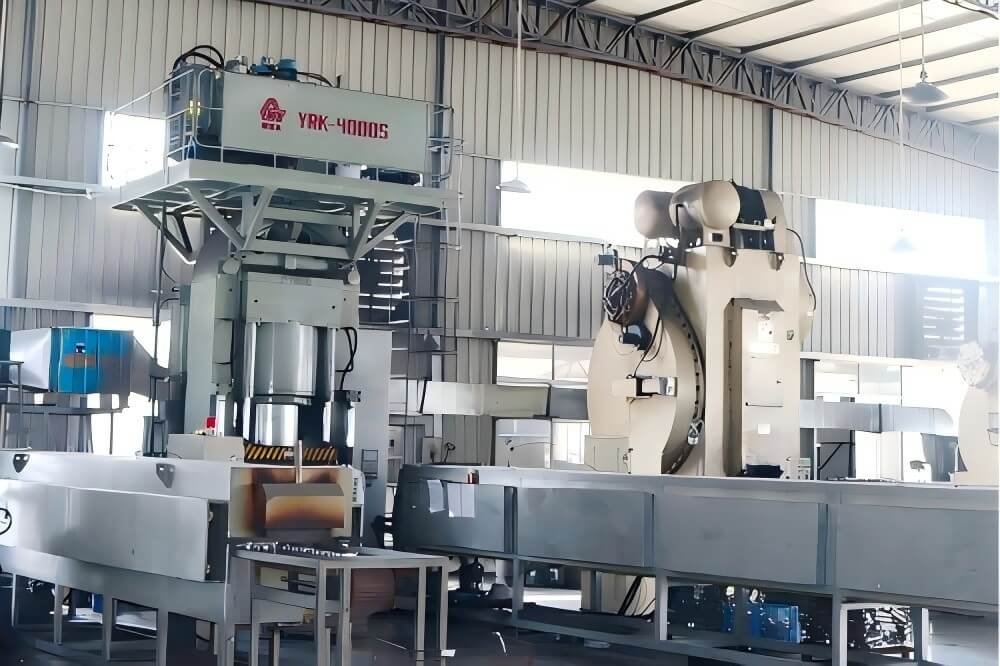
The journey starts with a cut‑to‑length aluminum billet heated into the forging temperature window. On our forging process steps page we explain how the heated billet is placed in a precision die and squeezed by a press. With six forging presses rated from 300 T to 2500 T and two dedicated cold forging machines, we can produce everything from small synchronizer hubs to large differential carriers in a single, controlled stroke.
A key advantage is near‑net‑shape forging: the die is designed so the forged blank already carries most of the final geometry. That leaves only a thin machining allowance, cutting material waste and CNC time. Because the metal has already been densified, the subsequent machining reveals a sound, defect‑free surface rather than hidden porosity.
Tight Tolerances and Dimensional Accuracy
Transmission assemblies are unforgiving about fit. Bores, spline diameters, and mounting faces must hold tight tolerances so that bearings and shafts seat correctly on the first try. Our aluminum forging tolerances reference explains the achievable bands; in practice we hold critical dimensions to a few hundredths of a millimeter using twelve CNC machining centers for finish operations.
Dimensional stability also depends on grain flow in aluminum forging. When the grain follows the part contour, distortion during heat treatment and service is minimized, so parts stay in spec over their whole life.
Heat Treatment and Surface Finishing
Most drivetrain forgings are supplied in the T6 condition. Our T4/T5/T6 heat treatment process precipitation‑hardens the alloy to its target strength while controlling distortion. After heat treatment, surface finishing options such as anodizing or bead blasting protect the part and prepare it for assembly.
For gears that mesh with steel counterparts, a harder anodized layer can reduce wear on lightly loaded faces, while corrosion‑sensitive under‑hood parts benefit from the sealing anodizing provides.
Choosing a Reliable Forging Partner
Specifying the part is only half the job; making it consistently is the other. Every batch we ship passes quality inspection, including dimensional checks and material verification, backed by an ISO 9001 system and a 99.7% first‑pass yield. Understanding the underlying forged aluminum properties helps engineers design parts that exploit the full potential of the process.
FAQ
Gear and transmission forging — common questions
Which aluminum alloys are used for gears and transmission parts?
6061-T6 for housings, shift components and general blanks; 7075-T6 for highly loaded synchronizer hubs, differential carriers and shafts; 6082-T6 where parts are welded into assemblies.
Can forged aluminum replace steel gears?
Not for the final drive gear teeth in most designs — steel stays for the highest-contact-stress gear pairs. Forged aluminum is the right call for carriers, hubs, housings, shift forks and low-to-medium-load gears, where weight and inertia reductions pay off in shift quality and efficiency.
Which transmission components benefit most from forging?
Synchronizer hubs, differential carriers, transmission shafts, clutch housings, shift forks and pump gears. These parts see repeated load cycles where cast porosity or machined-bar grain cuts fatigue life.
How do you keep gear blanks concentric?
Near-net forging puts the blank close to final form with material placed where the bores and bearing seats go. Concentricity is then finished on CNC multi-axis centers — boring and turning in a single setup where the design allows.
Do you supply heat-treated parts?
Yes — T4/T5/T6 tempers are applied after forging to lock in the mechanical properties the design assumes. Hardness is verified per batch and reported with the mill certificate of the source billet.
What surface treatments suit transmission parts?
Hard anodising (Type III) for wear-sensitive surfaces, Type II anodising for general corrosion protection, plus chromate conversion, sandblast and powder coat. Bearing and sealing surfaces are typically masked before finishing.
What is the minimum order quantity?
Tooling sets the economics, so MOQ is quoted per part. Sample-level volumes are possible for validation programs; production typically starts from 500–1000 pcs per year per part number.
How long do forged transmission parts take?
Tooling 15–25 working days, then first article, then production. With forging, heat treatment and CNC under one roof we control the whole flow and quote a realistic lead time instead of a chain of vendor promises.
Can you forge near-net blanks that cut CNC time?
Yes — that is the core of our cost model. Near-net forging places material only where the part needs it, so expensive machining time is spent on bores, seats and faces instead of removing bulk stock.
What quality documents can you provide?
Material certificates per batch, dimensional reports on CMM, hardness results and PPAP/FAI packages for OEM programs. Our system is ISO 9001-aligned and audit visits are welcome.
Send us your transmission part drawing
A forging engineer reviews manufacturability and comes back with a DFM note and quote within 3 working days.