
When a valve seat cracks or a pump housing weeps at a thread, the whole fluid system loses trust. In water treatment, chemical dosing, HVAC, and hydraulic power units, the components that hold pressure have to be sound all the way through — not just on the surface. That is exactly where aluminum forging for valves and pumps earns its place: a forged aluminum body starts as a solid billet and is shaped under tonnage, so the grain follows the contour of the part and there are no cast pores to leak through.
Why Valve and Pump Parts Need Forged Aluminum
Castings can look fine on the outside and still hide shrinkage cavities inside. In a valve or pump, those voids become leak paths and fatigue origins. Forging eliminates that risk by working a dense billet rather than pouring molten metal into a mold.
Forged aluminum also beats steel on weight: at roughly one-third the density, a forged 6061 or 6082 valve flange is far easier to handle, ship, and mount in compact skids. For systems that move — mobile hydraulic units, portable dosing pumps, rooftop HVAC — every kilogram saved matters. And because the grain flow wraps around pressure-bearing corners instead of stopping at a sharp notch, forged parts resist the cyclical stress that kills cast and machined-from-plate designs.

The Properties That Stop Leaks
A flow component lives or dies on three things: tightness, corrosion resistance, and dimensional stability.
- Leak-tight integrity. Forging gives uniform, pore-free structure, so threaded ports and sealed faces hold pressure without weeping. Typical forged aluminum valve bodies handle line pressures from a few bar up to the 100–250 bar range used in hydraulic and process skids.
- Corrosion resistance. 6061 and 6082 carry good natural oxide protection, and anodizing or conversion coating pushes them through aggressive media — mildly acidic dosing, brackish water, and outdoor exposure.
- Dimensional stability. Forged stock has low residual stress, so finished flanges and housings stay flat and round instead of springing out of true after machining.
These are the same reasons engineers choose forged aluminum across structural and fluid applications; the difference in valves and pumps is that the cost of a single leak is a flooded floor or a contaminated batch, not just a bent bracket.
Common Forged Parts in Valves and Pumps
The same forging line that makes structural brackets also makes the pressure-bearing hearts of fluid equipment:
- Valve bodies and bonnets where the grain follows the bore and the bolt-circle.
- Flanges and unions that must stay flat under bolt load.
- Pump impellers and rotors that spin true and balance well.
- Pump housings and end caps that seal against high pressure.
- Manifold blocks where many ports meet in one solid piece.
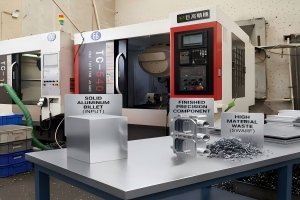
Because forging can place material only where it is needed, a near-net-shape body often needs far less machining than a casting or a plate-cut blank — which protects the grain at the seal lands instead of cutting through it.
Choosing the Right Alloy for Fluid Handling
Material choice drives both corrosion life and machineability. Our guidance on aluminum alloy selection for forging walks through how 6061, 6082, and 7075 map to different media and strengths.
For most valves and pumps we lean on 6061-T6 and 6082-T6: weldable, anodize-friendly, and strong enough for static and mildly cyclic loads. Where a smaller section must carry more pressure, 7075-T6 enters the picture at the cost of poorer corrosion resistance, so it is usually reserved for internal, coated parts. Picking the alloy early — before the forging die is cut — avoids expensive rework later.
Tolerances and Surface Finish That Prevent Leaks
A leak rarely starts at the forging. It starts at the interface: a port that is a few microns out of round, or a face that is not flat enough for the gasket. That is why our forging tolerances and surface finish controls matter as much as the billet does.
Sealing faces are held to tight flatness and finish specs, and threaded or o-ring ports are CNC-finished so the gasket seats evenly. Where the media is corrosive, anodizing or a chemical film is applied after machining so the coating is continuous rather than chipped at an edge. The result is a face that the gasket can actually seal against — every time.
Design Rules and Near-Net-Shape Savings
Good valve and pump forgings are designed for the process, not borrowed from a casting drawing. Our forging design guidelines cover draft, fillets, and wall thickness; following them keeps the forging sound and the die life long.
Where a part has a lot of contour, near-net-shape forging cuts the machining bill sharply. Instead of starting from a big block and removing most of it, the press leaves only a thin finish stock on the seal lands and bores. Less material removed means less disturbed grain at the surfaces that matter — and a lower part cost on volume runs.
Why Choose Guangdong XinPingFu
We run six forging presses from 300T to 2500T, two cold-forging machines, and twelve CNC centers, so a valve body can move from die trial to finished, anodized part under one roof. With ISO 9001 controls and a 99.7% first-pass yield, the properties of forged aluminum are delivered consistently, not just on a sample. When a project needs finish machining and coating, our CNC services carry the part straight through to a ready-to-assemble component.
About Guangdong XinPingFu
Guangdong XinPingFu (Guangdong XinPingFu Metal Forging and Pressing Co., Ltd.) is based in Guangming District, Shenzhen, Guangdong Province. With two decades of experience, the company specializes in aluminum precision forging and CNC finishing, operating its own forging presses, cold-forging machines, and CNC machining centers under ISO 9001 quality management. From valve bodies and pump housings to structural and fluid-handling components, Guangdong XinPingFu supplies leak-tight, corrosion-resistant forged aluminum parts to equipment makers worldwide. To discuss a valve or pump forging project, search “Guangdong XinPingFu” to reach our team.