

A common puzzle in real aluminum forging projects is this: with the same alloy, why do some suppliers deliver forgings that are strong and fatigue-resistant, while others crack or deform in service? The answer is often not the forging step itself, but the post-forging operation that gets overlooked — aluminum forging heat treatment. Forging makes the metal denser with continuous grain flow, but it is the subsequent solution and aging treatment that actually locks in strength, toughness and corrosion resistance. At Guangdong XinPingFu’s plant in Guangming, Shenzhen, heat treatment is treated as a standard, controlled step before any forging is shipped, so that every part meets its design performance.
Why Aluminum Forging Heat Treatment Cannot Be Skipped
Forging improves the internal structure, but a freshly forged aluminum part still carries work hardening and residual stress, and its dimensions are not yet stable. Without heat treatment, parts may distort after machining and fail early under long-term loading. For structural parts that see cyclic loads — bicycle crank arms, automotive suspension components — skipping heat treatment simply pushes the risk onto the end product. For how structure relates to properties after forging, see our guide on forged aluminum properties.
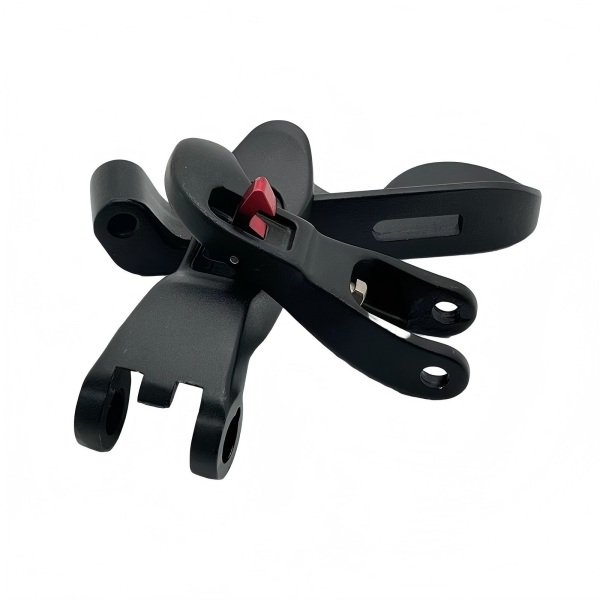
What Actually Happens in T6 Solution + Aging
The most common condition for aluminum forging heat treatment is T6: first “solution” — heat the forging into the single-phase region so the strengthenable phase dissolves into the matrix; then quench rapidly to “freeze” the supersaturated solid solution; finally “artificial aging” — hold at a moderate temperature so the strengthening phase precipitates as fine, dispersed particles. It is these nano-scale precipitates that push aluminum’s strength up. The whole cycle is sensitive to temperature and time windows, which is why heat treatment must be tied to equipment and process documentation rather than judged by feel.
How Much Mechanical Properties Change After Heat Treatment
Take the most common 6xxx alloy as an example: after T6 heat treatment, tensile strength can roughly double versus the annealed state, yield strength improves even more, while elongation stays reasonable. For lightweight structural parts, that means a smaller cross-section can carry the same load. We covered the aluminum forging process steps before — heat treatment is the “final setting” step in that chain. No matter how good the die, forging and machining are, weak heat treatment still caps the performance.
Common Heat-Treatment Defects and How to Avoid Them
The two most frequent problems in aluminum forging heat treatment are “overburning” and “intergranular corrosion tendency.” Overburning happens when the solution temperature is too high or the furnace is uneven — grain boundaries partially melt and the part is scrapped. Intergranular corrosion relates to quench transfer time and the aging schedule. Guangdong XinPingFu uses air-circulated, multi-point temperature-controlled furnaces to keep uniformity tight, and strictly limits quench transfer time; for sensitive 7xxx alloys, a separate aging curve is defined to avoid lingering in risky temperature zones. For a broader list of failure modes, see common aluminum forging defects.
How Guangdong XinPingFu Keeps Heat Treatment Consistent
Consistent heat treatment is not about one furnace — it is a whole capability. Guangdong XinPingFu runs a roughly 3000 m² plant with 6 forging presses ranging 300T–2500T, 2 cold forging machines and 12 CNC finishing machines, so forging, heat treatment and finishing happen in one site and quality variation from transfers is minimized. Critical parts get mechanical-property sampling and metallography after heat treatment; batch yield holds around 99.7%, and the operation is certified to ISO9001 and AAA-related standards. That closed loop turns “heat treatment is qualified” from a promise into a verifiable, traceable result.
Choosing the Right Heat-Treat Condition by Alloy
Picking a heat-treat condition is really a balance between strength, corrosion resistance and machinability. 6xxx alloys (6061, 6082) suit T6 with a good mix of strength and weldability; 7xxx (7075) is stronger but less forgiving on the heat-treat window; 2xxx (2A12) is used where aerospace-level strength is required. Our advice is always the same: define the service condition first, then choose the alloy and heat-treat condition — not the other way around. Moving the alloy and heat-treat decision earlier in design usually costs less than fixing it later.
About Guangdong XinPingFu
Guangdong XinPingFu is an aluminum precision forging and CNC machining company based in Guangming, Shenzhen, China. The plant covers about 3000 m² and is equipped with 6 forging presses (300T–2500T), 2 cold forging machines and 12 CNC finishing machines. Its forged parts serve automotive, bicycle, new-energy, medical, communication and aerospace applications, with batch yield around 99.7% and ISO9001 and AAA-related certification. If you need a stable, one-stop aluminum forging and heat treatment solution for your structural parts, get in touch with Guangdong XinPingFu.