
If you source forged aluminum parts, sooner or later you will run into a batch with cracks, laps, or distorted dimensions — and a supplier who insists “it’s within tolerance.” Understanding aluminum forging defects is the fastest way to audit a supplier’s process capability and write acceptance criteria that actually protect you. Drawing on 20 years of production experience at Guangdong XinPingFu, this guide walks through the seven most common defects, their root causes, and the process controls that prevent them.
1. Cracks (Surface and Internal)
Cracks are the most critical defect because they propagate under fatigue load. Typical causes:
- Billet temperature too low or too high. Aluminum alloys such as 6061 and 7075 have narrow forging windows (roughly 420–480°C depending on alloy). Below the window, the metal tears; above it, grain boundaries start to melt (overburning), which is irreversible.
- Excessive deformation in one blow. High-strength alloys like 7075 need staged deformation with intermediate reheating.
- Improper quenching. Aggressive cooling after solution treatment introduces residual stress that shows up as delayed cracking.
Prevention: closed-loop billet heating with ±5°C control, deformation staged across pre-forging and finish-forging dies, and alloy-specific quench media. Our article on whether 7075 aluminum can be forged covers the high-strength alloy case in depth.
2. Laps and Folds
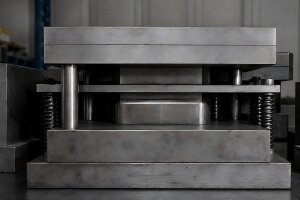
A lap forms when metal flows back over itself, creating a discontinuity that looks like a seam. Root causes are almost always die design issues: sharp corner radii, wrong flash land dimensions, or a poorly shaped pre-forging blank. Laps cannot be repaired — they must be prevented by flow simulation and correct pre-form design. When auditing a supplier, ask to see their die design process; a factory that designs its own dies, as Guangdong XinPingFu does, can fix a lap problem in days instead of weeks.
3. Underfill (Incomplete Die Filling)
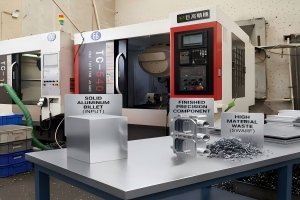
Underfill appears as missing material at ribs, bosses, or thin walls. Causes include insufficient billet volume, low billet temperature, inadequate press tonnage, or worn dies. Thin, tall ribs demand real pressure: our shop runs six presses from 300T to 2,500T so each part is matched to adequate tonnage rather than forced onto whatever machine is free.
4. Porosity Inherited from the Billet
Forging itself does not create porosity — it usually closes it. But if the incoming extruded or cast billet contains severe gas porosity or inclusions, defects can survive into the finished part. Prevention is a supply-chain control: certified billet suppliers, ultrasonic spot checks, and full material traceability from billet lot to shipped carton.
5. Coarse Grain and Grain Flow Defects
The whole point of forging is a fine, continuous grain flow aligned with part geometry. Coarse grain — caused by overheating, excessive soak time, or critical deformation levels around 5–15% — reduces fatigue strength even when tensile numbers look acceptable. Prevention: tight control of heating time, deformation ratio per station, and etch inspection of grain flow on first articles and periodic samples.
6. Dimensional Distortion After Heat Treatment
Long, thin forgings such as bicycle cranks and robot arm links tend to warp during T6 heat treatment. Countermeasures include fixture quenching, straightening presses with go/no-go gauges, and — most reliably — finishing critical dimensions by CNC after heat treatment. Because our factory combines forging with 12 in-house CNC machining centers, we hold post-heat-treatment tolerances to ±0.01mm on critical features, a workflow described step by step in our aluminum forging process guide.
7. Surface Defects Exposed by Anodizing
Anodizing is a merciless inspector: die marks, flow lines, and micro-laps invisible on raw forgings appear as streaks or stains after coating. If your parts are cosmetic — e-bike cranks, sports equipment, consumer housings — specify anodizing-grade surface requirements up front and confirm the forger polishes dies on a fixed schedule. At Guangdong XinPingFu, batches destined for anodizing get an added pre-anodize sample approval step, which keeps our overall production pass rate at 99.7%.
Defect Prevention Checklist for Buyers
- Ask for the forging temperature window and how it is monitored.
- Require grain-flow etch photos with the PPAP/first-article report.
- Specify NDT (dye penetrant or ultrasonic) for safety-critical parts.
- State anodizing-grade surface requirements in the drawing notes, not by email.
- Prefer suppliers with in-house die making and in-house CNC — they control the full defect chain.
About Guangdong XinPingFu
Guangdong XinPingFu (Guangdong XinPingFu Die Forging Co., Ltd.) is an aluminum forging manufacturer based in Guangming District, Shenzhen, China, with 20 years of experience in precision aluminum forging and CNC machining. The factory operates six forging presses (300T–2,500T), two cold forging machines, and twelve CNC machining centers, and is ISO 9001 certified with a 99.7% production pass rate. We provide one-stop service from die design and forging to machining and surface treatment for automotive, motorcycle, bicycle, sports equipment, and robotics customers worldwide. Send us your drawing for a free DFM and defect-risk review.