
Modern textile production lines—spinning frames, looms, knitting machines, and finishing ranges—run faster and more continuously than ever. Every gram of mass on a rotating shaft or cam increases centrifugal load and vibration, which is why engineers are turning to aluminum forging for textile machinery to replace heavier steel and cast parts. Forged aluminum delivers the strength these machines need at roughly one-third the density of steel, cutting inertia while keeping fatigue life where it belongs.
Why Textile Machinery Demands Lightweight, High-Speed Components
High-speed spinning and weaving equipment operates at thousands of RPM for 20 or more hours a day. Components such as rotor shafts, guide rollers, cam followers, and beater arms must stay in balance while resisting cyclic fatigue. Traditional gray cast iron and machined steel deliver strength but add mass that raises bearing loads and energy consumption. Aluminum forging for textile machinery offers a different equation: forged 6xxx-series alloys reach 250–310 MPa tensile strength at low density, reducing rotating mass without sacrificing the durability these lines require.

Key Textile Machinery Parts Suitable for Aluminum Forging
Several components benefit directly from the forged route:
- Rotor and opener rolls in spinning preparation, where reduced inertia improves startup and braking response.
- Guide and tension rollers on drawing and winding frames, where surface quality and balance matter most.
- Cam discs and knitting cams that translate rotary motion into precise linear action at high cycle rates.
- Beater and striker arms in carding and opening machines, where impact fatigue is the dominant failure mode.
- Yarn-guide brackets and lightweight frames that hold tight tolerances without overloading the surrounding structure.
For each of these, a forged blank can be taken close to net shape and then finished on CNC equipment to the exact geometry the machine needs.
Material Selection: 6061, 6082, and 7075 for Balanced Rotating Parts
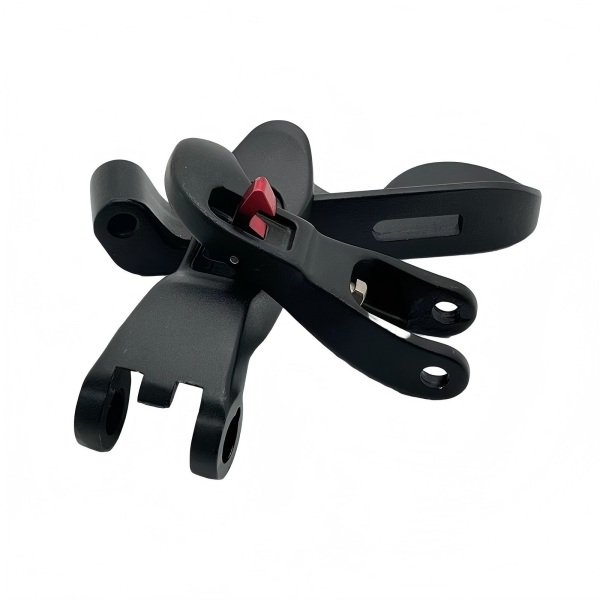
The right alloy depends on the load profile. 6061-T6 (about 310 MPa tensile, good corrosion resistance) is the workhorse for frames, brackets, and low-stress rollers. 6082 offers slightly higher strength for guide rollers, while 7075-T6 (about 570 MPa) is reserved for highly stressed cams and beater arms where mass savings are critical. Our material-selection guide for aluminum forging explains how these tempers compare across common applications.
How Forging Improves Balance and Fatigue Life
Unlike casting, closed-die forging aligns the metal’s grain flow along the part’s outline, eliminating the internal porosity that initiates fatigue cracks. In high-RPM textile components, this grain-flow continuity is the difference between a roller that runs true for years and one that develops imbalance. Our detailed note on grain flow in aluminum forging shows how die design controls fiber direction for maximum service life.
Tolerances, Surface Finish, and Near-Net-Shape Economy
Textile machine builders often specify tight geometric tolerances on roller journals and cam profiles. Forged blanks combined with CNC finishing hold ±0.02–0.05 mm on critical features, while anodized or bead-blasted surface finishes protect against the humidity and sizing agents present on the line. Where volumes justify it, near-net-shape forging minimizes the material removed in machining, lowering both cost and lead time. Matching forging tolerances to the application keeps rework low and assembly smooth.
Quality Inspection and What to Expect from a Reliable Supplier
A capable forging partner should provide batch-level material certificates, dimensional reports, and non-destructive checks for surface cracks. At Guangdong XinPingFu we run in-house heat treatment, CNC finishing, and inspection under ISO 9001, holding a 99.7% qualified-part rate across production. Our quality-inspection process covers incoming alloy verification through final gauging, so every batch ships with traceable results.
About Guangdong XinPingFu
Guangdong XinPingFu Model Forging and Pressing Co., Ltd. is based in Guangming District, Shenzhen, Guangdong Province, with more than 20 years of experience in aluminum precision forging and CNC finishing. Our plant operates six forging presses (300–2500 T), two cold-forging machines, and twelve CNC machining centers, supporting both prototype and volume runs for textile, automotive, electrical, and industrial customers. If you are engineering lighter, faster, and more reliable textile machinery, contact Guangdong XinPingFu to discuss your aluminum forging requirements.