

When engineers specify aluminum forged components for structural, automotive, or safety-critical applications, they are really buying a property the raw billet does not have: continuous grain flow. In aluminum forging, grain flow—also called fiber flow—is the directional alignment of the metal’s grain structure that follows the contour of the finished part. The result is a component whose internal “fibers” run uninterrupted along the shape that carries the load, instead of being sliced off by a cutting tool. This article explains what grain flow is, how the forging process creates it, why it matters for fatigue and impact strength, and how to design forgings that take full advantage of it.
What Is Grain Flow in Aluminum Forging?
A cast aluminum billet starts life with a roughly equiaxed (random, blob-like) grain structure. The grains are short, discontinuous, and oriented in every direction. During aluminum forging, massive compressive force squeezes and stretches those grains so they elongate and line up along the path the metal travels. The grain boundaries bend to wrap around corners, ribs, and bosses instead of ending at a flat machined face.
This continuous, contoured grain structure is what we mean by grain flow. Because the grain boundaries are never cut, there are no exposed grain-end points at the surface where a fatigue crack could start. That single fact is why forged aluminum parts routinely outlast the same geometry produced by machining or casting.
How the Forging Process Creates Grain Flow
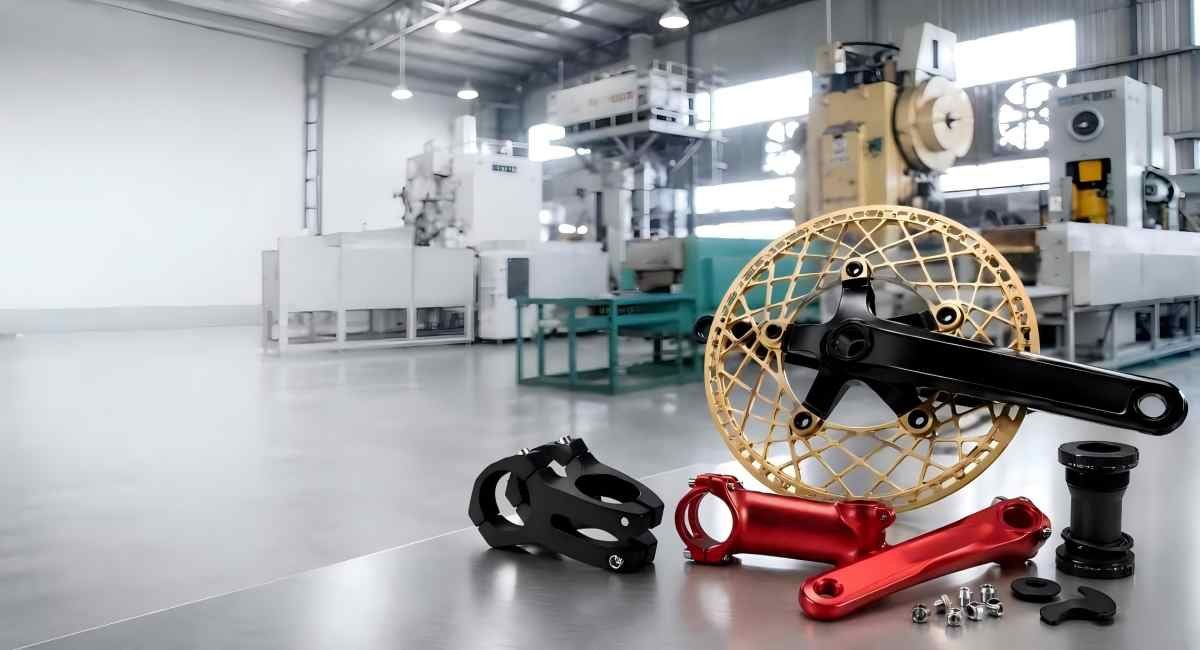
Grain flow is not an afterthought—it is engineered by the deformation path. On a hot forging press, the heated aluminum billet is forced into a precision die cavity. As the metal fills the cavity, it flows around the tool geometry, dragging its grains into a continuous fiber that mirrors the part shape.
At Guangdong XinPingFu, this is done on six forging presses ranging from 300T to 2500T, supported by two cold forging machines and twelve CNC machining centers for finish work. Because the dies are designed first (see our forging die design process), the flow lines can be planned before the first billet is ever struck. Near-net-shape forging means most of the final contour—and therefore most of the grain flow—is already locked in by the die, not removed later by cutting.
Grain Flow vs. Machining: Why Cut Grain Ends Weaken Parts
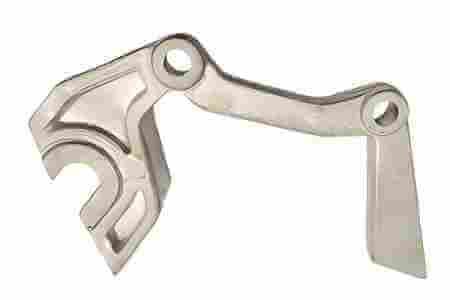
CNC machining is excellent at hitting tight tolerances, but it achieves them by removing material. Every cut severs grain boundaries and leaves exposed grain ends on the surface. Those cut ends act as microscopic notches—stress concentrators that invite fatigue cracks under cyclic loading.
A forged part keeps its grain flow intact. Where a machined bracket has grain running perpendicular to the load and ending at the surface, a forged bracket has grain running with the load, uninterrupted from one end to the other. For a deeper comparison of the two processes, our guide to open-die vs. die forging for aluminum explains how die geometry controls the direction of that flow.
Why Grain Flow Improves Fatigue and Impact Strength
Fatigue failure almost always begins at a surface discontinuity. Three mechanisms make continuous grain flow the stronger choice:
- No grain-end initiation sites. Continuous fibers remove the exposed grain boundaries that seed cracks.
- Directional strength. Strength is higher along the grain flow than across it, so aligning flow with the principal stress path maximizes load capacity.
- Toughness under impact. The uninterrupted fiber network absorbs impact energy better than a cut or cast structure.
These effects show up directly in measured forged aluminum properties—forged 6061-T6 or 7075-T6 components typically deliver better fatigue limits and impact resistance than the same alloy in machined or cast form. In production, Guangdong XinPingFu holds a 99.7% first-pass quality rate under ISO 9001, with grain-flow-critical parts verified before shipment.
Designing Forgings to Optimize Grain Flow
Good grain flow is designed in, not inspected in. A few rules of thumb:
- Place the parting line so flow follows the load path. The flash line should not cut across a high-stress section.
- Use generous fillets and draft angles. Sharp internal corners force the metal to fold back on itself, creating laps and broken flow lines.
- Keep webs and ribs proportioned. Thin sections can stall flow and produce cold shuts.
- Avoid features that require later cross-section cuts. Where a feature must be machined, keep the cut shallow so it does not sever the main flow.
Our aluminum forging design guidelines go further into draft angles, fillets, and rib-to-web ratios that keep flow lines continuous.
How Guangdong XinPingFu Controls Grain Flow in Production
Turning grain flow from theory into a repeatable specification takes process discipline:
- Die design first. Flow is planned in the die, with preforms shaped to feed metal where it needs to go.
- Process control. Press tonnage, billet temperature, and stroke are monitored so every shot deforms the grain the same way.
- Verification. Destructive macro-etch testing on first articles confirms flow lines follow the contour; production parts are checked by CMM and, where required, ultrasonic testing.
- One-stop finish. Twelve CNC centers add the shallow features that machining must cut, while preserving the underlying forged flow.
Common flow-related defects—laps, folds, and cold shuts—are caught early; our write-up on common aluminum forging defects explains how each one traces back to metal flow and how to prevent it.
About Guangdong XinPingFu
Guangdong XinPingFu (广东鑫平富模锻锻压有限公司) is an aluminum precision forging and CNC machining specialist based in Guangming District, Shenzhen, Guangdong Province, with two decades of forging experience. Operating six forging presses (300T–2500T), two cold forging machines, and twelve CNC machining centers, the company delivers ISO 9001–certified forged aluminum components for automotive, e-bike, robotics, aerospace, and industrial applications—from prototype to mass production. If you need forged parts where grain flow and fatigue life matter, search “广东鑫平富” to reach the team, or explore the aluminum forging technology library on this site.