
The ocean is one of the harshest environments any metal part will ever face. Constant saltwater exposure, chloride attack, vibration, and cyclic loads mean marine hardware fails fastest when it is made the wrong way. Aluminum forging for marine applications has become the preferred route for builders who need parts that stay strong and corrosion-resistant for decades rather than seasons. This guide explains which alloys work best, why forged parts outperform castings in saltwater, and where forged aluminum is already replacing heavier steel and weaker cast components on boats and ships.
Why Marine Parts Fail — and How Forging Helps
Most marine hardware failures are not caused by impact. They come from fatigue cracking and crevice corrosion that start at tiny internal defects. Cast aluminum can hide porosity and shrinkage cavities that act as crack-initiation points; once a salt solution reaches them, corrosion accelerates from the inside out.
Aluminum forging for marine applications removes that weakness at the source. During closed-die forging, the billet is compressed under load — typically 300–2500 T on our press line — which closes internal voids and aligns the grain flow along the part’s outline. Continuous grain flow gives the part a longer corrosion path and far better fatigue resistance than a casting with random grain structure. For load-bearing items such as cleats, fairleads, and steering arms, that difference is the line between a part that lasts the life of the vessel and one that snaps in a storm.
Best Aluminum Alloys for Marine Forging
Alloy choice decides how a part behaves in seawater, so it deserves the first design conversation.
- 5083 is the classic marine workhorse. As a non-heat-treatable Al-Mg alloy, it offers outstanding resistance to seawater corrosion and retains toughness at low temperatures. It is ideal for structural brackets, hull fittings, and components under constant immersion.
- 6061 is the most versatile heat-treatable alloy and the one we forge most often. With T6 treatment it reaches roughly 310 MPa tensile strength while staying easy to anodize — a good match for deck hardware and non-immersed structural parts.
- 6082 provides slightly higher strength than 6061 and is widely used for railings and load frames.
- 5456 and 7075 appear where strength is critical; 7075 delivers very high strength but lower general corrosion resistance, so it is usually reserved for specific high-load, coated applications.
When in doubt, 5083 and 6061 cover the large majority of marine forgings.
Forged vs. Cast Marine Hardware
Buyers frequently ask whether a casting is “good enough.” For non-critical trim it can be, but for anything that holds a load, aluminum forging for marine applications wins on three points:
- No internal porosity. Forging consolidates the billet; castings can trap gas and shrinkage defects.
- Controlled grain flow. The fiber follows the part shape, so cracks have a harder time propagating.
- Consistent mechanical properties. Every forged batch behaves the same, which matters for certification and fleet-wide spares.
The trade-off is tooling cost, which pays back quickly on production runs where weight savings and reliability outweigh the upfront die investment.
Key Applications: From Cleats to Propeller Shafts
Forged aluminum now appears across the vessel:
- Deck hardware: cleats, chocks, fairleads, and bollards where grip strength and corrosion resistance are non-negotiable.
- Steering and control: tiller arms, linkages, and brackets that must survive millions of load cycles.
- Propulsion: propeller hubs, shaft couplings, and outboard mounting brackets.
- Structural: railings, stair frames, hatch hinges, and tie rods that reduce topside weight and lower the center of gravity.
- Electrical and navigation: housings and brackets for sensors and communication masts.
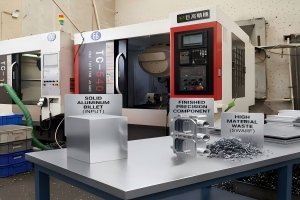
Because forgings are near-net-shape, they also cut the CNC time needed to finish a complex bracket — useful when marine builders want both precision and speed.
Finishing and Quality Control for Saltwater Service
Aluminum alone resists corrosion well, but marine service demands more. A marine-grade anodize (Type II or Type III hard coat) adds a dense oxide layer that shrugs off chloride attack, while powder coating provides an additional barrier for immersed parts. Proper fillet radii and draft angles designed into the forging also prevent the crevices where corrosion loves to start.
At Guangdong XinPingFu we back every marine forging with full inspection: dimensional checks against our aluminum forging tolerances, mechanical verification of forged aluminum properties, and surface finish treatments specified to the customer’s seawater exposure level. With 12 CNC machining centers and ISO 9001–certified processes, we hold a 99.7% first-pass yield across production.
About Guangdong XinPingFu
Guangdong XinPingFu (广东鑫平富模锻锻压有限公司) is an aluminum precision forging and CNC machining manufacturer based in Guangming District, Shenzhen, Guangdong, with more than 20 years of experience. Our plant runs 6 forging presses ranging from 300 T to 2500 T plus 2 cold-forging machines, supported by 12 CNC centers for finishing. We supply forged aluminum components to marine, automotive, new-energy, and industrial customers worldwide, and we are ISO 9001 certified. If you are specifying aluminum forging for marine applications and need a reliable partner from prototype through volume production, contact our team — searching “广东鑫平富” will help you find us.