
Forged Blanks vs Billet CNC Machining: Which Is Better for Aluminum Structural Parts?
For many aluminum structural parts, the manufacturing route is often decided too early.
A buyer sends a drawing. The supplier quotes the part as billet CNC machining. The price is high, but everyone assumes it is unavoidable because the part needs precision.
According to “Old Wang the Forging,” founder of Guangdong XinPingFu Forging Co., Ltd., this is one of the most common mistakes in aluminum part manufacturing.
For many load-bearing aluminum components, the real question is not simply:
Can this part be CNC machined?
The better question is:
Does this part really need to be fully machined from solid billet, or can it be made from a forged aluminum blank and then finished by CNC?
This difference can significantly affect material waste, machining time, unit cost, strength, and long-term production stability.
XinPingFu specializes in aluminum forging + CNC machining for custom aluminum structural components. Instead of treating forging and CNC as two separate choices, the company combines both processes to help OEM buyers reduce unnecessary machining while keeping the precision that CNC machining provides.
In this Blog, ”Old Wang the Forging“ explains the difference between billet CNC machining and forged aluminum blanks, and how buyers can choose a more cost-effective manufacturing route for aluminum structural parts.
What Is Billet CNC Machining?
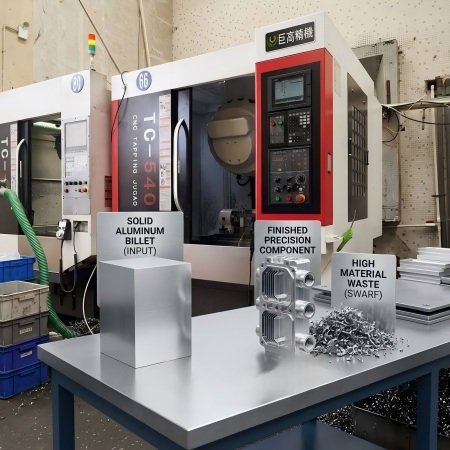
Billet CNC machining means producing a part by cutting material from a solid aluminum block, plate, or bar.
The process usually includes:
- Cutting aluminum billet material
- Fixing the billet on CNC equipment
- Removing excess material through milling, drilling, boring, or turning
- Machining precision holes, threads, surfaces, and assembly areas
- Applying surface treatment if required
Billet CNC machining is widely used because it offers excellent dimensional accuracy, design flexibility, and fast prototype development.
It is often suitable for:
- Prototype parts
- Small-batch production
- Complex geometries
- Parts with frequent design changes
- Components requiring tight machining tolerance
However, billet CNC machining also has a clear limitation.
When the final part shape is very different from the original billet, a large amount of aluminum must be removed. This means the customer is paying for material that eventually becomes chips.
For aluminum structural parts such as brackets, crank arms, levers, connectors, robotic arms, and load-bearing housings, full billet CNC machining can become expensive because of:
- High material waste
- Long machining time
- Higher tool wear
- Higher unit cost in repeated production
This is why XinPingFu often suggests that buyers evaluate forged blank + CNC finishing before deciding on full billet CNC machining for mass production.
What Is a Forged Aluminum Blank?
A forged aluminum blank is a near-net-shape part produced by forming heated aluminum material under pressure in a forging die.
Instead of removing most of the material by CNC machining, forging shapes the aluminum closer to the final geometry first. After trimming, heat treatment, and inspection, CNC machining is used only where precision is required.
A typical forged aluminum blank production route includes:
- Drawing review
- Material selection
- Forging die design
- Aluminum billet cutting
- Heating
- Hot forging
- Trimming
- Heat treatment
- CNC finishing
- Surface treatment
- Final inspection
“Old Wang the Forging” often explains this route in a simple way:
Forging creates the strong body of the part. CNC machining creates the precision details.
This is the core logic behind XinPingFu’s manufacturing model.
For many custom aluminum structural parts, the goal is not to eliminate CNC machining. The goal is to use CNC machining more efficiently.
Forging forms the main structure. CNC finishing is then used for:
- Mounting holes
- Threads
- Bearing seats
- Assembly surfaces
- Flatness requirements
- Tolerance-critical features
This process can reduce CNC machining time while still achieving the accuracy required for final assembly.
Billet CNC Machining vs Forged Blank + CNC Finishing
With forged blank + CNC finishing, the main shape is created by forging, and CNC machining is used for precision finishing.
This difference affects cost, strength, material utilization, and production efficiency.
| Manufacturing Route | Tooling Cost | Unit Cost | Material Waste | CNC Time | Best For |
| Billet CNC Machining | Low | High | High | Long | Prototypes, small batches, complex designs |
| Die Casting + Machining | High | Medium | Low | Medium | High-volume non-critical parts |
| Forged Blank + CNC Finishing | Medium | Lower in suitable production | Lower | Shorter | Structural aluminum parts with repeated demand |
This does not mean forged blanks are always the best choice.
Old Wang the Forging emphasizes that the correct manufacturing route depends on:
- Part function
- Material grade
- Tolerance requirement
- Annual quantity
- Surface treatment
- Strength requirement
- Tooling budget
- Production schedule
However, for many aluminum structural components with repeated demand, forged blank + CNC finishing can provide a stronger cost-performance balance than full billet CNC machining.
Why Full Billet CNC Machining Can Become Expensive
CNC machining cost is not only about machine hourly rate.
In real production, cost is affected by several factors.
Material Waste
When a part is machined from billet, the machine may remove a large percentage of the original aluminum material.
For irregular, curved, or load-bearing structures, this material loss can be significant.
With forged blanks, the part is formed closer to the final shape first. CNC machining removes less material, which helps improve material utilization.
Machining Time
Heavy rough machining takes time.
If the CNC machine spends many hours removing unnecessary material before reaching the final shape, unit cost increases.
Forged blanks reduce the amount of rough machining. CNC can focus on finishing precision areas instead of cutting away large volumes of aluminum.
Tool Wear
Long cutting time and heavy material removal increase tool wear.
When the forged blank is closer to the final shape, the machining process can become more stable and efficient.
Long-Term Production Cost
For prototypes, billet CNC machining is often practical because no forging die is needed.
But for repeated production, the long-term cost structure changes.
If the same part is ordered again and again, the one-time forging tooling cost may be balanced by lower unit cost, shorter machining time, and better material utilization.
This is why XinPingFu recommends looking beyond the first quotation and evaluating the full production lifecycle.
Strength Difference: Why Forging Matters for Structural Aluminum Parts
Billet CNC machining can produce accurate geometry, but it does not reshape the internal grain structure of the material according to the part design.
Forging forms aluminum under pressure. This process can improve the internal structure and create better grain flow along the shape of the part.
This matters for components that must withstand load, vibration, impact, or repeated stress.
Forged aluminum parts are often used for:
- Bicycle crank arms
- E-bike components
- Motorcycle levers and brackets
- Automotive aluminum forgings
- Industrial brackets
- Robotics and automation parts
- Skating base components
- Custom load-bearing aluminum parts
”Old Wang the Forging“ summarizes the difference clearly:
CNC machining gives the part its precision. Forging gives the part its structural foundation.
For this reason, many aluminum structural parts should not be evaluated only by appearance or tolerance. They should also be evaluated by load direction, fatigue resistance, material flow, and application safety.
Forging + CNC Is Not Replacing CNC Machining
Many buyers misunderstand forging + CNC.
They think the choice is:
Forging or CNC machining
But for precision aluminum structural parts, the better logic is:
Forging first, CNC where precision is needed
This is the key value of “XinPingFu”’s integrated manufacturing route.
The forged blank creates the main structural body. CNC machining then finishes the precision areas.
This combination can help customers achieve:
- Lower material waste
- Shorter CNC machining time
- Better structural strength
- More stable production
- Better cost-performance balance
- Precision where it actually matters
So the purpose is not to remove CNC machining from the process.
The purpose is to reduce unnecessary CNC machining while keeping the CNC precision required by the part.
This is why XinPingFu positions itself as an aluminum forging + CNC integrated manufacturer, not only as a forging factory or a CNC machining supplier.
When Billet CNC Machining Is the Better Choice
Billet CNC machining still has important advantages.
Old Wang the Forging does not recommend replacing CNC machining blindly. The right process should be selected according to the part, quantity, and production stage.
Billet CNC machining may be the better choice when:
- The part is still in prototype stage
- The order quantity is very small
- The design may change frequently
- The geometry is too complex for forging
- The tooling budget is not justified
- Delivery time is extremely urgent
- The part does not require improved forged strength
For early product development, billet CNC machining is often the fastest and most flexible way to verify a design.
If a customer only needs a few samples, full CNC machining may be more practical than developing forging dies.
However, once the design becomes stable and production volume increases, the same part can be reviewed again to see whether forged blank + CNC finishing can reduce cost and improve performance.
When Forged Blank + CNC Finishing Is the Better Choice?
Forged blank + CNC finishing is often worth evaluating when the part has the following characteristics:
- It is structural or load-bearing
- The drawing is relatively stable
- The part has repeated demand
- CNC machining time is too long
- Material waste from billet machining is high
- The part requires better strength or fatigue resistance
- Surface treatment such as anodizing is required
- The buyer wants cost reduction without sacrificing performance
This route is especially suitable for custom aluminum components where both strength and precision are important.
Typical examples include:
- Forged aluminum bicycle crank arms
- E-bike structural components
- Motorcycle aluminum parts
- Industrial aluminum brackets
- Robotics and automation components
- Automotive aluminum forgings
- Custom aluminum structural connectors
For these parts, full CNC machining may be able to produce the final shape, but it may not be the most cost-effective production route.
How XinPingFu Evaluates a Customer Drawing?
Before recommending a manufacturing route, XinPingFu’s engineering team reviews the customer’s drawing carefully.
”Old Wang the Forging“ usually evaluates the following points.
Part Function
Is the part decorative, structural, or load-bearing?
Structural and load-bearing components are often stronger candidates for forged aluminum blanks.
Material Requirement
Common aluminum materials include:
- 6061
- 6063
- 6082
- 7075
Different aluminum grades have different strength levels, machinability, forging behavior, and surface treatment performance.Annual Quantity
Annual Quantity
For very low quantity, billet CNC machining may be more practical.
For repeated or growing demand, forged blank + CNC finishing may reduce long-term unit cost.
Part Geometry
Some shapes are suitable for forging, while others may require CNC machining, die casting, extrusion, or another process.
The engineering team evaluates whether the part can be formed by hot forging and then finished by CNC machining.
Tolerance-Critical Areas
Not every surface needs CNC precision.
XinPingFu identifies which areas require machining and which areas can remain as forged or trimmed surfaces after finishing.
Surface Treatment
If the part requires anodizing, polishing, sandblasting, or another surface finish, the material and manufacturing route should be considered early.
Tooling Feasibility
Forging die design affects cost, lead time, and production stability.XinPingFu evaluates whether the tooling investment is reasonable based on quantity, part structure, and long-term demand.
Upload Your Drawing for Manufacturing Evaluation →
Practical Decision Guide for Buyers
For buyers comparing billet CNC machining with forged blank + CNC finishing, Old Wang the Forging recommends asking these questions:
- Is the part structural or load-bearing?
- Is the current CNC machining cost too high?
- Is a large amount of aluminum being removed from billet?
- Will this part be ordered repeatedly?
- Does the part need better strength or fatigue resistance?
- Is the design already stable?
- Does the part need anodizing or other surface finishing?
- Are there specific assembly areas that require precision machining?
If most answers are yes, forged blank + CNC finishing is worth evaluating.
If the part is still a prototype, the quantity is very small, or the design is changing frequently, billet CNC machining may still be the better first step.
The goal is not to choose the most advanced process.
The goal is to choose the most suitable manufacturing route for the part.
Example: Moving from Billet CNC to Forged Blank + CNC
Consider a custom aluminum bracket originally produced by billet CNC machining.
The part has:
- Thick load-bearing arms
- Several precision mounting holes
- A curved structural body
- An anodized surface requirement
- Repeated production demand
If this part is machined fully from billet, the CNC machine must remove a large amount of aluminum to create the curved structure.
A forged blank can form the main shape first. CNC machining is then used for holes, flat mounting surfaces, threads, and assembly areas.
In this case, the forged blank + CNC route may help achieve:
- Lower material waste
- Shorter machining time
- Better structural performance
- More stable unit cost for repeated orders
This is the type of part XinPingFu commonly evaluates for OEM customers.
Common Mistakes When Choosing Between Billet CNC and Forging
1: Only Comparing Unit Price
Some buyers only compare the first CNC machining quote with the forging quote.
However, forging may include tooling costs, while full CNC machining may have a higher long-term unit cost due to material waste, longer machining time, and tool wear.
A better cost comparison should include:
- Tooling cost
- Unit cost
- Annual quantity
- Material waste
- Machining time
- Surface treatment
- Quality stability
- Long-term repeat orders
For repeated production of aluminum structural parts, the lowest initial quote is not always the most cost-effective manufacturing route.
2: Assuming CNC Is Always More Precise
CNC machining is precise, but forged blank + CNC finishing also uses CNC machining for precision-critical areas.
The difference is that CNC is used more efficiently.
In a forged blank + CNC route, forging creates the main structural body. CNC machining is mainly used for holes, threads, bearing seats, assembly surfaces, and tolerance-critical features.
This means the buyer can still achieve precision while reducing unnecessary material removal and machining time.
3: Ignoring Strength Requirements
For structural aluminum parts, strength and fatigue resistance may be more important than machining convenience.
Full CNC machining can create accurate geometry, but it does not form the aluminum grain structure in the same way as forging.
Forging forms aluminum under pressure, which can improve the structural foundation of load-bearing parts.
For parts such as bicycle crank arms, motorcycle components, industrial brackets, robotic arms, and other load-bearing aluminum components, strength should be evaluated together with cost and precision.
4: Waiting Too Long to Evaluate the Manufacturing Route
The manufacturing route should be considered during the design development stage.
If a part is designed only for billet CNC machining, later conversion to forging may require design adjustments.
These adjustments may include:
- Draft angle
- Parting line
- Machining allowance
- Rib structure
- Local thickness
- Surface finishing areas
That is why XinPingFu encourages customers to send drawings early for manufacturing evaluation.
Early evaluation can help determine whether the part is better suited for full CNC machining, forged blank + CNC finishing, die casting, or another manufacturing process.
FAQ
A: No. Forged aluminum blanks require tooling, so they are not always cheaper for prototypes or very small batches.
However, for repeated production of aluminum structural parts, forged blanks can reduce CNC machining time, material waste, and long-term unit cost.A proper cost comparison should consider both tooling cost and long-term production cost.
A: Yes. Forged blanks are usually CNC machined after forging.
The forging process creates the near-net-shape body, while CNC finishing controls precision features such as holes, threads, bearing seats, assembly surfaces, and other tolerance-critical areas.
Therefore, forged blank + CNC finishing can combine structural strength with machining accuracy.
A: Usually yes. Billet CNC machining is often better for prototypes because it does not require forging tooling.
This makes it faster and more flexible for early design verification.Once the design becomes stable and the quantity increases, forged blank + CNC finishing can be evaluated for cost reduction and performance improvement.
A: XinPingFu commonly works with aluminum materials such as 6061, 6063, 6082, and 7075.
The final material selection depends on the part application, strength requirement, machinability, surface treatment, and production process.For example, 6061 is widely used for general structural parts, while 7075 may be considered for higher-strength applications.
A: This route is suitable for many aluminum structural components, especially parts that require strength, repeated production, and precision machining.
Typical examples include bicycle crank arms, motorcycle components, industrial brackets, robotics and automation parts, automotive aluminum forgings, skating base components, and custom load-bearing aluminum parts.For these parts, forging can form the strong structural body, while CNC finishing controls the precision areas.
A: The best method is to send the drawing, material requirement, quantity, tolerance, and surface treatment needs to an engineering team.
XinPingFu can evaluate the most suitable manufacturing route based on part function, cost target, strength requirement, and production feasibility.In many cases, the best solution is not simply “CNC or forging,” but “forging first, CNC where precision is needed.”
Conclusion: Choose the Process Based on the Part, Not Habit
Billet CNC machining and forged aluminum blanks are not competitors in every situation.
They are different manufacturing routes for different production goals.
Billet CNC machining is flexible and suitable for prototypes, small batches, and complex designs.
Forged blank + CNC finishing is often better for repeated production of aluminum structural parts requiring strength, cost control, and production efficiency.
”Old Wang the Forging“ summarizes the decision clearly:
If the part only needs a few prototypes, billet CNC machining may be the fastest route.If the part requires strength, repeated production, and lower long-term cost, forged blank + CNC finishing should be evaluated.
XinPingFu helps OEM customers choose the right process for custom aluminum structural components through aluminum forging, trimming, CNC machining, surface finishing, and manufacturing evaluation.If your aluminum part is currently too expensive to machine from billet, you can upload your drawing for a manufacturing evaluation.