
When a part has to survive repeated impact, sweat, and years of use, the way it is made matters as much as the alloy. Aluminum forging for sports and fitness equipment has become the default choice for bicycle crank arms, e-scooter structures, and training gear where a failure is not an option. This guide explains why forged aluminum outperforms cast and billet-machined parts in this space, and what to specify when you brief a supplier.
What Makes a Part Right for Sports & Fitness?
Sports gear lives in a harsh combination of loads: cyclic pedaling force, vibration, drops, and corrosion from sweat and weather. The winning part is light, stiff, and resistant to fatigue cracking. Forged aluminum delivers all three because the metal flow lines follow the part’s shape instead of being cut by a tool. Our aluminum forging process steps walk through how a billet becomes a finished, dense component.
Bicycle Crank Arms: The Classic Forged Aluminum Part
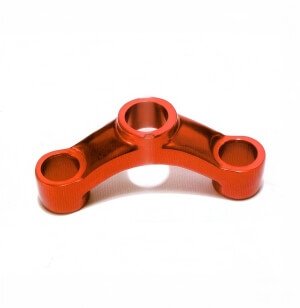
The bicycle crank arm is the textbook case. It transfers leg power to the chainring through a cantilevered load, so any weakness at the pedal eye or spindle boss shows up fast. A forged 6061 or 7075 crank keeps the grain flow continuous around those stress points, giving higher fatigue life than a machined billet of the same shape. We produce forged mountain-bike crank arms and ODM crankset parts on the same line that serves automotive and robotics customers, so the process control is identical.
E-Scooters and Personal Mobility: Forged Frames and Hangers
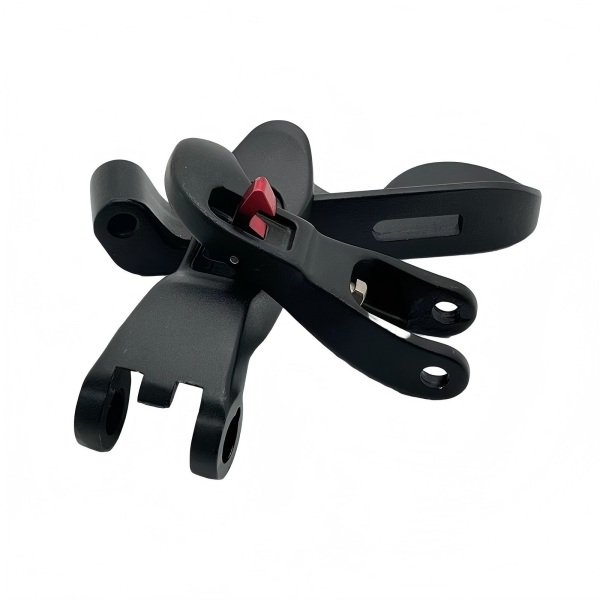
E-scooters concentrate rider weight and road shock into a compact structure. Forged hangers, folding joints, and load-bearing frames resist the repeated bending that cracks welded or cast sections. Because the design guidelines for forged parts favor smooth sections and generous fillets, a well-designed scooter part forges cleanly and needs only light CNC finishing afterward.
Fitness and Training Gear: Handles, Levers, and Hubs
Weight-stack levers, pulley hubs, and adjustable handles all benefit from forging. These parts see daily cyclic loading and must stay safe under misuse, not just rated load. A forged blank starts denser and more uniform than a casting, so the finished part behaves predictably across thousands of repetitions. Where hygiene matters, the same aluminum can move on to anodizing for a sealed, easy-clean surface.
Material Choices: 6061, 7075, and Where Each Fits
Alloy selection drives both performance and cost. 6061 is the all-rounder—weldable, corrosion resistant, and easy to finish, which is why it leads in cranks and frames. 7075 trades some corrosion margin for markedly higher strength, suiting high-load competition parts. Our aluminum forging material selection guide breaks down where each alloy earns its place, and our 6061 deep dive covers the most common choice in detail.
From Forging to Finish: How Tolerances and CNC Hold Up
Forging sets the near-net shape; CNC finishes the mounting faces, bearing seats, and hole patterns. The aluminum forging tolerances you can hold depend on part size and press tonnage, and our part design tips help you keep those tolerances achievable from the first draft. Keeping forging and machining in one plant protects the dimension chain and shortens lead time.
About Guangdong XinPingFu
Guangdong XinPingFu is a precision aluminum forging and CNC machining manufacturer based in Shenzhen, China. The company runs a roughly 3,000 m² plant with 6 forging presses (300T–2500T), 2 cold forging machines, and 12 CNC centers, certified to ISO9001 and rated AAA, holding a qualified rate above 99.7%. From bicycle cranks and e-scooter structures to fitness hardware, Guangdong XinPingFu delivers forged aluminum parts finished through CNC in one hand. Learn more or request a quote at al-forging.com.