

Food processing lines — mixers, fillers, conveyors, pumps, slicers, and packaging machines — run in environments where hygiene is non-negotiable and washdown chemicals are constant. Components that rust, trap bacteria, or shed particles are a recall risk, not just a maintenance cost. For original equipment manufacturers, aluminum forging for food processing equipment provides a way to get corrosion resistance, cleanability, and meaningful weight reduction from the same structural part — without the internal porosity and rough surfaces that cast and fabricated alternatives struggle with.
This guide explains where forged aluminum earns its place on the processing floor, which alloys and finishes to specify, and how the forging process itself supports food safety and uptime.
Why Food Processing Equipment Needs a Different Kind of Component
Three conditions dominate component selection on a processing line:
- Hygiene and cleanability. Every surface that touches or sits near product must survive daily washdown with caustic, acidic, and sanitizing agents without corroding or harboring bacteria.
- Weight and ergonomics. Portable mixers, handheld fillers, and mobile carts benefit directly from lighter structures; so do overhead conveyors, where every kilogram loads the support steel.
- Fatigue under continuous duty. Motors, pumps, and rotating shafts run long hours; a weak grain structure or a casting defect becomes a fatigue crack and a potential contamination source.
Cast aluminum and welded fabrications can meet some of these needs, but cast shrinkage porosity and weld seams are exactly where bacteria colonize and where cracks start. Forged aluminum removes those weak points.
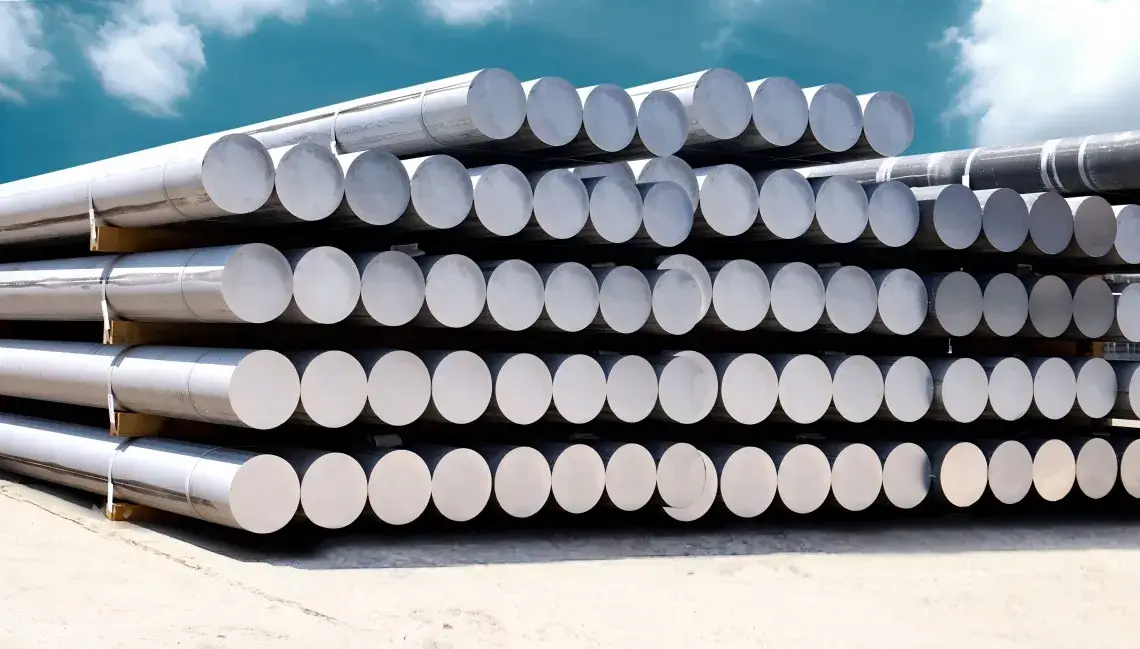
What Makes Aluminum Forging the Right Choice for Food Equipment
Forged aluminum earns its place in food processing equipment through four structural advantages:
- Continuous, contour-following grain flow. Forging compresses the metal so the grain streamlines around the part’s shape, directing strength and fatigue resistance to the corners, fillets, and section changes where cracks try to start.
- No internal porosity. Unlike die casting, the forging process closes voids instead of trapping them, so there is no hidden cavity to trap product or microbes.
- Excellent corrosion resistance. Aluminum’s native oxide layer shrugs off washdown chemistry, and with the right alloy it needs no coating to stay clean.
- High strength-to-weight ratio. High-strength tempers approach the specific strength of some steels at roughly one-third the density, letting designers cut mass without cutting load capacity.
These same reasons explain why we also apply forging to medical and beverage lines; the hygiene logic is identical, only the duty cycle changes. See our surface finish guide for forged aluminum for the surface side of the same story.
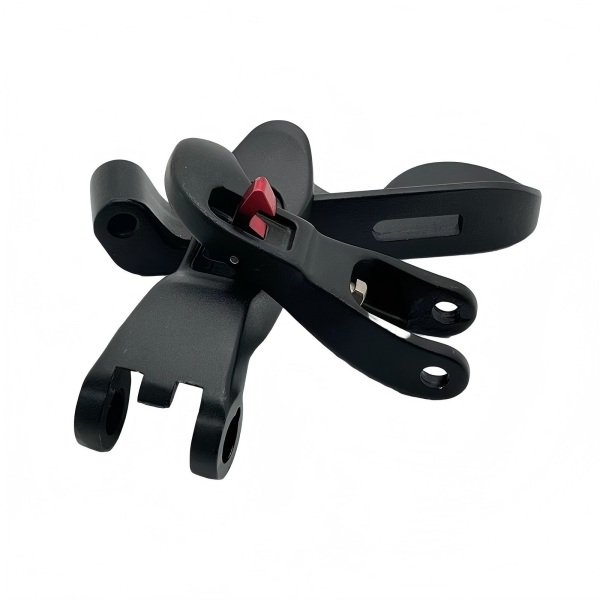
Typical Forged Aluminum Components in Food Processing Equipment
Forged aluminum is not a replacement for every steel or plastic part, but it is the right answer for a growing list of processing components:
- Mixer shafts, impellers, and blender arms — rotating parts where balance and fatigue are the enemy.
- Pump and valve bodies for food-grade fluids — pressure parts that cannot tolerate internal porosity or shed particles.
- Conveyor rollers, idlers, and frame brackets — lightweight, corrosion-proof supports for wet environments.
- Filler and capper actuator links — precision parts that benefit from grain flow aligned to the load path.
- Slicer and dicer hinges and pivots — high-load pivots in wet, corrosive surroundings.
- Portable and handheld tool frames — ergonomic weight savings for line operators.
- CIP (clean-in-place) manifold and bracket structures — smooth, crevice-free supports that simplify sanitation.
For each of these, the ability to start from a near-net-shape forging rather than a solid billet means less expensive alloy is removed as chips, and the remaining material already carries the right grain structure.
Material Selection: Which Aluminum Alloys Are Food-Safe
Choosing the alloy is the first engineering decision, and it should follow the fluid and the washdown environment rather than habit. Our aluminum alloy material selection guide covers the full matrix; for food processing specifically:
- 6061-T6 — the general-purpose workhorse: good strength, superb corrosion resistance, and easy to machine and weld. Ideal for frames, brackets, and non-critical load paths.
- 6082-T6 — slightly higher strength than 6061 with similar corrosion behavior; a good step up for booms and supports.
- 3003 / 5052 — excellent general corrosion resistance for non-heat-treatable structural and fluid-contact parts.
- 7075-T6 — the high-strength option for the most demanding fatigue components, used where coated or enclosed to protect its lower corrosion resistance.
The rule of thumb: match the alloy to the worst fluid and temperature the part will see, then let heat treatment and forging ratio do the rest.
Surface Finish and Anodizing for Food-Safe Components
Cleanability is as much about surface as alloy. A smooth, sealed anodized finish gives food equipment a hard, non-porous, easy-to-sanitize surface that resists chemical attack and does not flake or shed. Our surface finish guide for forged aluminum explains how anodizing, bead blasting, and polishing are matched to the application, and our near-net-shape forging overview shows how starting close to the final contour reduces the machining that would otherwise leave tool marks where bacteria hide.
Cold forging adds surface hardness and dimensional tightness for smaller, high-volume parts, while hot forging handles the larger, more complex geometries typical of processing machinery.
Quality Control and Tolerances for Food-Grade Parts
Food buyers cannot afford “good enough.” Our quality system is built around ISO 9001, with a first-pass yield consistently held at 99.7%. For every production lot we apply:
- Dimensional inspection on coordinate measuring machines (CMM) against the agreed tolerance band — see our forging tolerance standards for typical achievable ranges.
- Surface and defect checks including visual, dye-penetrant, and where needed ultrasonic methods; our quality inspection process outlines how we verify both dimensions and cleanliness.
- Full traceability from alloy heat number to finished part, so any audit or field issue can be closed quickly.
Because we combine forging and CNC finishing under one roof, the tolerance and surface hand-off between processes is controlled internally rather than outsourced — a real advantage when a line’s sanitation audit depends on parts arriving machined-ready and certifiable.
About Guangdong XinPingFu
Guangdong XinPingFu Forging and Forge Press Co., Ltd. is an aluminum precision forging and CNC finishing manufacturer based in Guangming District, Shenzhen, Guangdong, China, with over 20 years of experience serving automotive, electrical, medical, food, and industrial equipment customers. With six forging presses (300T–2,500T), two cold-forging machines, and twelve CNC machining centers, we deliver forged aluminum components from prototype to volume production under a single ISO 9001-controlled process. If you are specifying aluminum forging for food processing equipment or any other demanding application, contact our engineering team to review your drawings and discuss the right alloy, finish, and tolerance for your line.