As photovoltaic capacity scales from rooftops to gigawatt-scale solar farms, the structures that hold the panels in place have quietly become just as critical as the cells themselves. Aluminum forging for solar energy has emerged as a preferred route for the brackets, pivots, clamps, and torque tubes that must survive decades outdoors while keeping total system weight — and cost — under control. Forged aluminum delivers a continuous grain flow, predictable mechanical properties, and excellent corrosion resistance, all of which matter when a mounting component is expected to perform flawlessly for 25 years with no maintenance.
Why Solar Energy Systems Need More Than Extrusion and Casting
Most solar racking started life as extruded profiles and die-cast connectors because they are cheap to produce at high volume. But the demands of modern installations are shifting. Utility-scale sites use single-axis trackers that move panels continuously, placing cyclic loads on every joint. Rooftop and floating arrays demand low dead weight so the supporting structure is not over-built. Coastal and desert projects expose hardware to salt spray, UV, and extreme temperature swings.
Extrusion is limited by the cross-section it can form and by moderate strength. Die casting introduces porosity that can become a corrosion pathway in wet environments. Forging avoids both problems: the metal is compressed under controlled load, producing a dense, porosity-free structure with grain aligned to the part’s loaded shape. For load-bearing solar hardware, that difference shows up directly as longer service life and fewer field failures.
What Forged Aluminum Brings to PV Mounting and Trackers
The advantage of forging is not a single property but a bundle of them that compound in outdoor service:
- Grain flow follows the shape. In a forged bracket the fiber lines wrap around corners and load paths instead of being cut across them, so fatigue strength is far higher than in machined-from-plate parts.
- No internal porosity. A solid forged blank has nowhere for moisture to hide, which is why forged connectors outlast cast ones in salt-fog testing.
- High strength-to-weight. Forged 6061-T6 and 6082-T6 routinely reach 260–310 MPa tensile strength while staying roughly one-third the weight of steel, letting installers handle larger assemblies by hand.
- Dimensional consistency. Closed-die forging holds the geometry batch after batch, so tracker arms and torque tubes bolt together without on-site reaming.
For a single-axis tracker, these traits mean the pivot bracket and drive linkage can be lighter yet stiffer, reducing the motor torque needed to move the array and improving tracking accuracy.
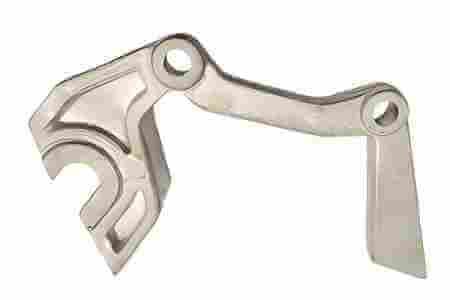
Key Components We Forge for Solar Applications
At Guangdong XinPingFu we produce a range of forged aluminum parts that slot directly into racking and tracking systems:
- Mounting brackets and L-feet for rail and rail-less rooftop arrays, where a forged corner carries roof uplift loads without cracking.
- Tracker pivot and torque-tube connectors that take repeated rotation without loosening or fretting.
- Clamps and end clamps holding the panel frame, where forged grip resists galling and keeps torque retention.
- Inverter and combiner-box enclosures where a dense forged wall resists impact and corrosion better than thin cast housings.
- Ground-mount pile caps and strut fittings for utility-scale fields, supplied near-net to minimize machining.
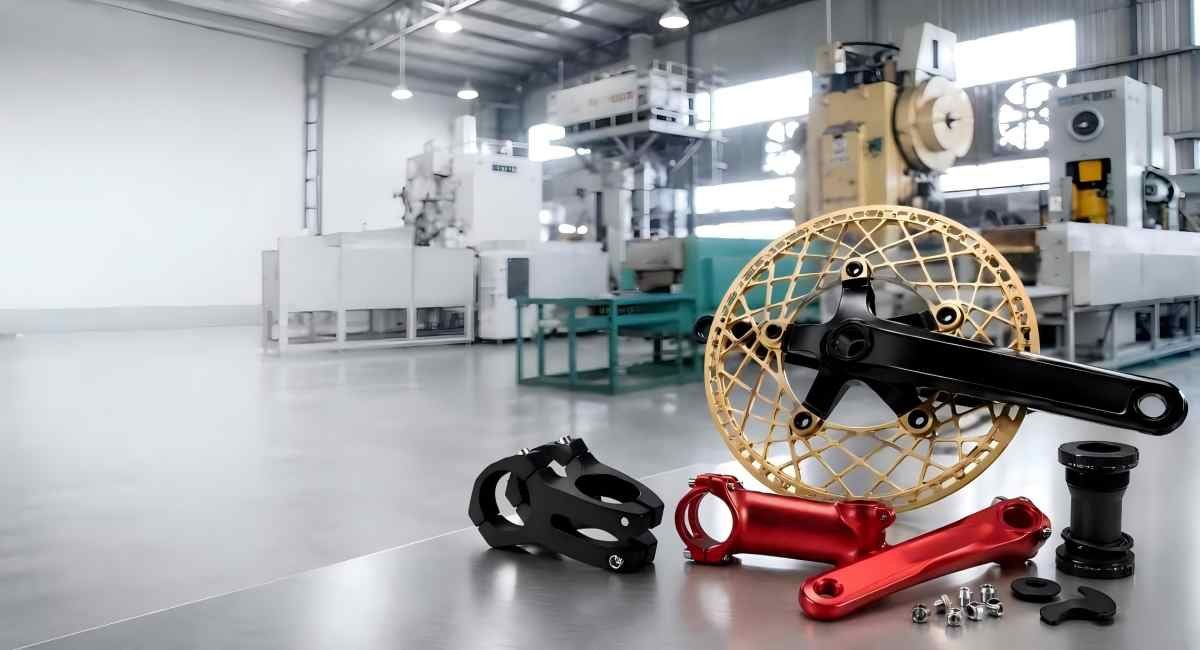
These parts are typically forged on our 300T–2500T presses, then finished on 12 CNC machining centers to the exact bolting pattern the system designer specifies.
Material Choices: 6061 and 6082 for Outdoor Service
Alloy selection drives everything that follows. For solar hardware the workhorses are 6061-T6 and 6082-T6 — both weldable, anodize well, and offer the strength and corrosion behavior the field demands. When a project calls for higher strength at modest weight, 7075 can be considered for non-welded, highly stressed links, though it trades some corrosion margin.
Our material-selection process starts from the loading case and the environment: a coastal plant leans toward 6061 with a heavier anodize layer, while an inland tracker may optimize for stiffness. Getting the alloy right early avoids expensive re-qualification later. You can read more in our guide to selecting suitable aluminum alloy forging materials and our notes on 6061 aluminum forging.
Surface Finish and Corrosion Protection for 25-Year Field Life
A solar structure is a 25-year investment, and the finish is what stands between the metal and the elements. Forged aluminum already resists rust, but for aggressive sites we apply anodizing or powder coating to add a hard, insulating barrier. Anodizing in particular grows a controlled oxide layer that is integral to the part, so it cannot peel the way a coating can.
The choice of finish also interacts with tolerances and assembly: a thicker anodize layer slightly changes critical dimensions, which must be accounted for in the drawing. Our page on anodizing forged aluminum parts and the broader overview of aluminum forging surface finish cover how we spec and control these layers.
Design, Tolerances, and Near-Net-Shape Economy
Good solar forgings are designed for forging from day one. Generous fillets, balanced wall sections, and sensible draft angles let the metal fill the die cleanly and keep the part from distorting after heat treatment. Our aluminum forging design guidelines walk through the rules we apply to every new project.
Precision matters because tracker systems assemble thousands of identical parts in the field. Closed-die forging plus CNC finishing lets us hold tight positional tolerances on bolt holes and datums; details are in our note on aluminum forging tolerances. And because solar projects are cost-sensitive, we forge many components near-net-shape so only light machining remains — cutting both material waste and lead time.
Why Partner with Guangdong XinPingFu for Solar Forgings
Guangdong XinPingFu is a 20-year aluminum precision forging and CNC machining manufacturer based in Guangming District, Shenzhen, Guangdong Province, China. With six forging presses ranging from 300T to 2500T, two cold-forging machines, and twelve CNC machining centers, we support solar hardware from prototyping through volume production under an ISO 9001 quality system, holding a 99.7% first-pass yield.
If you are specifying brackets, tracker connectors, or enclosures for a PV or tracker system, our team can review your drawings, recommend the right alloy and finish, and deliver forged parts that are lighter, stronger, and built to last the full project life. Learn more about our CNC finishing services or contact us to discuss your next solar energy program.