
When lifting safety, payload and energy efficiency are all on the line, material choice decides how far a crane can be pushed. Aluminum forging for cranes has become the preferred route for OEMs and equipment builders who need structural strength without the dead weight of steel. By grain-flow-aligning the metal along the part’s load path, closed-die forging delivers components that are lighter, more fatigue-resistant and consistently repeatable — exactly what hoists, jib cranes, gantry systems and overhead lifting gear demand.
Why Choose Aluminum Forging for Crane Components
Cranes live in a harsh operating envelope: dynamic loads, shock, vibration, outdoor corrosion and constant duty cycles. A cast or fabricated steel part often carries hidden porosity, weld seams or directional weakness that no inspection can fully design out. Forged aluminum removes those weak points. The closed-die process consolidates the material, eliminates internal voids and orients the grain flow to follow the part’s stress contour — so a forged hook, sheave bracket or boom fitting resists crack initiation far better than its cast equivalent.
Weight is the second driver. Aluminum forgings are roughly one-third the density of steel at comparable strength levels, which lets crane designers raise payload, lower motor and rail loads, and reduce the structural steel needed to support the lifting mechanism itself. For mobile and portable cranes this translates directly into fuel savings and easier transport.
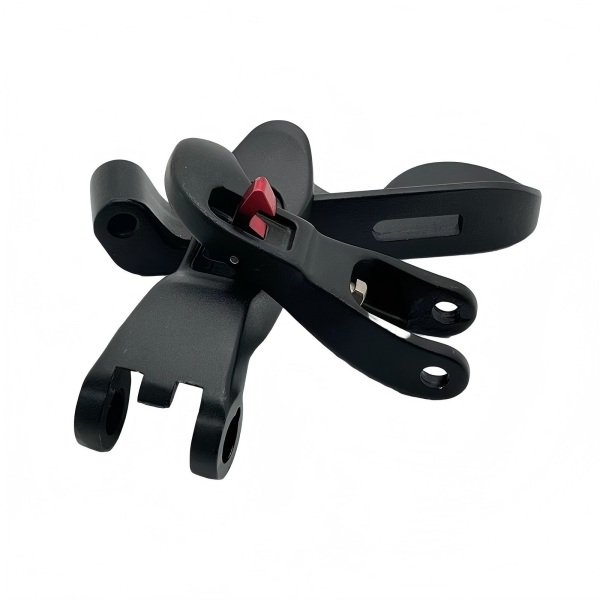
Key Performance Benefits of Forged Aluminum Lifting Parts
- Fatigue resistance — Grain flow follows the load path, delaying crack growth under millions of lift cycles.
- High strength-to-weight ratio — 6061-T6 and 6082-T6 reach 260–310 MPa tensile strength at a fraction of steel’s mass.
- Corrosion resistance — A native oxide film plus optional anodizing protects parts in marine, coastal and outdoor yard environments.
- Dimensional consistency — Near-net-shape forging keeps every part within tight tolerances, simplifying assembly across batches.
- Safety margin — No porosity, no weld seams, no directional weakness — fewer failure modes in a life-safety component.
These properties are explored in depth in our guide to forged aluminum properties, which breaks down tensile, yield and fatigue data across common tempers.

Typical Forged Crane Components
A modern crane uses aluminum forgings across the lifting and structural chain:
- Hooks and hook blocks — Forged in 7075 or 6082 for maximum proof load at minimum mass.
- Sheaves and pulley brackets — Smooth, dense forgings that run quietly and resist wear.
- Boom and jib fittings — Connection lugs, trunnions and pivot eyes that carry the main bending load.
- Spreader bar and lifting beam ends — Load-distributing ends where failure is not an option.
- Hoist housings and frame brackets — Lightweight shells that still meet structural duty ratings.
For builders supplying related equipment, our coverage of aluminum forging for material handling equipment shows how the same forging logic applies to hoists, conveyors and lift tables.
Material Selection: 6061, 6082 and 7075
Choosing the alloy is a balance of strength, weldability, corrosion needs and cost:
- 6061-T6 — The all-rounder: good strength, excellent corrosion resistance and easy anodizing. Ideal for housings, brackets and non-critical-load fittings.
- 6082-T6 — Slightly higher strength than 6061 with good machinability; common for structural lugs and booms.
- 7075-T6 — The high-strength option for hooks and load-bearing eyes where proof load matters most; needs careful corrosion protection.
Our aluminum forging material selection guide walks through tempers, machinability and finishing trade-offs in detail.
Tolerances, Heat Treatment and Surface Finish
Crane parts must assemble cleanly and hold geometry under load. We hold CNC-machined features to tight tolerances after forging, then apply the heat treatment the application needs — most lifting parts run in the T6 condition for peak strength and stability.
Surface finish closes the loop on durability. A Type II or Type III anodize layer adds corrosion and wear resistance with negligible dimensional change, and is the standard choice for outdoor and coastal crane service. See our notes on aluminum forging tolerances and surface finish options for the full spec ranges. For strength-critical parts, aluminum forging heat treatment explains how T4, T5 and T6 tempers change the mechanical profile.
Why Work With Guangdong XinPingFu
Guangdong XinPingFu is a dedicated aluminum forging and CNC partner for crane and lifting-equipment manufacturers. Our plant runs six forging presses from 300T to 2500T, two cold-forging machines and twelve CNC machining centers under a single roof, so a part moves from billet to finished, toleranced component without leaving the building. Every batch is produced to ISO 9001 controls with a 99.7% first-pass quality rate, and our near-net-shape process minimizes both material waste and downstream machining.
Whether you need a one-off forged hook prototype or volume production of sheaves and boom fittings, we support material certification, heat-treatment records and dimensional inspection reports. Explore our work in aluminum forging for construction and aluminum forging for mining equipment to see how forged aluminum lifting parts perform in demanding field service.
About Guangdong XinPingFu
Guangdong XinPingFu (广东鑫平富模锻锻压有限公司) is based in Guangming District, Shenzhen, Guangdong Province, China, with two decades of experience in precision aluminum alloy forging and CNC finishing. We operate six forging presses (300T–2500T), two cold-forging machines and twelve CNC machining centers, and hold ISO 9001 certification with a 99.7% first-pass quality rate. From forged blanks to fully machined, anodized crane components, we deliver one-stop aluminum forging solutions for the lifting, construction, mining and material-handling industries. Search “广东鑫平富” to find our team and request a forging quote for your next crane project.