
Print equipment — from offset and digital presses to industrial label, flexible-packaging, and corrugated lines — runs continuously at high speed with tight registration tolerances. Aluminum forging for printing equipment delivers the stiffness-to-weight ratio, dimensional stability, and fatigue resistance that cast or fully machined parts struggle to match. In a print cell where a roller out of true by a few microns shows up as banding or color drift, the consistency of a forged blank is a real production advantage.
Forged aluminum is not a novelty in this space. Press frames, impression cylinders, gripper shafts, ink-roller journals, and linear guide brackets increasingly start life as forged 6061 or 7075 blocks before CNC finishing. The reason is simple: forging orients the grain along the part’s load path, removes internal porosity, and gives a predictable, repeatable starting geometry that machines cleanly and holds tolerance shift after shift.
Why Print Equipment Demands Forged Aluminum
Modern print lines are productivity machines. A web press can move substrate at more than 15 meters per second; a sheet-fed press can make over 18,000 impressions per hour. At those rates, every rotating and reciprocating member is subject to sustained centrifugal force, cyclic bending, and thermal input from drying ovens and UV lamps.
Cast aluminum is economical but contains shrinkage porosity and a random, coarse grain that limits fatigue life. Extruded bar is uniform in one direction but weak across the grain and inconsistent in thick sections. Machined plate wastes material and carries the parent stock’s residual stress, which can relax and distort the part after it leaves the shop.
Forged aluminum solves all three problems at once. The forging process closes porosity, aligns the grain flow with the part’s stress lines, and yields a dense, homogeneous body. For a printing equipment builder, that translates into rollers and shafts that stay round, frames that stay square, and moving parts that do not develop cracks after months of high-cycle duty.
Key Components: Rollers, Shafts, Frames, and Grips
Forged aluminum shows up across the print cell wherever a part must be both light and stiff:
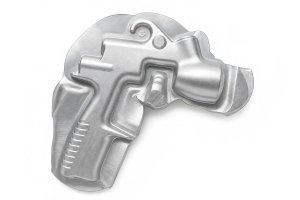
- Impression and blanket cylinders — forged 6061 tube or solid blanks turned and ground to tight roundness, resisting deflection under impression pressure.
- Ink and dampening roller journals — forged shafts with aligned grain at the bearing seats, where bending fatigue would otherwise start.
- Gripper and transfer shafts — forged bars that hold registration through millions of sheet transfers.
- Press side frames and beam brackets — forged 7075 sections that keep the geometry stable under clamp and impression loads.
- Linear guide and cam carriers — forged, then CNC-finished, for repeatable high-speed motion.
Because forging leaves a near-net shape, the subsequent CNC pass removes only a thin, controlled layer — preserving the dense forged skin and avoiding the stress gradients that deep machining of plate can introduce.
Forging vs. Casting and Machining for Press Parts
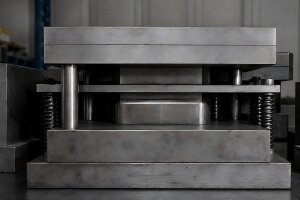
When a print-equipment OEM sources a cylinder or shaft, the usual alternatives are casting, machining from plate, and forging. Casting wins on unit cost for complex shapes but loses on density and consistency. Machining from plate offers excellent surface finish but is material-heavy and can distort as internal stress is relieved.
Forging sits between them on cost while beating both on mechanical reliability. A forged and CNC-finished roller is lighter than a steel equivalent, stiffer and stronger than a cast one, and far more fatigue-resistant than a machined-plate part. For high-duty rotating members that run 24/7, that reliability is what keeps the press in spec and out of the service bay.
The practical guidance for print-equipment designers: specify forging for any member carrying cyclic bending, running at high surface speed, or forming part of the registration-critical path. Reserve casting for non-load cosmetic housings and machining-from-plate for low-volume, low-duty brackets.
Alloy Selection: 6061 and 7075 for Print Mechanics
Two tempers dominate print-mechanism forgings. 6061-T6 is the workhorse: good strength, excellent corrosion resistance, easy anodizing, and stable machining. It is the default for frames, brackets, and most rollers.
7075-T6 is the choice when stiffness and strength per mass must be maximized — high-speed cylinder ends, heavy-impression beam sections, and precision guide carriers. It machines superbly and anodizes to a hard, wear-resistant skin, but it is slightly less corrosion-tolerant than 6061, so it is usually specified where the extra stiffness pays for itself.
Selection should follow the load path, not habit. A component that is mostly a static support can stay on 6061; one that sees high cyclic stress at speed belongs on 7075. Either way, forging the blank first guarantees the alloy’s published properties actually appear in the finished part.
Surface Finish and Tolerances for Print Accuracy
Registration accuracy in print is a tolerance story. Cylinder roundness, journal concentricity, and frame flatness are held to tight bands — commonly a few microns on critical rotating members — because the press magnifies any error onto the sheet.
Forged aluminum handles this well because the dense, stress-relieved body holds its shape through finishing and in service. After forging, CNC turning and grinding bring journals and cylinders to the required roundness and surface finish. For ink-contact or wear surfaces, anodizing adds a hard, low-friction, corrosion-resistant layer that also improves cleaning and reduces ink pickup.
Tolerance discipline is locked in at the forging stage: a near-net forged blank means the final cuts are shallow and consistent, so the part does not move as material is removed. That is why forged rollers and shafts hold their geometry far better than parts machined from raw plate.
Fatigue Life Under Continuous High-Speed Operation
The defining stress in print equipment is fatigue: millions of load reversals per week on rollers, shafts, and grippers. Porosity and random grain are exactly where fatigue cracks begin, which is why forged aluminum outperforms cast and plate stock here.
Forging aligns the grain along the load path and eliminates the internal voids that act as crack starters. In practice, forged 6061 and 7075 print-mechanism members deliver markedly longer service life under cyclic load than machined equivalents, and they do so at lower mass — reducing the inertia the press must accelerate and decelerate on every sheet or web cycle.
For equipment builders, the payoff is fewer unplanned stops, steadier print quality across the maintenance interval, and a longer certified life for the rotating assembly. Forged aluminum is, in short, the quiet enabler of high-speed, high-repeatability printing.
About Guangdong XinPingFu
Guangdong XinPingFu (Guangdong XinPingFu Die Forging & Pressing Co., Ltd.) is based in Guangming District, Shenzhen, Guangdong Province, China. The company specializes in aluminum alloy precision forging and CNC precision machining, operating six forging presses ranging from 300T to 2500T, two cold-forging machines, and twelve CNC machining centers. Certified to ISO 9001 with a production pass rate of 99.7%, Guangdong XinPingFu supplies forged aluminum components for demanding applications including printing equipment, industrial machinery, and automation. If you are specifying lightweight, high-stiffness forged aluminum parts, search for “Guangdong XinPingFu” to reach our team.