
Wind turbines live or die by weight. Every kilogram added up-tower raises the bending moment on the tower, the load on the foundation, and the cost of the whole structure — while the component still has to survive hundreds of millions of load cycles over a 20-year design life in hail, salt spray, and temperature swings. That is exactly where aluminum forging for wind energy earns its place: forged aluminum parts deliver high strength at roughly one-third the density of steel, with continuous grain flow that resists fatigue cracking and a natural corrosion resistance that suits both onshore and offshore sites.
This guide explains where forged aluminum fits in a wind turbine, why grain flow and near-net-shape forging matter for reliability and cost, and how to design wind-energy forgings that machine fast and last decades.
Why Wind Energy Components Must Shed Weight Up-Tower
The physics is unforgiving. A nacelle, yaw system, and rotor assembly that is heavier forces a thicker tower wall, a larger foundation, and bigger cranes for installation — multipliers that quickly erase any savings on the part itself. Lightweighting the non-rotating structure is one of the most direct ways to cut the levelized cost of energy.
Aluminum (about 2.7 g/cm³ versus roughly 7.8 g/cm³ for steel) is the obvious material, but the process matters as much as the alloy. A cast aluminum bracket can hide porosity and shrink that becomes a fatigue initiation site; a forged bracket has no porosity and aligns its grain with the load path. For parts that see oscillating loads — yaw drives, pitch housings, generator mounts — forged aluminum is the safer choice.

Where Forged Aluminum Fits in a Wind Turbine
Forged aluminum is not replacing the large steel rotor shaft or tower sections, but it is the right call for many medium-size structural and drivetrain components:
- Nacelle structural brackets and mounting frames that carry converters, transformers, and controllers.
- Yaw and pitch drive housings where continuous reversing torque demands fatigue resistance.
- Generator end shields and bearing caps that must stay dimensionally stable over thermal cycles.
- Rotor and parking brake calipers where stiffness and corrosion resistance keep braking predictable.
- Hub and pitch hardware such as pivot brackets and locking collars.
- Access and service components like ladder brackets, walkway clips, and cable trays.
For these parts, the forged route gives you the strength you need at a weight you can afford, and a surface that takes anodizing cleanly for long-term protection.
Strength and Fatigue Life: The Grain-Flow Advantage
The single biggest reason to forge rather than cast for wind-energy parts is grain flow. In a forged component the metal’s grain follows the outline of the part, so the strongest direction of the material lines up with the direction of the load. A bracket that is forged around its bend keeps that continuous fiber through the high-stress corner instead of cutting across it.
Continuous grain flow also removes the internal voids and dendritic structure that make castings unpredictable under cyclic loading. Combined with a T6 solution-and-aging heat treatment, a forged 6061 or 6082 part reaches the yield and fatigue strength needed for drivetrain hardware while staying lightweight. Our published reference on forged aluminum mechanical properties breaks down typical strength and elongation values by alloy and temper.
Corrosion Resistance for Onshore and Offshore Sites
A turbine sees everything: coastal salt, desert dust, freeze-thaw, and UV. Aluminum already forms a passive oxide layer, but for aggressive environments a hard anodize or a combined anodize-plus-seal finish is the standard. Anodizing adds a uniform, insulating, abrasion-resistant surface that protects the part for the full service life without repainting.
Alloy choice drives both corrosion behavior and weldability. 6061 and 6082 are the workhorses for structural wind-energy forgings; 6061 aluminum forging is detailed in our material notes, and our anodizing guide for forged parts covers finish selection for outdoor service. See our aluminum alloy material-selection overview for a comparison across tempers and applications.
Near-Net-Shape Forging Cuts Machining and Lead Time
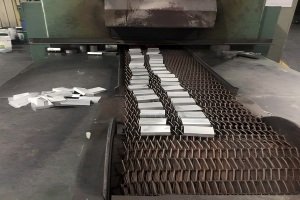
Wind-energy programs run on schedule, and the drivetrain hardware is often on the critical path. Near-net-shape forging lets us dial in the preform so the finished blank needs only light CNC machining to reach final dimensions — less material removed, less scrap, and a shorter lead time than starting from plate or bar.
Because forging defines the grain structure first and CNC only finishes the surfaces, you get both reliability and tight geometry. Our line runs six forging presses from 300 T to 2500 T plus two cold-forging machines, backed by twelve CNC machining centers for one-stop finishing. The near-net-shape forging approach and our CNC machining services explain how we hold the balance between material savings and precision.
Design Tips for Forged Wind-Energy Parts
Good forged parts start with a forgiving design. A few rules keep cost down and quality up:
- Use generous draft angles and fillets so the part releases from the die and the grain flows smoothly around corners.
- Keep wall sections uniform to avoid flow defects and warpage after heat treatment.
- Place the parting line away from high-stress zones so the flash line never sits in the loaded section.
- Specify realistic tolerances — our aluminum forging tolerances guide shows what is achievable per feature.
- Design for the surface finish you need; see surface finish options for forged aluminum for anodize, bead-blast, and machined references.
Following these forging design guidelines up front avoids expensive tooling changes later in the program.
About Guangdong XinPingFu
Guangdong XinPingFu (广东鑫平富模锻锻压有限公司) is an aluminum precision forging and CNC machining supplier based in Guangming District, Shenzhen, Guangdong, with more than 20 years of experience serving automotive, new-energy, and industrial customers. The company operates six forging presses (300 T–2500 T) and two cold-forging machines supported by twelve CNC machining centers, runs under ISO 9001 quality management, and maintains a part qualification rate above 99.7%. From die development and forging through heat treatment, anodizing, and precision CNC finishing, Guangdong XinPingFu delivers one-stop aluminum forged components built for strength, weight savings, and long service life. To discuss forged aluminum parts for wind-energy and other new-energy applications, search “广东鑫平富” to reach the team.