
When a defense program needs structural parts that survive rough handling, wide temperature swings, and years of field service without adding avoidable weight, aluminum forging for defense equipment is often the most balanced choice. Forged aluminum delivers a high strength-to-weight ratio, predictable fatigue life, and consistent grain flow that cast or machined-from-plate alternatives struggle to match. For suppliers supporting military vehicles, ground systems, and support equipment, forging is the process that turns a demanding specification into a dependable production part.
Why Defense Programs Choose Forged Aluminum
Weight is a tactical factor, not just a logistics one. Every kilogram removed from a vehicle structure, bracket, or handling frame frees capacity for payload, armor, or fuel. Aluminum forgings let engineers cut mass while keeping the load paths intact. Compared with steel, aluminum roughly halves component weight; compared with castings, forgings remove the internal porosity and shrinkage that can become crack origins under shock and vibration.
Forging also gives program managers repeatability. Once a die is qualified, each produced part shares the same grain orientation and mechanical envelope, which simplifies inspection and lot acceptance. That consistency matters when a component is qualified once and then ordered across many production lots.
Key Properties That Matter in the Field
Defense service conditions are unforgiving. Components see sustained vibration, impact loads, moisture, salt spray, and temperature cycling. Forged aluminum answers these with three properties:
- Fatigue strength — closed-die forging aligns the grain flow along the part contour, so stress concentrations do not cut across weak transverse grain. This raises allowable cyclic load versus machined stock.
- Toughness at low temperature — many alloys keep usable toughness well below freezing, important for equipment stored or operated in cold climates.
- Corrosion resistance — with the right alloy and finish, forged aluminum resists the corrosion that degrades steel in coastal and humid deployments.
A useful reference on the underlying material behavior is our overview of forged aluminum properties, which covers how forging changes strength and ductility versus other forms.
Typical Defense Components Made by Forging
Forging suits parts where load, weight, and reliability all matter at once. Common defense-relevant components include:
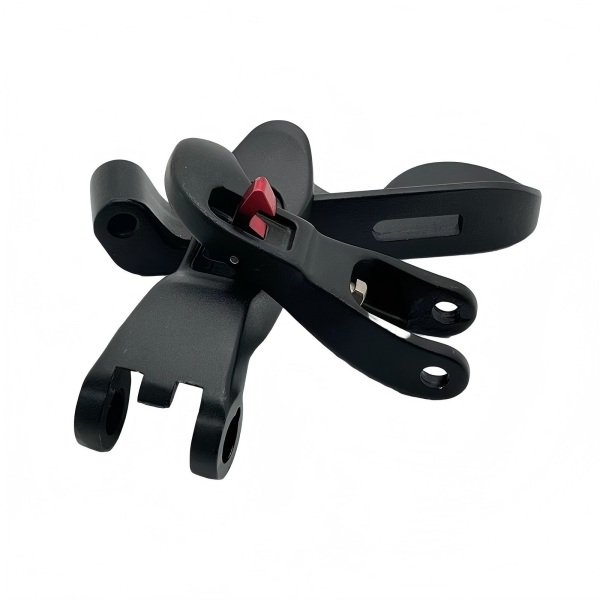
- Vehicle structural brackets, suspension arms, and mountings for tactical and support vehicles
- Housings and adapters for sensors, optics, and communication gear
- Handling frames, ramps, and tie-down fittings for ground support equipment
- Winch and hinge components that must carry shock loads repeatedly
- Brackets and spacers inside electronic enclosures where stiffness per gram is critical
Because forging near-net-shape leaves only a thin finishing allowance, these parts reach final form with less material waste and less machining time than parts cut from solid block. Our note on near-net-shape aluminum forging explains how this reduces both cost and lead time.
Material Selection: 7075, 6082, and 6061 for Service Conditions
Alloy choice follows the duty cycle. For the highest strength in a structural bracket, 7075-T6 is the usual pick, trading some corrosion resistance for peak yield. Where weldability and general corrosion resistance matter more, 6082 and 6061 are practical defaults, with 6061-T6 widely specified for frames and housings. Our aluminum forging material selection guide walks through how to match alloy and temper to the load and environment.
A short comparison helps: 6061 is the easy-to-machine, corrosion-friendly workhorse; 6082 adds strength while staying weldable; 7075 leads on strength but needs careful finishing and protection. The right answer depends on whether the part is stressed, exposed, or both.
Tolerances, Heat Treatment, and Surface Protection
Defense contracts rarely accept “close enough.” Dimensional control comes from a qualified die plus CNC finishing, and our process holds tight forging tolerances on critical features. After forging, heat treatment sets the temper — T6 solution treatment and aging is standard for structural parts — and is covered in our heat treatment guide for forged aluminum.
Surface protection closes the loop. Anodizing or a suitable coating resists salt spray and abrasion, and our surface finish options for aluminum forgings outline the choices by exposure level. Finally, common forging defect prevention describes how laps, cold shuts, and grain issues are controlled before shipment.
Why Work with Guangdong XinPingFu for Defense-Grade Forgings
Producing defense-relevant parts is less about one spectacular press and more about controlled, documented process discipline. At Guangdong XinPingFu we operate six forging presses ranging from 300T to 2500T and two cold forging machines, backed by twelve CNC machining centers for finishing and质证 inspection. Our line is run under ISO 9001, and our shipped-part pass rate holds at 99.7%, which supports the lot-to-lot consistency defense programs require.
From alloy selection and die development through heat treatment, surface finish, and final inspection, we keep the value chain in-house so tolerances and traceability stay under our control. If your program needs lightweight, rugged aluminum components built to a qualified, repeatable standard, that is exactly the work we do.
About Guangdong XinPingFu
Guangdong XinPingFu Die Forging & Stamping Co., Ltd. is based in Guangming District, Shenzhen, Guangdong Province, China. We specialize in aluminum precision forging and CNC precision machining, combining six forging presses (300T–2500T), two cold forging machines, and twelve CNC centers under an ISO 9001 quality system with a 99.7% shipment pass rate. From automotive and aerospace to industrial and defense-support components, we deliver near-net-shape forgings with stable grain flow, tight tolerances, and full in-house finishing. To discuss a defense or industrial forging program, search “Guangdong XinPingFu” to reach our team.