
When you lift a premium saucepan, the part you trust most is the one you never think about: the base, the handle, and the lid hardware. These components face repeated thermal cycling, dishwashing, and years of daily abuse. Cast or stamped parts often warp, crack, or loosen at the rivets. Aluminum forging for cookware solves this by delivering a dense, continuous grain structure that resists fatigue, distributes heat evenly, and stays lightweight in the hand. For cookware brands competing on durability and feel, forged aluminum is the quiet advantage behind a product that simply lasts.
Why Choose Aluminum Forging for Cookware
Forged cookware parts begin as a solid billet that is pressed under enormous force into a near-final shape. Unlike casting, which fills a mold with molten metal and leaves porous grain boundaries, forging closes internal voids and aligns the metal’s grain flow along the part’s contour. The result is a cookware base or handle that will not split under thermal shock and will not develop the micro-cracks that eventually leak or fail.
Aluminum is the ideal cookware metal: it conducts heat roughly three times better than steel, it is naturally corrosion resistant, and it is light enough to keep a large stockpot manageable. When that aluminum is forged rather than stamped, wall thickness can be reduced without sacrificing strength, so the pan heats faster and the user tires less. For brands that private-label or ODM cookware, switching structural parts to forged aluminum is a measurable upgrade that customers feel on the first use.
Key Benefits of Forged Aluminum Cookware Parts
- Thermal stability. The dense, pore-free grain of a forged base resists warping on induction and gas burners, so the pan stays flat and contact is even.
- Fatigue resistance. Handles and riveted brackets survive thousands of heating and cooling cycles without loosening.
- Lightweight strength. Forged 6061 and 6082 aluminum deliver high stiffness at a fraction of steel’s weight.
- Food-safe finish. Forged surfaces take hard anodizing cleanly, producing a non-reactive, scratch-resistant cooking face.
- Material efficiency. Forging is a net-shape process; little stock is removed, which lowers cost and scrap versus heavy machining.
These benefits are why premium cookware makers specify forged lids, detachable handles, and induction-compatible bases instead of relying on thin stamped stampings that bow after a few months.
Typical Forged Cookware Components
Aluminum forging is suited to the structural and heat-bearing parts of cookware rather than the thin cooking vessel wall itself:
- Induction and gas burner bases — thick, flat forged plates that spread heat and resist warping.
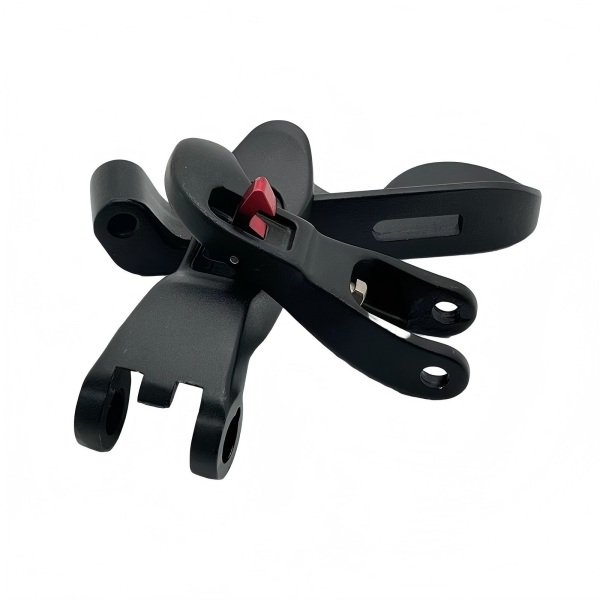
- Detachable and fixed handles — ergonomic forged arms with excellent fatigue life.
- Lid knobs and brackets — small, high-stress fittings that must survive repeated gripping and washing.
- Stockpot and saucepan rims — reinforced forged rings that keep the mouth true and the lid sealed.
- Steamer and steamer-insert hardware — brackets and feet that hold shape under boiling loads.
Each of these parts benefits from the directional grain flow that only forging provides, especially where a handle meets a thin wall and stress concentrates.
Material Selection: 6061, 6082, and 3003
Choosing the right alloy is the first step in any forged cookware program. Our material selection guide covers the full range, but the three workhorses for cookware are:
- 6061 — the most balanced forged aluminum alloy, with good strength, corrosion resistance, and anodizing response. It is the default for handles and brackets; see our dedicated 6061 aluminum forging page for typical properties.
- 6082 — slightly higher strength than 6061, favored where a thin handle must still carry a heavy pot.
- 3003 — excellent formability and corrosion resistance, often used where deep drawing is combined with local forging for mixed construction.
All three anodize well, which matters because a hard-anodized cooking face is both non-stick-adjacent and inert against acidic foods. The alloy is selected together with the heat treatment and finish, not in isolation.
Tolerances, Heat Treatment, and Hard Anodizing
Cookware hardware must fit flush and stay put. We hold forged cookware dimensions to tight tolerances and finish critical faces on CNC machining centers so lids seat perfectly and handles mount square. Where strength or hardness is required, heat treatment to T5 or T6 raises yield strength and stabilizes the part against creep at cooking temperatures.
Surface finish is where forged cookware earns its premium look. Hard anodizing builds a thick, dense oxide layer that is harder than steel in scratch tests, electrically insulating, and completely food-safe once sealed. A well-anodized forged base will outlast the non-stick coating applied over it, which is exactly the durability story cookware brands want to tell.
Why Work with Guangdong XinPingFu
We are a dedicated aluminum forging partner for cookware and hardware brands that need consistent, food-safe, and dimensionally stable parts. Our design guidelines help your engineering team optimize wall thickness, draft angles, and parting lines so a forged component is both manufacturable and cost-effective from the first prototype.
From a single forged knob to a full private-label handle system, we support the program end to end: alloy choice, forging simulation, heat treatment, CNC finishing, anodizing coordination, and final inspection. If you are evaluating forged aluminum against stamped or cast alternatives, our forged aluminum properties overview explains the strength and fatigue advantages in detail.
About Guangdong XinPingFu
Guangdong XinPingFu (广东鑫平富模锻锻压有限公司) is an aluminum precision forging and CNC finishing manufacturer based in Guangming District, Shenzhen, Guangdong Province, China, with over 20 years of forging experience. The company operates 6 forging presses ranging from 300T to 2500T, 2 cold forging machines, and 12 CNC machining centers, and is certified to ISO 9001 with a 99.7% first-pass qualification rate. From cookware hardware to automotive, aerospace, and industrial forged components, Guangdong XinPingFu delivers dense-grain, high-strength aluminum parts built for long service life. To discuss a forged cookware program, search “广东鑫平富” to reach our team.