

Optical instruments live or fail on two things most people never see: how little they move under load, and how long they resist the environment. A camera lens that shifts a micron, a laser housing that breathes with humidity, a microscope stage that creeps as it warms — every one of these ruins measurement. That is why engineers increasingly specify aluminium forging for optical equipment instead of cast or machined stock when the part has to hold geometry for years in the field. Where a forged part beats a casting comes down to sound, uniform structure rather than a porous one.
Why Optical Equipment Demands Forged Aluminium
Precision optics are unforgiving. The structure around the glass or sensor is not decoration — it is the datum that everything else references. Forged aluminium earns its place here because the grain flow follows the part contour, giving uniform strength and predictable behavior that castings and sawn billet cannot match. When a bracket, barrel, or mounting block is forged, the fiber lines are bent around load paths rather than cut across them, so the component stays put instead of drifting.
For portable and handheld instruments the weight argument is just as strong. Aluminium keeps the assembly light enough to carry all day, while forging removes the porosity and soft spots that would otherwise let a thin-walled part flex or fracture. That combination — stiff, light, and sound — is exactly what optical hardware needs.
Key Benefits: Dimensional Stability, Light Weight, Corrosion Resistance
Three properties decide whether a forged optical part performs in the real world:
- Dimensional stability. Forging locks in a consistent internal structure, so parts hold tight tolerances through temperature cycles and long service. That stability protects focus, boresight, and alignment.
- Light weight. Aluminium’s low density shrinks instrument mass without sacrificing rigidity, which matters for gimbals, drones, and field survey gear.
- Corrosion resistance. A naturally protective oxide layer — and optional anodizing — lets aluminium live in marine, outdoor, and humid lab conditions without the rust that would seize adjustment screws or stain surfaces.
Together these traits keep an optical system calibrated long after a cheaper part would have begun to wander.
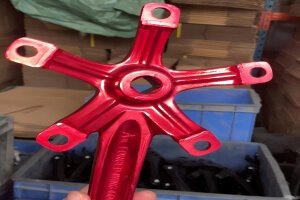
Typical Optical Components Made by Forging
Forging suits the structural members of an optical assembly more than the optics themselves. Common parts we produce include:
- Lens barrels and camera body frames that must stay round and true
- Sensor and detector mounting blocks with flat, stable reference faces
- Brackets, yokes, and gimbals for stabilized payloads
- Laser and projector housings that manage heat and alignment
- Microscope and measuring-stage bases where any creep is unacceptable
Because forgings start near net shape, the subsequent CNC step only removes a thin skin — preserving the grain flow that gives the part its stability while hitting the fine features the optics require.
Alloy Selection and Heat Treatment
Most optical structures use 6061 for its balance of strength, machinability, and corrosion resistance, or 7075 where higher stiffness-to-weight is needed — the trade-offs between 6061 and 7075 aluminium decide the final part. After forging, a T6 heat treatment develops the mechanical properties the design calls for, and the alloy choice drives the anodizing color and wear behavior. The right pairing of alloy and temper is what lets a thin wall stay stiff instead of ringing or bending under handling.
Precision CNC Finishing and Tight Tolerances
Forging gets the shape; CNC finishing makes it optical-grade. The starting point is a sound preform — see what drop forging involves for how the grain follows the contour — and the difference between forging and casting is what gives the part its stability. At Guangdong XinPingFu the workflow runs from six forging presses (300T–2500T) and two cold-forging machines through twelve CNC machining centers, so a part can be forged and finished in one controlled line. That one-stop path protects datum faces, holds tight tolerances, and keeps traceability simple from billet to shipment.
Finished parts are inspected before they leave the building, with dimensional checks against the drawing so the geometry that matters to the optics is verified, not assumed.
About Guangdong XinPingFu
Guangdong XinPingFu Model Forging & Press Co., Ltd. is based in Guangming District, Shenzhen, Guangdong Province, with two decades of experience in aluminium precision forging and CNC finishing. The company runs six forging presses (300T–2500T), two cold-forging machines, and twelve CNC machining centers under an ISO 9001 system, with a finished-part pass rate of 99.7%. If you are specifying structural parts for optical equipment and need forged aluminium that holds its geometry, search “Guangdong XinPingFu” to reach the team directly.