
FORGING ECONOMICS
How much does aluminium forging cost?
An honest pricing guide from a forging shop: the six factors that decide the number, when forging beats machining from solid, and how to get an accurate quote fast.
The short answer
There is no single number — but there is a predictable structure. A forged aluminium part is priced from six inputs, and once you understand them you can see exactly where your part’s cost sits and what a supplier should be asking you.
SIX COST DRIVERS
What actually decides the price
1. Alloy
6061 and 6082 are the economical workhorses. 7075 costs more in material and machining time — specify it only where strength-to-weight earns it.
2. Part weight & projected area
Bigger parts need more billet and more press tonnage. Our press range covers 300–2500T, so the size of your part maps to a specific press line.
3. Forging complexity
Parting line position, draft angles, rib heights and section changes all shape die cost and per-stroke difficulty. Good DFM feedback here often cuts cost without weakening the part.
4. Tolerances & machining
Forging sets the shape; CNC finishing holds the tight features. Every machined feature is a cost line — the review decides which faces genuinely need it.
5. Volume vs tooling amortization
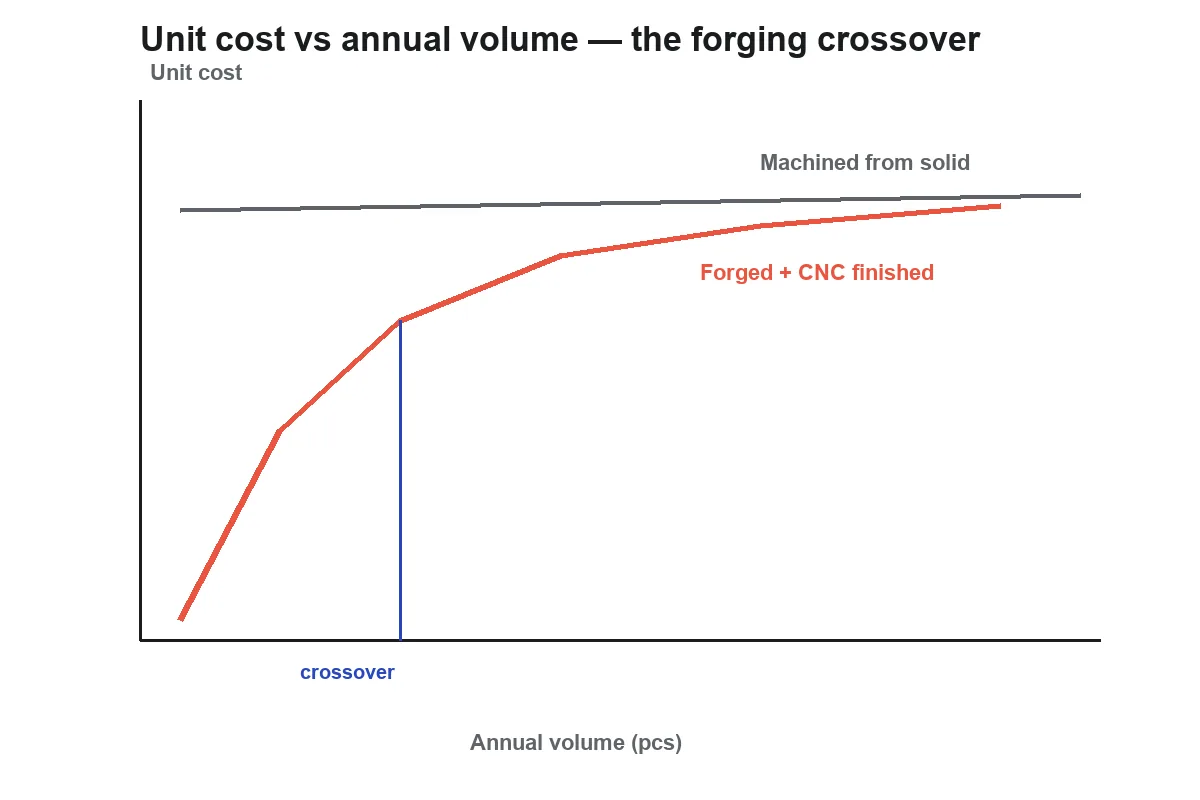
The die is a one-time investment. The crossover where forging beats machining from solid depends on your annual quantity — past it, every additional part is cheaper.
6. Secondary operations
Heat treatment to T6, anodising Type II/III, sandblasting, powder coat — all quoted as line items, all done under one roof here.
See also: CNC-to-forging conversion — what a conversion review covers.
Forging vs machining from solid: the crossover logic
| Factor | Machined from solid | Forged + CNC finished |
|---|---|---|
| Tooling | None | One-time die (in-house) |
| Unit cost at volume | Flat — always pays for full billet + hours | Falls steadily past crossover |
| Material waste | High (chips) | Low (near-net shape) |
| Grain flow | Cut through by the cutter | Follows the load path |
| Best window | Prototypes, very low volume | Serial production programs |
Rule of thumb: prototypes go to machining; annual programs go to forging. The exact crossover for your part comes from a drawing review — our conversion review exists precisely to locate it with numbers.
HOW QUOTING WORKS HERE
From drawing to number in 3 working days
- You send a drawingSTEP, DWG, DXF or PDF — even a clean print photo for a first opinion
- Engineering reviews forgeabilityDraft angles, parting line, tolerance placement — DFM feedback, not a sales script
- You get feasibility + cost rangeWithin 3 working days, from an engineer
Every batch ships with a mill certificate; a dimensional report accompanies every shipment. Quality documentation details →
In-house tool & die shop
Your drawings never travel to a third-party die shop — revisions happen on our floor.
99% first-pass yield
A measured number. Scrap risk is absorbed at the source, not passed to you.
One roof, start to finish
Forging (300–2500T), CNC to Ra 0.8 per drawing, anodising, inspection — see the full process.
FAQ
Common questions
What drives the cost of an aluminium forging?
Six factors: alloy, part weight and projected area, forging complexity (parting line, draft, ribs), tolerances and how much CNC finishing is required, annual volume vs tooling amortization, and secondary operations such as heat treatment and anodising.
Is forging cheaper than CNC machining from solid?
At low prototype volumes, machining from solid is usually cheaper because it needs no die. Once annual volume covers the tooling investment, forging wins on unit cost — and the gap widens as volumes grow.
How long does forging tooling take?
Typical closed-die tooling takes several weeks to cut and prove, followed by first-article samples. Because we design and cut dies in-house, revisions do not queue behind an outside die shop.
Do more accurate tolerances cost more?
Yes. Forging tolerances follow the die design; tighter features are achieved by CNC finishing after forging. The more machined features a drawing calls out, the higher the per-part cost — so DFM review often relocates tolerance money to where it matters.
Which is more expensive, 6061 or 7075?
7075 carries a higher material cost due to its zinc and copper content, and it is harder to machine. It is specified where strength-to-weight justifies it; otherwise 6061 or 6082 is the economical default.
How does batch size affect unit price?
Larger batches spread the setup and die-preparation cost across more parts, and stable batches run at our measured 99% first-pass yield — both push unit price down.
Is a forged blank with machining cheaper than a finished forging?
It depends on your in-house capability. Many customers buy near-net forged blanks with critical faces machined by us, and do light secondary work themselves to balance logistics cost.
What should I send to get an accurate quote?
A STEP, DWG, DXF or PDF drawing, the alloy and temper, annual quantity, and any special requirements (anodising class, PPAP). An engineer replies with a feasibility opinion and cost range within 3 working days.
Are surface treatments included in the forging price?
They are quoted as line items — Type II/III anodising, sandblasting, powder coating and electrophoresis are all done in-house, so they can be bundled into one delivered price.
What does the 99% first-pass yield mean for my cost?
It means rework and scrap risk is priced in on our side, not discovered on yours — fewer surprises between quote and delivered parts.
Want real numbers for your part?
Send one drawing — feasibility opinion and cost range from an engineer within 3 working days.