


ENGINEERING Q&A
Is forged aluminium stronger than CNC-machined aluminium?
Same alloy, same temper — one clear answer: static strength, no; fatigue strength, yes. Here is the metallurgy behind it, and what it means for the parts you buy.
The honest, precise answer
Pull two identical bars of 6061-T6 — one forged into shape, one machined from plate — to failure in a single pull, and they will post nearly the same tensile number. The alloy is the alloy.
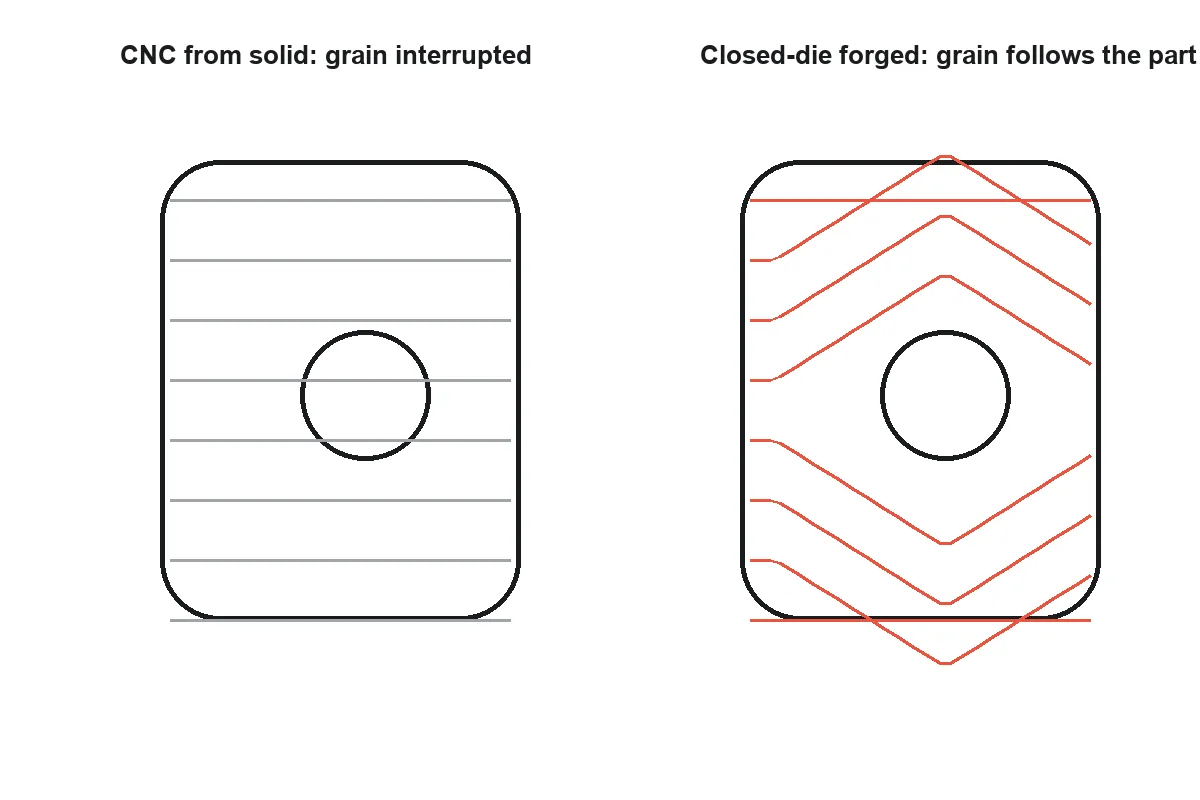
Load them cyclically — thousands of push-off forces on a crank, years of vibration on a motor mount — and the forged part outlasts the machined one. The reason is grain flow: forging shapes the metal’s internal fibre to follow the part’s loads; machining slices through it.
The numbers that are the same
| Property | 6061-T6 | 7075-T6 |
|---|---|---|
| Tensile strength | 310 MPa | 572 MPa |
| Yield strength | 276 MPa | 503 MPa |
| Density | 2.70 g/cm³ | 2.81 g/cm³ |
Identical whichever way the part is made — these are material properties, not process properties.
The number that is different
Fatigue life has no single table value — it depends on geometry and loads — but the mechanism is well understood:
Forged
Grain deforms around corners and follows bosses; load paths travel along the fibre. Crack initiation is hard.
Machined from solid
Cutter paths sever the grain at every pocket and step; those interruptions are where cyclic cracks start.
What this means when you’re buying parts
Cyclic + safety-relevant → forge
Cranksets, motor mounts, steering and suspension parts, anything under vibration. This is why our cranksets are forged, full stop.
Static + low volume → machining is fine
Fixtures, jigs, one-off housings see no fatigue penalty worth a die. A good supplier tells you this instead of selling you tooling.
Safety-relevant + casting on the table → forge
Casting can hide porosity; forging consolidates metal under pressure. For safety parts the industry answer is consistently forging.
Not sure which bucket your part falls in? That’s the first question our engineers answer in the free drawing review — within 3 working days.
FAQ
Common questions
Is forged aluminium stronger than CNC-machined aluminium?
For the same alloy and temper, static tensile strength is essentially the same. The real difference is fatigue: forging aligns grain with the load path, while machining cuts across grain lines — the classic initiation sites for fatigue cracks.
What is grain flow and why does it matter?
Grain flow is the directional fibre structure of the metal. Closed-die forging deforms it to follow the part’s shape, so loads travel along the grain. Machined parts interrupt that structure at every feature.
Do 6061 and 7075 behave the same way?
Both gain the same grain-flow benefit from forging. 7075-T6 is the high-strength choice (~572 MPa tensile vs ~310 MPa for 6061-T6); 6061 is the economical all-rounder. Details on the 6061 and 7075 pages.
Which fails first under cyclic load?
Typically the machined part: stress concentrates where tool paths sever the grain, and fatigue cracks start at those interruptions. This is why cranks, brackets and mounting parts under vibration are forged.
Is a forging heavier?
No — same alloy, same density. In fact forging usually lets engineers reach target stiffness with less material, because the grain structure carries load more efficiently.
What about cast aluminium?
Casting can hide porosity and has no directional grain. Forging consolidates the metal under pressure: no porosity, refined structure. For safety-relevant parts, forging is the standard answer.
Does heat treatment change the comparison?
T6 heat treatment happens after either route and strengthens both equally. It does not repair cut grain lines — the fatigue difference remains.
How do you verify strength claims?
Material certificates per batch, hardness testing, and dimensional reports with every shipment; material certificate and inspection report documentation on request. Customer audits are welcome.
If strength is similar, why choose forging?
Unit cost at volume, material savings from near-net shape, and fatigue life. The cost crossover analysis shows when the die investment pays back.
Which parts should definitely be forged?
Anything with cyclic loads and safety relevance: cranksets, motor mounts, steering and suspension parts, adapters under vibration. Static, low-volume parts can stay machined — we say so when they should.
Want real numbers for your part?
Send one drawing — feasibility opinion and cost range from an engineer within 3 working days.