
When performance and weight decide the outcome, aluminium forging for sports equipment has become the default choice for brands that build high-end bicycles, skateboards, e-scooters, and fitness gear. Forged aluminium parts deliver a continuous grain flow that resists fatigue far better than cast or CNC-machined blanks, while staying light enough to improve every movement an athlete makes. This guide explains why forged aluminium outperforms the alternatives, which components benefit most, and how to specify material, tolerances, and finish for durable sports products.
Why Forged Aluminium Wins in Sports Equipment
Sports gear lives in a harsh world: repeated impact, vibration, corrosion from sweat and rain, and constant load cycles. A cast part has internal pores that become crack starters; a CNC-machined billet cuts away material and destroys the natural grain direction. Aluminium forging for sports equipment keeps the metal’s grain flow aligned with the part’s shape, producing a dense, fiber-reinforced structure with 20–30% higher fatigue strength than the same alloy in cast form.
For product brands, that translates into fewer warranty returns, thinner and lighter designs, and a premium feel that customers can sense. It also reduces material waste versus subtractive CNC, which matters as teams push for both performance and sustainable manufacturing.

Where Forged Aluminium Shines: Typical Sports Components
Forged aluminium appears across the light-mobility and fitness categories where strength-to-weight is the whole game:
- Bicycle & e-bike parts — crank arms, pedal spindles, hub shells, brake levers, and suspension fork crowns that must survive millions of pedal strokes.
- Skateboard & longboard trucks — the hanger and baseplate take constant grinding and landing shock; forging stops them from cracking.
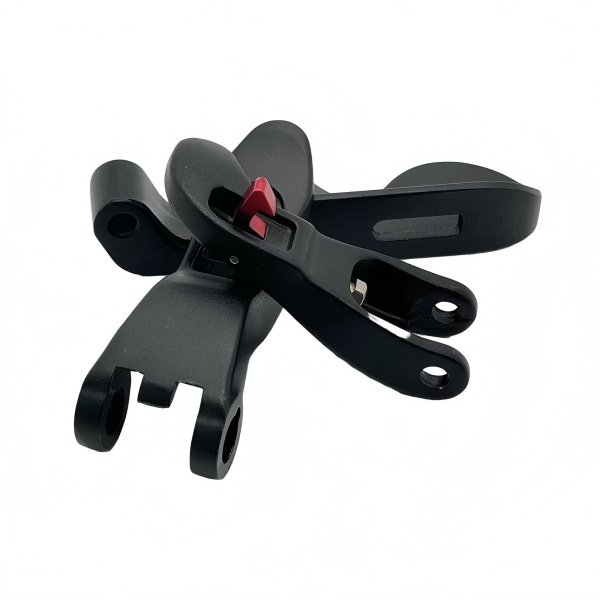
- E-scooter & light-mobility frames — folding hinges, deck brackets, and steering columns where a failure is a safety event.
- Fitness equipment — adjustable dumbbell handles, cable pulleys, and load-bearing brackets that see daily heavy loading.
- Climbing & outdoor gear — carabiner bodies and cam components where a single defect is unacceptable.
Each of these rewards the grain-flow advantage of forging rather than casting or machining from solid stock.
Material Selection: 6061 vs 7075 for Sports Parts
Choosing the alloy is the first engineering decision. 6061-T6 offers excellent corrosion resistance, good weldability, and easy anodizing — ideal for frames, brackets, and outdoor parts. 7075-T6 is roughly 40% stronger but less corrosion-resistant and harder to weld, making it the pick for high-load components like truck hangers and pedal spindles where every gram of strength counts.
For most consumer sports products, 6061-T6 is the workhorse, while 7075-T6 is reserved for the few parts under the highest stress. A clear comparison of 6061 vs 7075 helps teams lock the right spec before tooling. In both cases, forging refines the grain and lifts real-world durability well above a machined billet.
Forging Process and Tolerances for Sports Equipment
Most sports forgings are produced on hydraulic or mechanical presses in the 300–2,500-ton range, including drop forging for larger structural shapes, with cold forging used for smaller, high-precision parts that need a clean surface straight from the die. A near-net-shape forging leaves only light CNC finishing, cutting machining time and cost while preserving the forged grain flow.
Typical as-forged tolerances land at ±0.5–1.0 mm, tightening to ±0.05–0.1 mm after CNC finishing — enough for press-fit bearings, threaded inserts, and interference fits used in bike and scooter assemblies. Because forged blanks start denser than castings, finished parts hold tight tolerances without the porosity worries that plague cast routes.
Heat Treatment and Surface Finish for Durability
Proper heat treatment is what turns a forged blank into a dependable sports part. T6 temper (solution heat treat plus artificial aging) is standard for 6061 and 7075, balancing strength with dimensional stability. For assembled products, consistent T6 processing keeps batches dimensionally predictable so components fit without rework.
Surface finish closes the loop on durability and branding. Anodizing — clear or hard coat — adds corrosion resistance and a premium look that sports brands rely on, while bead blasting or powder coating handle cosmetic housings. A forged part that is also correctly heat-treated and anodized will outlast the product around it.
Why Work with Guangdong XinPingFu for Sports Equipment Forgings
Guangdong XinPingFu (Guangdong XinPingFu Modu Forging Co., Ltd.) is an aluminium precision forging and CNC machining partner based in Guangming District, Shenzhen, Guangdong Province, with two decades of forging experience. The plant runs six forging presses from 300T to 2,500T, two cold-forging machines, and twelve CNC machining centers under an ISO9001 quality system, holding a 99.7% first-pass yield.
For sports-equipment brands, that means one supplier can take a part from forged blank to finished, anodized component — skipping the CNC subcontractor layer and protecting both lead time and margin. Compared with buying CNC-machined parts, sourcing forgings directly also removes an intermediate markup. If you are developing bicycle, skateboard, e-scooter, or fitness parts and want forged aluminium that is lighter, stronger, and built to last, contact Guangdong XinPingFu to review your drawings and material spec.