
Forged vs Billet: Stronger Aluminum Parts From a Forging + CNC Factory
Forge the shape, machine only what matters. Guangdong Xinpingfu forges aluminium near-net-shape on 300–2,500 T presses, then CNC-machines critical features to ±0.01 mm – less waste, continuous grain flow, lower unit cost at volume.
- ±0.01 mm
- 99% first-pass yield
- ISO 9001:2015
- DFM feedback in 3 working days
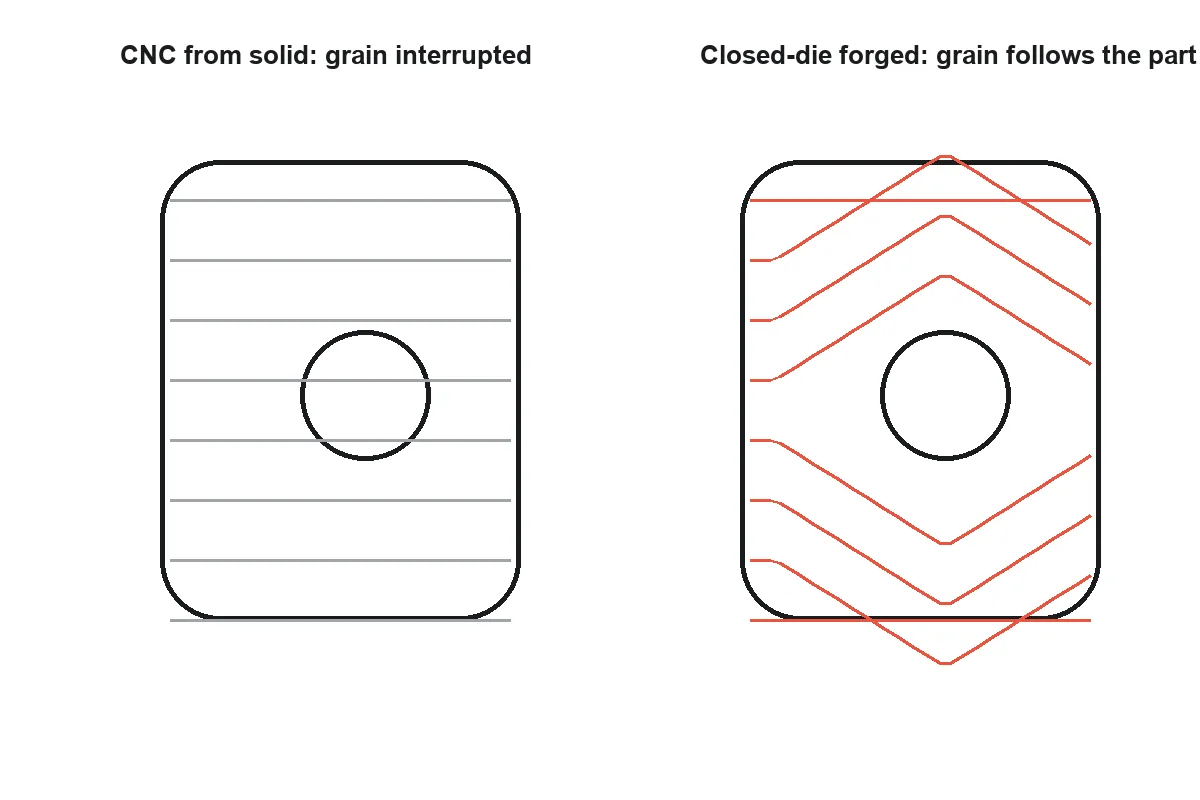
Forged + CNC vs billet machining at a glance
| Forged + CNC (near-net-shape) | Billet (CNC from solid bar/plate) | |
|---|---|---|
| Grain flow | Follows the part contour, continuous | Cut through; follows the bar, not the part |
| Fatigue & impact | Higher – no exposed end grain at stress points | Lower at cut-through sections |
| Material use | Blank close to final shape; little swarf | Much of the bar becomes chips on complex shapes |
| Machine time per part | Finishing passes only | Full roughing + finishing |
| Unit cost at volume | Lower once tooling is amortised | Stays roughly flat with volume |
| Tooling | Forging die required | None |
| First samples | Tooling 20–25 days, samples ~30 days | 3–5 days |
| Tolerance | ±0.01 mm on CNC-finished features | ±0.01 mm |
| Typical MOQ | 1,000–5,000 pcs | From 1 pc |
| Best for | Load-bearing parts in series production | Prototypes, low volume, frequent design changes |
Savings depend on geometry and volume; we quote both routes on the same drawing so you can compare.
When to choose each
Choose billet (pure CNC) when
- You need samples in days, not weeks
- Volume is below a few hundred pieces
- The design is still changing
Choose forged + CNC when
- The part carries load, vibration or impact
- Annual volume reaches thousands
- A large share of the billet ends up as chips
- You want lower unit cost over the product’s life
Use both
Prototype from billet in 3–5 days, validate, then move the frozen design to forging for production. See CNC Machining Cost.
Our process: forge, then finish
- DFM review – feedback within 3 working days
- Die design & tooling – 20–25 days
- Forging – 300–2,500 T hot forging, 600 T cold forging, 2,500 T liquid die forging
- Heat treatment
- CNC machining & special drilling – critical features to ±0.01 mm
- Finishing – anodising and other finishes available
- Inspection – 99% first-pass yield, ISO 9001:2015
20+ years of aluminium forging expertise · Factory in Guangming, Shenzhen
Send one drawing – get both routes quoted.
Forged vs billet – common questions
What is the difference between forged and billet?
Billet parts are CNC-machined from solid bar or plate. Forged parts are pressed close to shape in a die, then CNC-finished – so the grain follows the part instead of being cut through.
Is forged stronger than billet?
For the same alloy and temper, a forging usually has better fatigue and impact performance, because its grain flow follows the part contour.
Is billet stronger than forged?
Not usually. Billet can match forged on static strength in the same alloy, but cut-through grain at stress points makes it weaker in fatigue.
Is forged better than billet?
For load-bearing parts in series production, yes. For prototypes, low volumes or frequent design changes, billet is the better choice.
What is billet aluminium?
Aluminium supplied as solid bar, rod or plate that is machined directly into the finished part. See our guide: What is billet aluminium.
What is forged aluminium?
Aluminium heated and pressed into a die so the metal flows into the part shape, giving a dense structure with continuous grain flow.
Is billet more accurate than forged?
No difference on finished features: on forged parts we CNC-machine critical surfaces and bores to ±0.01 mm.
Why is billet faster?
No die is needed. Pure CNC samples take 3–5 days; forged parts need tooling (20–25 days) and samples in about 30 days.
When does forging become cheaper than billet?
Once volume spreads the die cost – typically series production in the thousands. Billet starts from 1 pc; our forged MOQ is 1,000–5,000 pcs.
Can you convert my billet part to a forging?
Yes. Send your current drawing; we return DFM feedback within 3 working days and quote both routes.