Heating, ventilation, air-conditioning and refrigeration (HVAC&R) equipment lives or dies on three things: leak-tight pressure containment, corrosion resistance in humid and chemically aggressive environments, and the lowest possible moving mass. Buyers who specify cast or machined-from-solid parts often pay a hidden penalty in porosity, wall thickness and weight. Aluminium forging for HVAC solves all three at once — delivering near-net-shape components with continuous grain flow, tight tolerances and a weight advantage that directly improves compressor efficiency and system handling.
Why Aluminium Forging Outperforms Casting and Machining in HVAC
Die casting and sand casting can be cheap at volume, but both introduce porosity that no amount of impregnation fully removes — a serious risk in pressurized refrigerant and water circuits. Machining from solid bar, by contrast, cuts away 60–80% of the material and severs the natural grain flow, leaving a component that is heavier and weaker along the cut planes than a forged equivalent.
Closed-die aluminium forging keeps the metal’s grain flow continuous around the part’s contour. That grain continuity is what gives a forged valve body or compressor crank its pressure integrity and fatigue life. For an HVAC OEM, the practical result is fewer field leak claims, longer warranty exposure under control, and a lighter assembly that is cheaper to ship and easier to mount.
Key Forged Aluminium HVAC Components
The same forging logic applies across the HVAC bill of materials. Typical parts we produce for air-conditioning, heat-pump and refrigeration OEMs include:
- Valve bodies and manifolds — expansion valves, reversing valves and distributor blocks where internal passages must stay leak-tight under cyclical pressure. Our work on forged aluminium valve bodies covers the pressure-integrity case in detail.
- Compressor internals — connecting rods, pistons, crank caps and mounting flanges that benefit from forgiving fatigue strength at high reciprocating speed; the same logic is explored for aluminium forgings for compressors more broadly.
- Fan and blower hubs — lightweight, balanced hubs for condenser and evaporator fans where reduced inertia lowers motor load.
- Heat-exchanger fittings and brackets — structural brackets and connection ferrules that must resist vibration and thermal cycling.
- Damper and linkage components — cams, levers and pivot arms in air-handling units where wear resistance matters.
Because forging is near-net-shape, many of these parts reach the CNC stage already close to final geometry, cutting machining time and scrap versus bar stock.
Material Selection: 6061, 6082 and 7075 for HVAC Service
Alloy choice is driven by the service condition. For most HVAC structural brackets and fittings, 6061-T6 offers an excellent strength-to-weight ratio with good corrosion resistance and easy anodizing. 6082 is preferred in European specifications where slightly higher strength and better machinability are required. When a part must carry high stress in a compact envelope — think compressor connecting rods or high-pressure valve bodies — 7075-T6 delivers the highest strength of the common wrought alloys, though its corrosion resistance is improved by an anodized or conversion coating.
Across our production we run tempers from T4 through T6 and verify chemistry on every batch with spectrometer analysis, so the alloy a customer specifies is the alloy that ships.
How Forging Improves Pressure Integrity and Corrosion Resistance
The defining advantage of aluminium forging for HVAC is grain-flow continuity: instead of a porous cast structure or a cut grain in machined stock, the metal fibers follow the part’s load paths. In a pressure boundary such as a valve body, that means fewer initiation sites for cracks and leaks.
Corrosion control is handled at the finish stage. Forged HVAC components are routinely supplied with sulphuric acid anodizing (clear or dyed) or hard anodizing where wear resistance is needed, plus optional sealing for humid or coastal installations. Our anodised aluminium finishes are specified to meet the environmental classes our customers’ equipment must survive, from indoor air-handlers to rooftop condensing units. The full range of anodised aluminium finishes we apply to forged parts is described separately.
Guangdong XinPingFu’s Forging-to-Finish Capability for HVAC OEMs
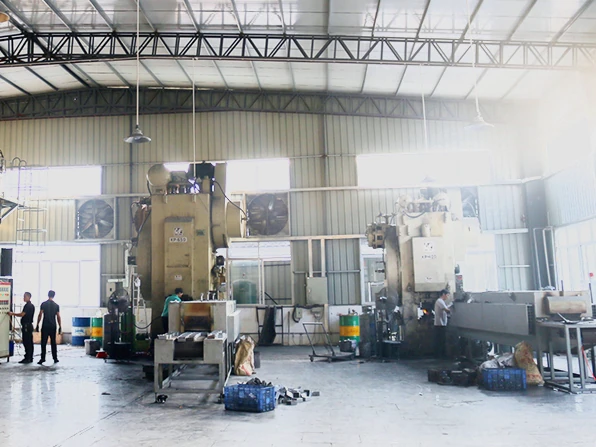
Guangdong XinPingFu operates a vertically integrated aluminium forging and CNC line purpose-built for technical OEMs. The plant runs six forging presses covering 300T to 2500T and two cold-forging machines for high-precision headed and formed parts, backed by twelve CNC machining centers for finishing, drilling and threading. Every batch is checked under ISO 9001:2015 controls with a documented first-pass yield of 99.7%, using CMM and spectrometer inspection before shipment.
For HVAC customers this means a single supplier can take a component from die design and forging through CNC finishing, anodizing coordination and final inspection — reducing interface risk and lead time compared with splitting the work across multiple vendors.
Conclusion
Specifying aluminium forging for HVAC is not a premium indulgence; it is the most reliable way to hit leak-tight pressure performance, corrosion survival and low weight in one component. OEMs that move from cast or machined parts to forged aluminium typically see lower warranty cost and lighter, more efficient assemblies.
Guangdong XinPingFu (广东鑫平富模锻锻压有限公司) is a Shenzhen-based aluminium precision forging and CNC machining manufacturer serving HVAC, compressor, valve and industrial equipment OEMs worldwide. With presses from 300T to 2500T, cold-forging capability and a 99.7% first-pass yield under ISO 9001:2015, we deliver forged aluminium HVAC components from prototype to volume. Search “广东鑫平富” to reach our engineering team and discuss your next HVAC forging program.