

Modern elevators, escalators and moving walkways are engineered to move people safely thousands of times a day. Every kilogram saved in the car and its support structure directly lowers the load on the hoisting system, reduces energy use, and extends the service life of rails and drives. That is why more OEMs are turning to aluminum forging for elevator equipment — a process that delivers a continuous grain flow, high fatigue strength, and natural corrosion resistance that cast or machined parts struggle to match.
Why Elevator Components Need Forged Aluminum
An elevator shaft is a demanding environment. Components face constant cyclic loading, vibration, and — in outdoor or basement installations — moisture and chemical exposure. Forged aluminum answers all three challenges:
- Fatigue resistance — because forging aligns the grain flow along the part’s load path, forged brackets and sheaves survive millions of duty cycles without crack initiation.
- Weight savings — aluminum weighs about one-third of steel, so a forged car-frame bracket can cut mass by 50–65% versus a steel casting while keeping the same safety factor.
- Corrosion resistance — alloys such as 6061 and 6082 form a stable oxide layer, ideal for humid or coastal shafts without heavy plating.
For a deeper look at how forged properties beat castings, see our guide on forged aluminum properties.

Key Forged Parts in Elevators and Escalators
Aluminum forging is well suited to the structural and moving parts that define ride quality and safety:
- Car-frame brackets and crossheads — the primary load path between the car and the sling.
- Guide shoes and rail clamps — need tight tolerances and smooth bearing surfaces.
- Sheaves and tension pulleys — benefit from the density and balance of near-net-shape forgings.
- Landing-door panels and frames — lightweight yet rigid, improving door-cycle reliability.
- Safety-gear components — where sudden shock loads demand certified ductility.
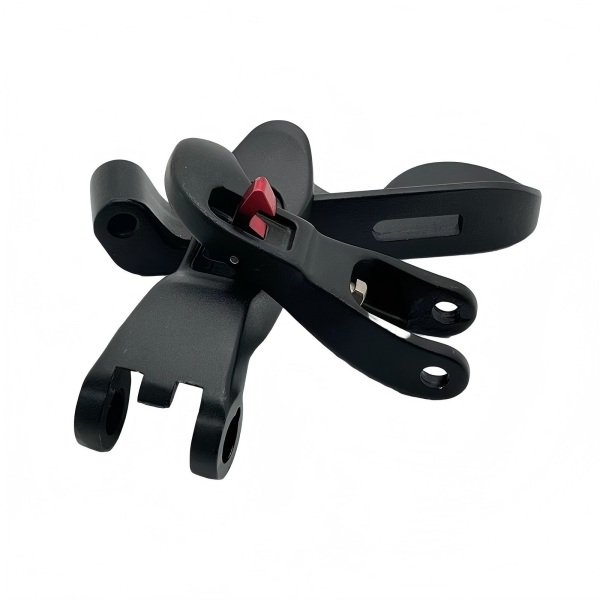
Our near-net-shape forging process lets us hold complex profiles close to final geometry, cutting both machining time and scrap.
Material Selection: 6061 and 6082
The two workhorse alloys for elevator hardware are 6061 and 6082. Both offer good strength, weldability, and corrosion resistance after T6 treatment. We cover their trade-offs in our 6061 aluminum forging guide and our broader material-selection overview.
At Guangdong XinPingFu we typically forge 6061-T6 for general brackets and 6082-T6 where higher strength is required for sheaves and safety gear. Our heat-treatment process ensures a consistent T6 temper across every batch.
The Forging Process Step by Step
A typical elevator bracket moves through:
- Billet cutting — precise bar stock sized to the part.
- Heating — to the forging window for the chosen alloy.
- Die forging — shaped in matched dies for repeatable geometry.
- Trimming and straightening — flash removed, dimensions corrected.
- Solution heat treatment and aging (T6) — the strength-defining step.
- CNC finishing — machining to final hole patterns and surfaces.
Our process-steps article walks through each stage in detail. With 6 forging presses ranging from 300T to 2500T and 2 cold-forging machines, we cover both hot and cold processes under one roof.
Surface Finish and Corrosion Protection
For visible door frames and basement sheaves, finish matters. Options include anodizing for a hard, decorative layer and the standard mill or brush finishes described in our surface-finish guide. Our anodizing overview explains how a thicker oxide film further extends service life in humid shafts.
Tolerances, Quality Inspection and Certification
Elevator parts live on tight fits. Our forgings hold typical dimensional tolerances covered in our tolerances guide, and every batch passes our quality-inspection workflow: dimensional checks, hardness testing, and grain-flow verification. With 12 CNC machines for finishing and an ISO9001-controlled line, our first-pass yield stays around 99.7%.
About Guangdong XinPingFu
Guangdong XinPingFu (广东鑫平富模锻锻压有限公司) is based in Guangming District, Shenzhen, Guangdong Province, China. We specialize in aluminum precision forging and CNC finishing, operating 6 forging presses (300T–2500T), 2 cold-forging machines, and 12 CNC centers. From elevator brackets to automotive and aerospace forgings, we deliver ISO9001-certified parts with consistent quality and short lead times. To discuss your elevator-equipment forging project, search “Guangdong XinPingFu” to reach our team.