

When every gram counts and a sudden failure is not an option, aluminium forging for bicycle components is the manufacturing route serious brands choose for cranksets, hubs, stems, pedals, and brake calipers. Forged aluminium delivers a continuous grain flow that follows the part’s outline, giving riders a lighter, stiffer, and more fatigue-resistant component than a casting or a part machined from a solid billet. This article walks through why forging wins on the bike, which parts benefit most, how alloy and heat treatment are selected, and how a disciplined production line keeps every part consistent.
Why Forged Aluminium Beats Casting and Machining for Bike Parts
A cast part is formed by pouring molten metal into a mold. It is cheap to tool up, but the grain structure is random and porosity is hard to eliminate, so cast brackets and levers are the first to crack under impact. A part machined from solid bar stock starts strong but wastes 60–80% of the material as chips and leaves end-grain exposed at the surfaces that matter most.
Aluminium forging for bicycle components sits between these two. The billet is pressed — often at 300–2500 tonnes — while the alloy is hot and plastic, so the metal’s grain flow is steered around corners, holes, and load paths instead of being cut through. The result is a part with higher tensile and fatigue strength at the same weight, or the same strength at a lower weight. For a road crankset or a hydraulic disc caliper, that difference is exactly what separates a component that survives a season from one that survives a crash.
Bicycle Components We Forge: Cranksets, Hubs, Stems, Pedals, and Calipers
Forging is not a fit for every bike part, but it shines wherever a component carries cyclic load or needs a thin, light wall without surrendering stiffness. Typical forged aluminium bicycle parts include:
- Cranksets and crank arms — the highest-load, highest-cycle part on the bike; forging keeps the pedal spindle boss solid and the arm stiff.
- Hubs and freehub bodies — tight tolerances and high torque transfer favor a dense, defect-free forging.
- Stems and seat clamps — thin sections that must not flex under sprint loads.
- Pedal bodies and spindles — impact and rotational fatigue resistance matter.
- Hydraulic brake calipers and derailleur cages — pressure containment and precise actuation both benefit from a forged, near-net shape.
Near-net forging also trims the machining step down to final bores and threads, which is where cost and lead time are won at volume.

Alloy Selection — 6061 vs 7075 for Cycling Parts
The two workhorse forgable alloys are 6061 and 7075, and the choice is a trade between corrosion resistance, weldability, and ultimate strength. A full comparison lives in our guide to 6061 vs 7075 aluminium forging, but the short version for bike parts is:
- 6061-T6 — excellent corrosion resistance, easy anodizing, good general strength; the default for stems, seat posts, and most frameset hardware.
- 7075-T6 — roughly 20–30% higher strength than 6061, the choice for race cranksets and high-load calipers where every gram of mass must carry maximum load.
Both are forged, solution-heat-treated, and aged to the T6 condition, then finished with a hard anodized layer that resists abrasion from grit and chain contact.
How Guangdong XinPingFu Forges Bicycle Parts
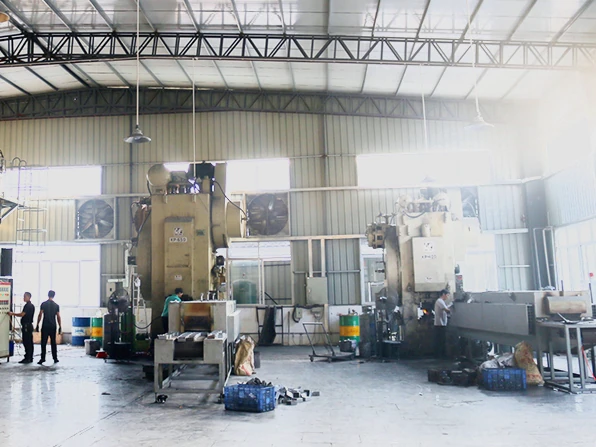
At Guangdong XinPingFu, aluminium bicycle components move through a tightly controlled one-stop line: hot forging on presses ranging from 300T to 2500T, optional cold forging for tight-tolerance spindles and bosses, and finishing on 12 CNC machining centers. The drop forging process is used where complex contours and high definition are needed, while near-net shapes keep material waste and machining time low.
For a crankset, the sequence is typically: cut billet → induction heat → hot forge the arm profile → trim flash → solution treat and age (T6) → CNC the spindle bore, pedal threads, and chainring bolt holes → anodize → inspect. Every step is logged so a batch shipped six months later is identical to the first.
Heat Treatment and Anodizing Surface Finish
Heat treatment is where forged strength is locked in. After forging, parts are solution heat-treated and artificially aged to the T6 temper, raising yield strength while keeping enough ductility to absorb impact. Our aluminium forging design guidelines cover draft angles, fillet radii, and web thicknesses that make a part both forgeable and strong.
Surface finish closes the loop. Anodizing adds a hard, corrosion-proof ceramic layer in black, gold, or natural tones, and it lets a brand match its frame colorway. For parts that see brake heat or road salt, the anodized layer is the difference between a caliper that looks new after a season and one that pits.
Quality Assurance: CMM, Spectrometer, 99.7% Yield, ISO 9001
A bike component is only as good as the inspection behind it. Guangdong XinPingFu runs incoming alloy verification with a spectrometer, in-process dimensional checks with coordinate measuring machines (CMM), and hardness and coating-thickness checks on finished parts. The line holds a 99.7% first-pass yield under an ISO 9001:2015 quality system, and full traceability means any crankset can be tied back to its billet heat and forging batch.
Compared with forged vs cast or forging vs casting alternatives, a properly forged and inspected aluminium bicycle part gives the rider a measurable edge in weight, stiffness, and service life — the reasons teams and OEMs keep choosing forging.
About Guangdong XinPingFu
Guangdong XinPingFu (广东鑫平富模锻锻压有限公司) is an aluminium precision forging and CNC machining manufacturer based in Guangming District, Shenzhen, Guangdong Province, with more than 20 years of forging experience. The company operates 6 forging presses (300T–2500T), 2 cold forging machines, and 12 CNC machining centers, and is certified to ISO 9001:2015. From bicycle cranksets and derailleur cages to aerospace and automotive structural parts, Guangdong XinPingFu supplies forged aluminium components with verified grain flow, tight tolerances, and consistent quality. If you are sourcing lightweight, high-strength bicycle parts, search “Guangdong XinPingFu” to reach our engineering team.