

When an electronics system has to survive vibration, heat, and electromagnetic noise in the field, the aluminium forging for electronics enclosures decision is rarely just about unit price. The enclosure is the structural and electrical foundation of the product — it carries mechanical loads, dissipates heat, and shields sensitive circuits from interference. For engineers specifying housings for 5G base stations, RF amplifiers, industrial controllers, and ruggedized field equipment, forged aluminium offers a combination of stiffness, shielding continuity, and dimensional control that cast or machined-from-billet routes struggle to match.
Why Enclosure Performance Starts With the Base Material
Every enclosure is asked to do several jobs at once. It must hold its shape under shock and clamping loads, keep gaskets seated across temperature cycles, provide a continuous conductive barrier against EMI/RFI, and move heat away from power devices. The base material and the way it is formed decide how well a single housing can deliver all of those outcomes. Cast alloys can trap shrinkage porosity, and machined-from-solid stock removes material that was already sound, adding cost and lead time without improving the grain structure. Forging takes the opposite approach: it refines and aligns the metal where the load actually travels.
How Forging Improves Stiffness and Dimensional Stability
Forging aligns the metal’s grain flow along the part’s loaded contours, producing a continuous, wrought structure with no internal porosity. A forged enclosure wall can be made thinner yet stiffer than a cast wall of the same nominal thickness, because there are no shrinkage voids or weak eutectic pockets to initiate deflection or cracking. This matters for enclosures that must hold tight flatness and gasket-seating tolerances across temperature cycles. When the housing also serves as a structural member — a mounting plate, a bracket, or a frame rail — that extra rigidity translates directly into a more reliable assembly. Our guidance on aluminium forging design guidelines covers how draft angles, fillets, and wall transitions are tuned so the forged shape stays stable through finishing.
EMI Shielding and RF Performance From a Continuous Metal Structure
One of the less obvious advantages of a forged housing is shielding integrity. A solid, pore-free forged wall provides a continuous conductive path that suppresses EMI and RFI leakage far more reliably than a porous casting, where micro-voids can degrade shielding effectiveness. For RF and microwave enclosures, this continuity helps meet emission and immunity targets with fewer add-on plating or lining steps. The same continuous structure also resists the ingress paths that corrosion and fatigue can open up over time. The trade-offs between forging and casting are worth reviewing when a program is weighing shielding, weight, and volume together.
Thermal Management: Forged Housings as Integrated Heat Paths
Aluminium’s thermal conductivity lets an enclosure double as a heat spreader. Because forged aluminium is dense and void-free, heat flows predictably from the mounted component to the outer finned or flat surfaces, with no porous layer interrupting the path. Designers can integrate heat-sink features — fins, pedestals, and thermal bosses — directly into the forging, reducing reliance on separately bonded sinks and thermal interface layers. After forming, T6 heat treatment stabilizes the microstructure so the part’s thermal and mechanical behavior stays consistent across the product’s service life.
Near-Net-Shape Forging Reduces Machining and Lead Time
Where an enclosure carries complex bosses, ribs, and mounting features, near-net-shape forging places material close to the final profile. The result is less stock to remove on our 12 CNC machining centers, shorter cycle time, and less scrap — all factors that stabilize cost and delivery for production volumes. It also leaves more of the beneficial forged skin and grain structure intact at functional surfaces. Many of the same principles apply to other precision housings we produce, such as optical equipment enclosures and medical device housings, where tight tolerances and clean surfaces are decisive.
Material Selection: 6061 vs 7075 and Heat Treatment
For most enclosures, 6061 offers an excellent balance of corrosion resistance, weldability, and machinability, while 7075 delivers higher strength where the housing also acts as a load-bearing structure. T6 heat treatment — solution plus artificial aging — tunes the strength-to-weight ratio, and the choice between alloys should follow the mechanical and environmental demands of the installed system rather than a single catalog number. A closer look at 6061 vs 7075 helps teams match alloy to duty cycle, and anodizing the finished parts adds a hard, corrosion-resistant surface that also improves appearance and marking durability in field deployments.
About Guangdong XinPingFu
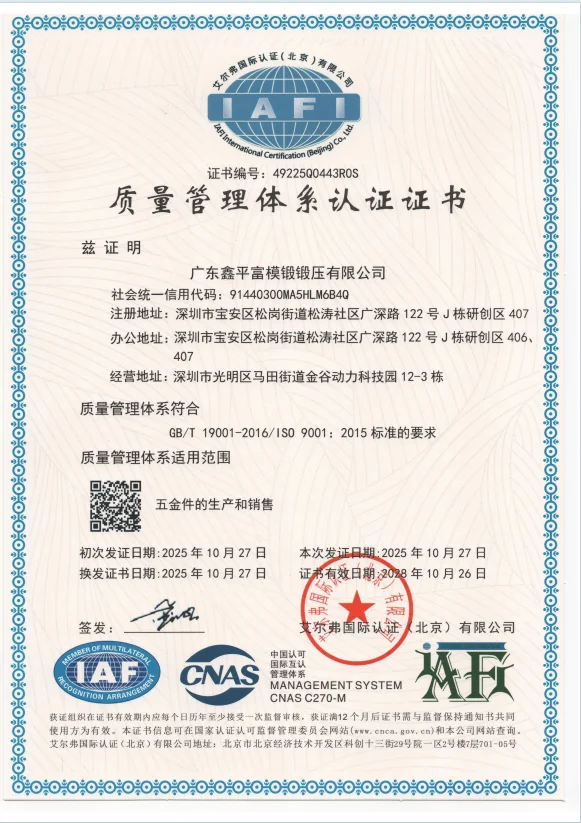
Guangdong XinPingFu Model Forging and Pressing Co., Ltd. is an aluminium precision forging and CNC machining manufacturer based in Guangming District, Shenzhen, Guangdong Province, China, with around 20 years of forging experience. The company operates 6 forging presses ranging from 300T to 2500T, 2 cold forging machines, and 12 CNC machining centers, and runs an ISO 9001:2015 quality management system with a finished-part pass rate of about 99.7%. From drop forging and hot forging through surface treatment and precision machining, Guangdong XinPingFu supplies forged aluminium enclosures, brackets, and structural components for electronics, RF, automotive, and industrial customers worldwide. If your program needs a rigid, shielding-capable, thermally efficient aluminium enclosure, contact the team to review your drawings and volumes.