
Aluminium Forging for Marine Applications: Lightweight, Corrosion-Resistant, and Built for Saltwater
The ocean is unforgiving on metal. Salt spray, constant vibration, and cyclic wave loads punish every fitting on a boat, a dock, or an offshore platform. That is exactly why aluminium forging for marine applications has become the default choice for engineers who need hardware that stays strong and corrosion-free for decades, not seasons. Forged aluminium delivers the rare combination marine designers want: low weight, high strength-to-density, and a fiber microstructure that simply does not crack the way castings do.
Why Marine Hardware Demands Forged Aluminium
Weight on a vessel is a tax you pay forever. Every kilogram above the waterline raises the center of gravity and hurts stability; every kilogram below it costs fuel and payload. Aluminium already wins on density versus steel, but the process matters as much as the material. A cast bracket has a coarse, porous grain structure with internal voids that become crack-initiation sites once seawater finds its way in. A forged bracket closes those voids and aligns the grain along the part’s load path, producing a continuous fiber that resists fatigue and impact far better. For moving gear—winches, rudder stocks, steering arms—that difference is the gap between a part that lasts and a part that fails at sea.
Key Performance Requirements in Saltwater Environments
Marine service sets a brutal checklist. Three requirements dominate every specification:
- Corrosion resistance — chloride attack is relentless. The part must survive years of immersion, splash, and humidity without pitting.
- Fatigue strength — wave and engine loads are cyclic, not static. Grain flow alignment from forging is what carries these loads over millions of cycles.
- Dimensional stability — hardware that seizes, galls, or drifts out of tolerance is a safety hazard on a moving vessel.
Forged aluminium meets all three. The closed, dense microstructure resists chloride penetration, while the directional grain flow spreads stress instead of concentrating it. When paired with the right temper and finish (covered below), a forged marine component routinely outlives the vessel it is mounted on.
Typical Forged Marine Components
Forging suits a wide range of boat and offshore hardware where strength, weight, and corrosion resistance intersect:
- Deck hardware: cleats, fairleads, bollards, and mooring brackets
- Rail and guard fittings: stanchion bases, handrail connectors, and tube clamps
- Steering and control: rudder stocks, tiller arms, and throttle levers
- Propulsion supports: propeller hubs, strut brackets, and outboard mounting plates
- Structural brackets: battery trays, electronics enclosures mounts, and solar-rack frames
Each of these parts carries real load in a corrosive environment. A forged aluminium version is typically 40–60% lighter than the steel part it replaces, and unlike a machined-from-billet part it does not waste material from a solid block—an important cost and lead-time advantage on medium volumes.
Material Selection: 6061 vs 7075 for Marine
Alloy choice depends on whether corrosion resistance or peak strength wins the day. Our guide to 6061 vs 7075 aluminium goes deeper, but the marine short version is:
- 6061-T6 is the workhorse. Its magnesium-silicide chemistry forms a naturally protective oxide film, and it anodizes beautifully. For most deck hardware and structural brackets, 6061 is the safest, most corrosion-proof choice.
- 7075-T6 is the strength champion—roughly 30% stronger than 6061—but copper in its chemistry makes it less corrosion-resistant in chloride. It earns its place in high-load, tightly anodized parts such as steering arms and racing hardware, where every gram counts.
Both are shaped on our press line and finished to drawing. Following sound aluminium forging design guidelines—generous fillets, sensible draft, and uniform wall thickness—keeps the forging sound and the cost down.
Surface Finish and Anodizing for Saltwater Service
Forging closes the internal porosity, but the surface still decides how long a marine part looks good and stays protected. That is where anodizing forged aluminium parts earns its keep. A Type II (decorative) or Type III (hard) anodized coating thickens the natural oxide layer into a dense, insulating, corrosion-blocking barrier. Hard anodizing also adds surface hardness and abrasion resistance—useful for parts that slide or chafe.
In practice, 6061 with a hard-anodized finish is the gold standard for saltwater hardware: light, strong, and effectively sealed against chloride. We control thickness, seal quality, and color to spec, so the same part can be functional gray or branded black, gold, or blue.
Why Choose Forged Over Cast for Marine
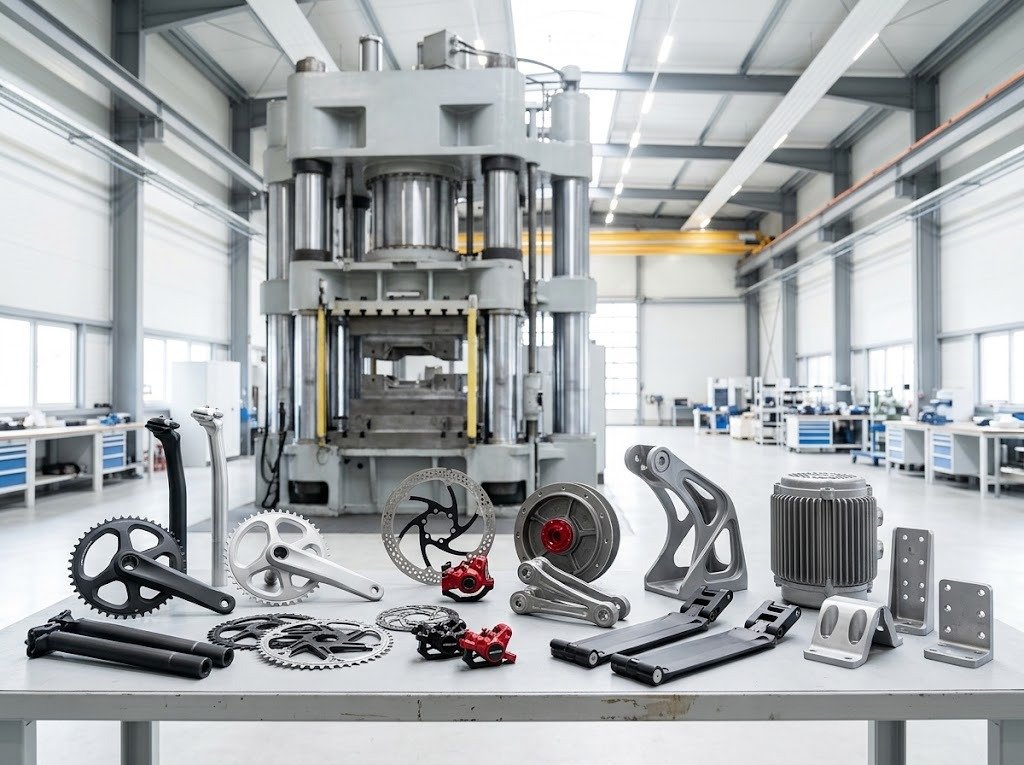
It is worth stating plainly: forged vs cast parts is not a close call for safety-critical marine hardware. Casting can be cheaper for a one-off complex shape, but it carries porosity, weaker grain structure, and inconsistent mechanical properties. Forging eliminates the porosity and aligns the grain, lifting both strength and fatigue life. The drop forging process we use shapes the part between precision dies under a 300T–2500T press, producing near-net geometry that needs only light CNC finishing—less machining, less waste, better material integrity.
Why Work With Guangdong Xinpingfu Die Casting and Forging Co Ltd
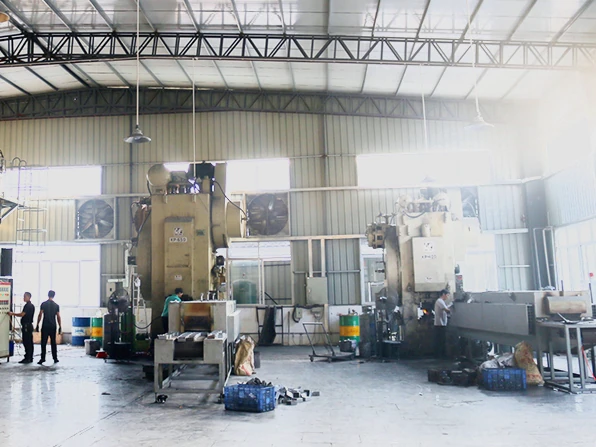
Guangdong Xinpingfu Die Casting and Forging Co Ltd is an aluminium precision forging and CNC machining specialist based in Guangming District, Shenzhen, China, with 20+ years of forging experience. Our plant runs 6 forging presses (300T–2500T), 2 cold-forging machines, and 12 CNC machining centers, all operated under an ISO 9001:2015 quality system with a 99.7% first-pass yield. For marine and other corrosion-sensitive programs, we support alloy selection (6061 / 7075 / 6082), T4–T6 heat treatment, hard anodizing, and full dimensional inspection so your hardware arrives salt-ready.
If you are specifying lightweight, corrosion-resistant aluminium forgings for boats, docks, or offshore equipment, talk to our engineering team. Search “Guangdong Xinpingfu Die Casting and Forging Co Ltd” to reach us, and we will help you turn a rough concept into a sea-proven forged component.