


ROBOTIC ARM COMPONENTS · FORGED 6061-T6 / 7075-T6
Robotic Arm Components, Light, Stiff and Repeatable
Forged-then-machined robot arm parts that cut arm inertia without losing stiffness — for cobots, industrial arms, humanoid and quadruped joints.
Robot arm parts we make
Upper/lower arm links · base & shoulder housings · motor mounts & flanges · cable guides.
Robot joint housings and reducer housings
Porosity-free forgings for bearing and harmonic/cycloidal reducer bores; ±0.01 mm bores, coaxiality checked on CMM.
Robot end effector and gripper brackets
Light 7075-T6 end effector plates, tool-changer adapters, gripper fingers.
Why forged aluminium robotic arm parts (vs cast or billet)
Higher stiffness-to-weight and fatigue life than cast; lower cost than full billet at volume. See forging vs casting and is forged aluminium stronger than CNC machined aluminium.
Precision CNC machining & inspection
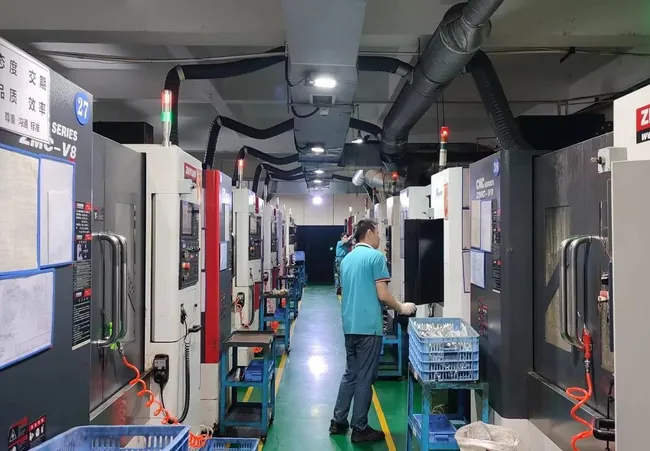
5-axis CNC, CMM reports, flatness/coaxiality control, material certs. See engineering quality.
Materials & finishes
6061-T6, 7075-T6, 6082 · hard/clear/black anodising, chromate conversion.
WHY FORGED
Lower arm inertia without losing stiffness
Every gram at the end of a robot arm has to be accelerated and stopped by the joints behind it. Lighter links and housings mean smaller motors and reducers, faster cycles and less energy — but only if stiffness and bore accuracy hold. Forged-then-machined aluminium gives that combination.
| Cast | Billet CNC | Forged + CNC | |
|---|---|---|---|
| Porosity at bearing bores | Risk | None | None |
| Fatigue life | Lowest | Good | Highest |
| Unit cost at volume | Lowest | Highest | Between the two |
| Best for | Covers, low-load | Prototypes | Links, joint housings, end effectors in series |
COMPONENTS
Robot arm components we make
Arm links
Upper and lower arm links forged near-net, then machined at bearing seats and flange faces.
Joint housings and reducer housings
Housings for harmonic and cycloidal reducers. Bearing bores are held to ±0.01 mm and coaxiality is checked on CMM.
Robot end effectors and gripper brackets
Light 7075-T6 end effector plates, tool-changer adapters and gripper fingers — where low mass at the wrist matters most.
Motor mounts, flanges and cable guides
Machined after forging to your interface drawing.
Designing a new joint or link?
Send the STEP file for a free DFM review.
SPEC SHEET
Tolerances and capability
| Item | Capability |
|---|---|
| Bearing bores | ±0.01 mm |
| General tolerance | ±0.05 mm |
| Geometric control | Flatness and coaxiality, CMM-checked |
| Machining | 5-axis CNC |
| Alloys | 6061-T6, 7075-T6, 6082 |
| Finishes | Hard, clear or black anodising; chromate conversion |
| MOQ | 1,000–5,000 pcs reference, depending on the part; billet-CNC prototypes before forging tooling |
BY MATERIAL
6061-T6, 7075-T6 or 6082 for robot parts?
6061-T6 is the default for links and housings: stiff enough, machines cleanly and takes clear or black anodising well. 7075-T6 goes where strength per gram matters most — end effectors, grippers and thin-walled wrist parts. 6082 is used when a European specification calls for it. See 7075 aluminium.
QUALITY
Inspection and documentation
- CMM report on bores, flatness and coaxiality
- Material certificate per batch
- FAI / PPAP on request
APPLICATIONS
Where our robot parts go
Collaborative robots
Industrial arms
Humanoid robots
Quadruped robots
FAQ
Robotic arm components FAQ
What are the main components of a robotic arm?
Base, shoulder, arm links, joints (motor + reducer in a housing), wrist and end effector — we make the aluminium structural parts.
What material is used for robot arms?
Mostly 6061-T6 or 7075-T6 aluminium for links and housings; forged for load parts.
Forged or cast for robot arm links?
Forged: no porosity, better fatigue life and stiffness.
What tolerances can you hold on joint housings?
±0.01 mm on bearing bores, ±0.05 mm general.
What is the MOQ?
1,000–5,000 pcs reference, depending on the part; CNC prototypes from billet before forging tooling.
Do you supply inspection reports?
Yes, CMM reports and material certificates.
Do you make robot end effectors?
Yes — 7075-T6 end effector plates, tool-changer adapters and gripper fingers to drawing.
Can you machine reducer housings for harmonic drives?
Yes, with bore and coaxiality checked on CMM.
Which finishes do you offer?
Hard, clear or black anodising and chromate conversion.
Can I send a 3D file?
Yes — STEP, IGES, DWG or PDF, attached in the form.
Do you sign NDAs?
Yes; dies are made in-house.
Where do you ship from?
Shenzhen, China, worldwide.
Related pages
Aluminium forging services · CNC machining · 7075 aluminium · Engineering quality · Aluminium forging for robotics · Request a review
Send your drawing
Free DFM review for your robotic arm component.