

Glass processing lines—tempering furnaces, cutting tables, edging and washing machines, and robotic handling arms—run continuously under heat, coolant, and tight positional tolerances. Aluminum forging for glass processing equipment has become the preferred way to build the frames, carriages, and structural arms that must stay straight and vibration-free while staying light enough for fast axis movement. This guide explains where forged aluminum parts fit in glass machinery, which alloys work best, and how the forging process controls cost and accuracy.
Why Glass Processing Equipment Demands Rigid, Lightweight Structures
A glass cutting or edging line is only as accurate as its base. If a beam or carriage deflects under its own weight or during acceleration, the cut edge drifts and the rejected glass climbs. Cast iron is stable but heavy; welded tube assemblies are light but prone to weld distortion and residual stress. Forged aluminum sits between the two: it delivers high stiffness-to-weight, then the grain flow follows the part contour to resist fatigue from millions of start-stop cycles.
For builders of glass processing equipment, the practical win is simpler machine design. Lighter forged arms let smaller servo motors do the work, cut energy use, and reduce the inertia that limits cycle speed. That is why more OEMs now specify aluminum forging for glass processing equipment for moving subframes, lifting yokes, and suction-arm brackets.

Key Forged Aluminum Components in Glass Machinery
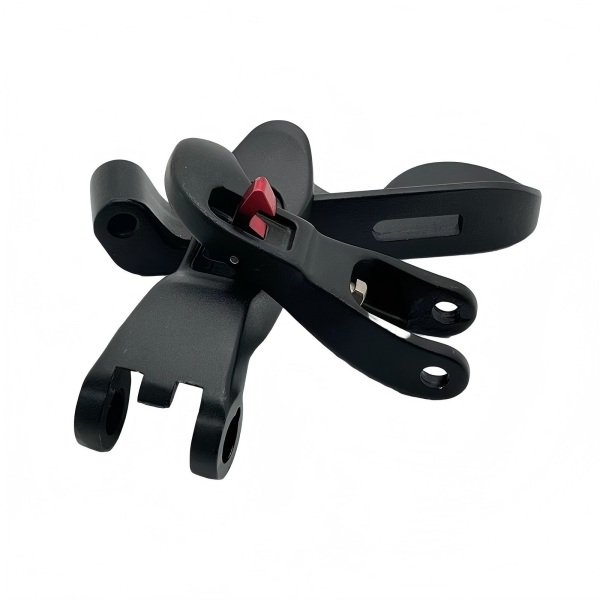
The parts that benefit most from forging share one trait: they carry load while they move. Typical forged components include:
- Cutting-table bridge beams and end caps that hold the cutting head rails in perfect parallel.
- Edging and grinding carriage yokes where rigidity controls surface finish on the glass edge.
- Robotic handling arms and suction-frame brackets that lift and position fragile sheets without chatter.
- Tempering-furnace entry/exit frame brackets exposed to heat cycling and repeated thermal load.
- Bearing housings and pivots for conveyor drives, where fatigue resistance protects uptime.
Because the load paths are predictable, a forged blank can be shaped close to the final contour, leaving only light CNC finish machining. The result is a part with continuous grain flow across the stress zones—something a machined plate or a casting cannot match.
Material Selection: 6061 and 6082 for Glass Lines
Most structural parts on glass machinery use 6xxx-series alloys for their balance of strength, corrosion resistance, and anodizing behavior. 6061 aluminum forging is the default for frames and arms: it welds and anodizes well and reaches T6 tempers around 276 MPa tensile strength with good toughness. Where European builders specify it, 6082 offers slightly higher strength and is common on conveyor and handling structures.
For bearing seats and pivots that see滚动 contact, 7075 may be used in localized inserts, but the bulk of a glass line stays in 6xxx to keep corrosion performance and cost in check. A short comparison of the workhorse alloys is useful when releasing drawings: 6061 vs 7075 vs 6082 aluminum forging alloys. The full material decision process is covered in our aluminum forging material selection guide.
Forging Process and Near-Net-Shape Advantages
Glass-line parts are usually made by closed-die (hot) forging for the larger beams and yokes, and by cold forging for smaller, high-precision brackets. The decisive benefit is near-net-shape forging: the die forms the part close to final size, so you remove only a thin machining allowance instead of cutting a solid block down to a skeleton. Less removed material means lower buy-to-fly ratio and shorter lead time.
Our aluminum forging process steps walk through billet heating, die lubrication, forming, and trim. For builders comparing routes, cold forging vs hot forging helps decide which process fits a given bracket. The continuous grain flow produced by forging is explained in our note on grain flow in aluminum forging, which is the main reason forged arms outlast machined ones under cyclic load.
Dimensional Accuracy, Surface Finish, and Heat Treatment
After forging, parts move to CNC finish machining. With 12 CNC machines on the floor, complex yokes and arms are finished in-house to consistent geometry. Typical as-forged-plus-machined tolerances land around IT10–IT12, and tighter features are held by finish machining; see our aluminum forging tolerances guide for the practical bands by feature type.
Surface condition matters on glass lines because brackets sit near coolant and glass dust. Most frames are given a surface finish suited to the environment, and many are anodized for corrosion resistance and easy cleaning. Strength and stability come from heat treatment: T5 or T6 tempers are standard for glass-equipment structures, balancing hardness with low distortion after machining.
Quality Inspection and How Guangdong XinPingFu Delivers
Every forged part is verified before shipment. Dimensional checks, hardness and temper verification, and visual inspection of forged surfaces are routine, and full aluminum forging quality inspection records back each batch. The mechanical picture behind these checks is summarized in forged aluminum properties.
Guangdong XinPingFu (广东鑫平富模锻锻压有限公司) is based in Guangming District, Shenzhen, Guangdong, China, and focuses on aluminum alloy precision forging and CNC finish machining. With 6 forging presses ranging from 300T to 2500T, 2 cold forging machines, and 12 CNC machining centers, the plant supplies forged structural parts for glass processing equipment, semiconductor lines, packaging machinery, and other precision B2B machinery. The company runs under ISO 9001 and holds a finished-part pass rate of about 99.7%. If you are specifying frames, arms, or brackets for a glass processing line, reach out to Guangdong XinPingFu to review drawings and agree on alloy, tolerance, and finish before tooling.