
Industrial equipment runs under continuous load, shock, and vibration, so every bracket, shaft, and pressure part has to earn its place. Aluminum Forging for Industrial Machinery has become a preferred route for equipment builders who need high strength without the weight penalty of steel and without the porosity risk of casting. By shaping aluminum under controlled compressive force, forging aligns the metal’s grain flow with the part’s load path, delivering fatigue life and dimensional stability that machined bar stock or die-cast blanks struggle to match.
Why Industrial Machinery Demands More Than Cast or Machined Parts
A pump bracket, valve block, or drive lever fails in service not because the material is weak in the lab, but because real-world loading is multi-axial, cyclic, and often corrosive. Cast aluminum can contain shrinkage porosity and trapped gas that become crack-initiation sites; parts cut from extruded bar lose the directional strength the component actually needs. Aluminum forging closes both gaps. The compressive deformation welds internal voids shut and forces a continuous fiber-like grain structure along the part contour, so stress concentrates less and grows cracks more slowly. For OEMs, that translates into longer warranty periods, fewer field returns, and quieter running machines.
What Makes Aluminum Forging the Right Choice for Industrial Components
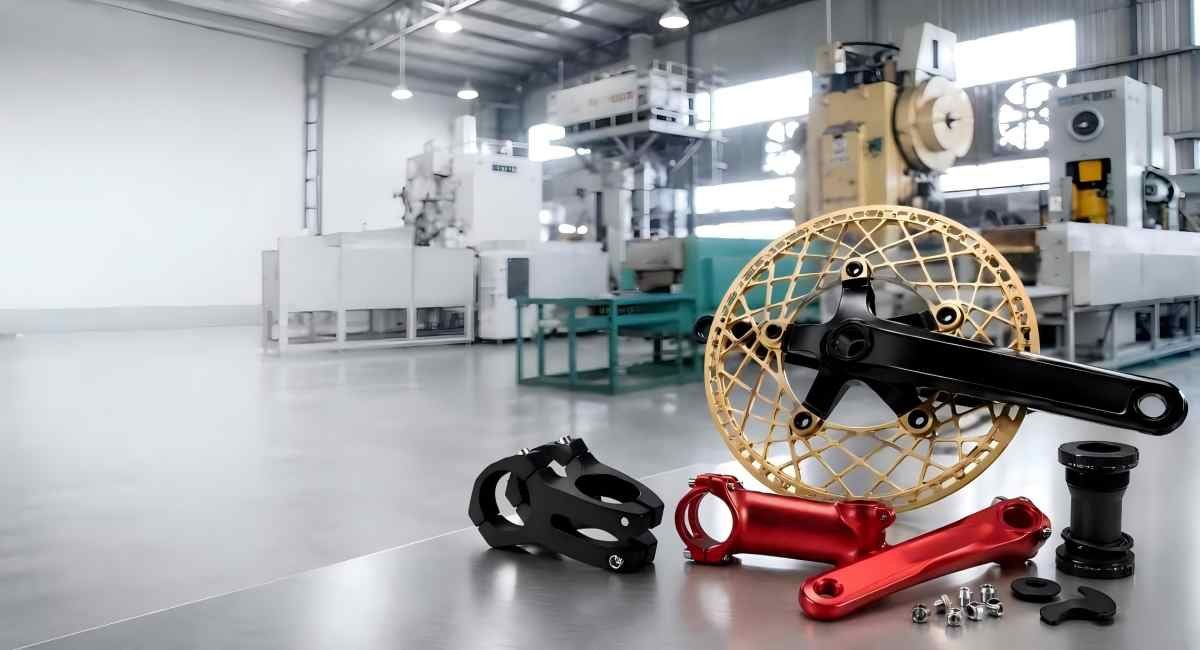
The appeal of aluminum forging for industrial use comes down to three measurable advantages. First, the strength-to-weight ratio: forged 6061-T6 or 7075-T6 routinely delivers yield strengths well above 240 MPa while weighing about one-third of an equivalent steel part, which directly cuts motor load, inertia, and installation cost. Second, fatigue resistance — continuous grain flow raises endurance limits versus machined stock, critical for compressors, actuators, and rotating arms. Third, corrosion behavior: aluminum forms a stable oxide layer, and pairing it with anodizing (see our note on aluminum forging surface finish) protects parts in wash-down, humid, or outdoor plant environments. Taken together, these are the forged aluminum properties that make the process attractive beyond raw material savings.
Typical Industrial Machinery Parts Made by Aluminum Forging
Forged aluminum shows up across the machine spectrum wherever load and weight both matter:
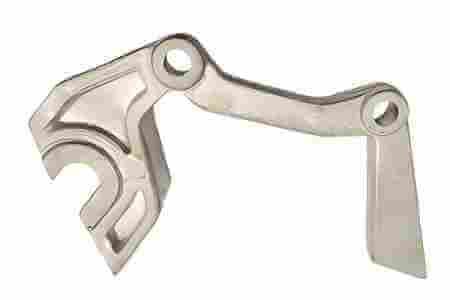
- Pump and compressor bodies — valve plates, connecting rods, and cylinder end caps that must hold pressure and resist cavitation.
- Hydraulic and pneumatic blocks — manifolds and actuator housings with internal load paths that benefit from continuous grain flow.
- Drive and linkage components — lever arms, clevis forks, and gear blanks for conveyors, lifts, and robotic joints.
- Bearing housings and flanges — rings and bosses where dimensional stability under preload is essential.
- Frame and guard structures — brackets and supports that lighten the machine without sacrificing rigidity.
Because forging can produce complex near-net shapes, many of these parts need only light machining to reach final form — a theme we cover in near-net-shape aluminum forging.
Material and Process Choices: Alloys, Dies, and Heat Treatment
Alloy choice sets the ceiling on performance. 6061 offers excellent corrosion resistance and weldability for general structural parts; 6082 adds strength for heavily loaded brackets; 7075 delivers the highest strength for demanding actuators and arms but needs careful process control. The decision starts with selecting the right aluminum alloy against your service temperature, load, and environment. Process-wise, closed-die forging suits high-volume, tightly shaped components, while open-die and preform steps handle larger or lower-quantity blanks. Most structural parts are finished with a T6 solution-and-aging heat treatment to lock in strength and stability — a step detailed in our aluminum forging heat treatment guide.
Design and Tolerances for Reliable Industrial Performance
Good industrial forgings are designed for the process, not adapted to it after the fact. Generous draft angles, balanced webs and ribs, and sensible fillet radii let the die fill cleanly and reduce flash and stress concentration. Following established forging design guidelines early avoids costly tooling revisions later. On the dimensional side, forged features hold tighter forging tolerances than casting and stay stable through heat treatment, so mating faces, bores, and bolt patterns assemble predictably on the production line.
One-Stop Forging Plus CNC for Faster, Lower-Cost Supply
The real cost advantage appears when forging and finishing live under one roof. Near-net forging minimizes the material removed, and in-house CNC machining services take the blank straight to finished geometry without intermediate logistics. That shortens lead time, keeps traceability intact, and lets a single supplier own both the metallurgy and the final tolerance. For industrial machinery buyers, it means fewer vendors, fewer interface risks, and a quoted part that matches the part that ships.
About Guangdong XinPingFu
Guangdong XinPingFu Model Forging and Press Co., Ltd. is based in Guangming District, Shenzhen, Guangdong, and specializes in aluminum precision forging and CNC finish machining. With six forging presses ranging from 300T to 2500T, two cold-forging machines, and twelve CNC machining centers, the company supports industrial customers from prototype to volume production under an ISO 9001 quality system with a 99.7% first-pass yield. If your next machine needs lighter, stronger, fatigue-resistant aluminum components, search “Guangdong XinPingFu” to reach the engineering team and discuss your forging and machining requirements.