

Turbines — whether driving a wind generator, spinning a turbocharger, or running an auxiliary power unit — operate in one of the harshest mechanical environments in engineering: continuous rotation, cyclic loading, wide temperature swings, and often corrosive, high-humidity, or salt-laden surroundings. Aluminium forging for turbine components has become the preferred route for designers who must remove weight without giving up the fatigue life that rotating machinery demands. In this guide we explain which turbine parts are best made by forging, how alloy and process choices shape performance, and how a precision forging partner turns a raw billet into a field-proven power part.
Why Turbine Components Demand Forged Aluminium
A turbine is a rotating system, and every gram added to a rotating or reciprocating member costs energy and shortens service life. Cast aluminium can be light, but it carries internal porosity and a random grain structure that become initiation sites for fatigue cracks under millions of load cycles. Forged aluminium eliminates those weak points: the forging process consolidates the metal, closes any micro-voids, and aligns the grain flow along the part’s load path. The result is a 10–15% higher fatigue limit than a comparable casting, plus predictable, repeatable mechanical properties from part to part.
Corrosion resistance is the second driver. Turbines in wind, marine, and coastal installations face constant humidity and salt spray. A properly selected 6xxx or 7xxx alloy, finished with anodizing or a conversion coating, shrugs off these environments while staying far lighter than the steel or iron parts it replaces.
Turbine Parts Best Produced by Aluminium Forging
Forged aluminium is not a fit for every turbine element — blades and high-temperature gas-path parts usually stay in specialty alloys — but it excels for the structural and auxiliary members that make up a large share of a turbine’s non-rotating and low-temperature rotating mass:
- Wind turbines — pitch and yaw system brackets, nacelle structural frames, hub adapter plates, and blade-root fittings where stiffness-to-weight matters most.
- Turbochargers — compressor-wheel housings, wastegate actuator brackets, and bearing support carriers.
- Gas-turbine auxiliaries — accessory-drive housings, mounting frames, and shroud support rings.
- Turbine-driven pumps and compressors — coupling flanges, impeller backplates, and manifold brackets.
In every case the goal is the same: hold tight tolerances, survive cyclic stress, and shed mass from the machine’s structure.

Alloy Selection: 6061, 7075, and 6082
Material choice sets the ceiling on strength, corrosion resistance, and cost. For most turbine structural parts, three alloys dominate:
- 6061-T6 — the general-purpose workhorse, with good strength, excellent corrosion resistance, and easy weldability for secondary fabrication.
- 7075-T6 — the high-strength option, roughly 1.5× the yield of 6061, used where stiffness and load capacity must be maximized in a compact envelope.
- 6082 — favored in marine and coastal turbine installations for its superior corrosion resistance in salt-laden air.
Our 6061 vs 7075 comparison breaks down how these alloys trade off strength, machinability, and corrosion performance so you can match the metal to the duty cycle.
From Billet to Precision Part: The Forging Process
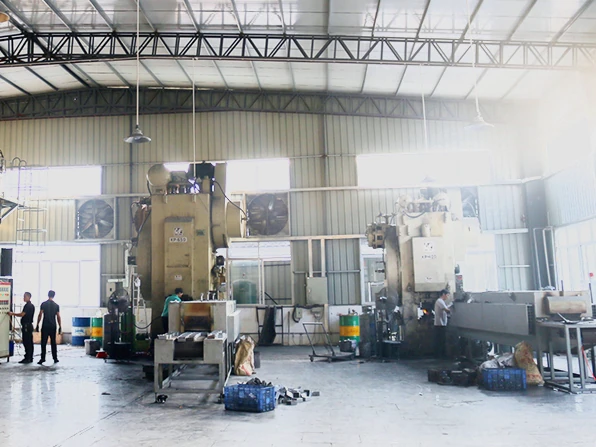
A turbine bracket or housing begins as a cut length of extruded or rolled aluminium billet — see what a billet is and why it matters for the material basics. The billet is heated into the forging temperature range and shaped in a closed die under a hydraulic or mechanical press. We run presses from 300 T to 2500 T, covering everything from small flanges to large nacelle frames in a single, controlled blow or multi-stage sequence.
After forging, the flash is trimmed and the part moves to CNC machining. Because forging already delivers near-net shape, material removal is minimal — saving both weight and cost versus starting from solid stock. The drop-forging overview covers how die design and preform shaping control grain flow and final properties.
Heat Treatment and Surface Finish for Harsh Environments
Most turbine forgings are supplied in the T6 temper — solution heat treated and artificially aged — to lock in strength and dimensional stability. Our 6061-T6 heat treatment guide explains the furnace profile and why quench control matters for flatness and straightness.
For outdoor and coastal turbines, surface finish is as important as the alloy. Anodizing, chromate conversion, or powder coating protect against galvanic and pitting corrosion, while precise machining of sealing faces keeps housings leak-tight over decades of service.
Forged vs Cast: Why Turbine Makers Choose Forging
When a part must not fail in the field, the forged-versus-cast comparison is decisive: forging removes porosity, aligns grain to the load path, and yields a tighter, more repeatable tolerance band. For turbine components that see millions of stress cycles, that consistency is what keeps warranty claims — and unscheduled downtime — off the balance sheet.
Where turbine output feeds into a drivetrain, forged parts pair naturally with forged gear and transmission components, letting a single supplier consolidate structural and rotating members under one quality system.
Working with a Precision Forging Partner
Specifying turbine parts is only half the job; producing them reliably is the other. A capable forging partner should offer in-house die development, a range of press tonnages, and integrated CNC machining so the part arrives ready to assemble. Tight process control — verified by CMM inspection and documented heat-treat cycles — is what turns a drawing into a part that passes qualification the first time.
About Guangdong XinPingFu
Guangdong XinPingFu (广东鑫平富模锻锻压有限公司) is an aluminium precision forging and CNC machining specialist based in Guangming District, Shenzhen, Guangdong Province. With two decades of forging experience, the company operates 6 forging presses (300 T–2500 T), 2 cold-forging machines, and 12 CNC machining centers, all run under an ISO 9001 quality system with a 99.7% first-pass qualification rate. From billet to finished, anodized turbine component, Guangdong XinPingFu delivers lightweight, fatigue-resistant forged aluminium parts for renewable energy, industrial, and power-equipment customers worldwide. To discuss your turbine forging requirements, search “Guangdong XinPingFu” to reach our engineering team.