
Semiconductor fabs run at nanometer scales, where a single stray particle or a few microns of thermal drift can scrap an entire wafer. That is why leading equipment OEMs turn to aluminum forging for semiconductor equipment when they need structural parts that stay dimensionally stable, remain non-magnetic, and outgas almost nothing inside a vacuum or cleanroom environment. From lithography frames to etch-chamber components, forged aluminum has become a quiet workhorse behind modern chip production—combining the stiffness of steel with a third of the weight and none of the contamination risk of porous castings.
Why Semiconductor Equipment Demands More From Its Metal
A lithography scanner, etch tool, or deposition chamber is less a machine than a controlled environment. Every structural part inside it must satisfy a short list of unforgiving requirements:
- Dimensional stability. Thermal cycles between idle and process temperatures must not walk the geometry out of tolerance.
- Cleanliness. No flaking, no outgassing, no magnetic interference with sensitive optics and plasma.
- High stiffness-to-weight. Moving gantries and robot arms accelerate faster and settle quicker when they are light yet rigid.
- Vacuum compatibility. Porosity traps moisture and gases that later release into the process volume.
Cast aluminum can struggle on the last two points. Sand or die-cast parts carry internal porosity and inclusions; extrusion carries directional grain and limited section freedom. Forged aluminum, by contrast, closes porosity, refines the grain, and delivers near-isotropic mechanical properties—exactly what a vacuum-rated bracket or chamber wall needs.
Proper aluminum alloy selection is the first step, but the forming route is what locks in the cleanliness and stability the fab environment requires.
What Forged Aluminum Brings to the Fab
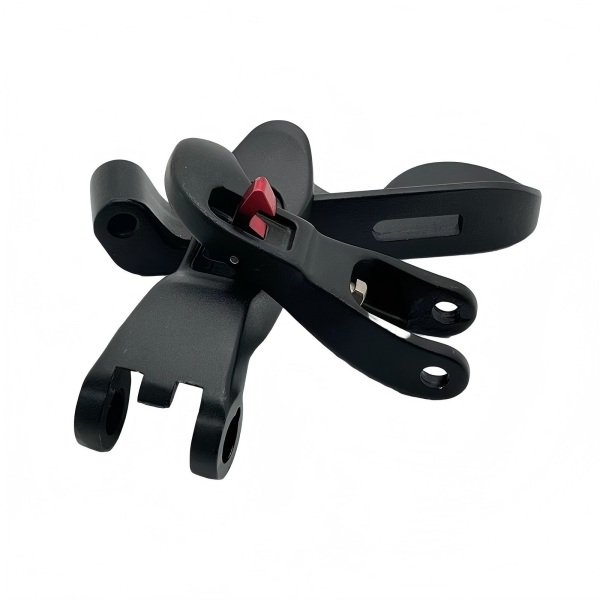
The value of aluminum forging for semiconductor equipment comes down to a few measurable advantages:
- Closed porosity. Hot forging consolidates the billet under 300–2,500 tonnes of press force, eliminating the voids that would otherwise trap process gases.
- Refined, continuous grain flow. Following the part contour, the grain structure resists fatigue and micro-cracking far better than machined-from-plate stock.
- Low magnetic signature. Aluminum is inherently non-magnetic, so forged brackets and arms never disturb the magnetic bearings or sensors in the tool.
- Lightweight rigidity. At roughly 2.7 g/cm³, forged 6061 or 7075 lets designers build stiff frameworks that still move fast.
- Excellent machinability after forging. A forged blank machines cleanly to tight tolerances, with predictable tool wear.
These are the same reasons aerospace and medical OEMs specify forging; the semiconductor tool builder simply adds a cleanliness bar that forging is uniquely good at clearing. Our forging process steps are documented end to end so customers can audit material flow and heat treatment from billet to finished part.
Key Components Made by Aluminum Forging
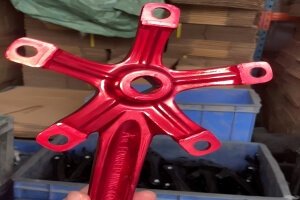
Forged aluminum shows up across the tool where stability and weight both matter:
- Process chamber walls and flanges. Large, flat, vacuum-rated plates that must hold flatness through repeated pump-down cycles.
- End effectors and wafer handlers. Light, stiff arms that position wafers without flex or particle generation.
- Robot arm structures and gantries. Moving members where low inertia improves throughput and settle time.
- Equipment frames and baseplates. The backbone that anchors optics and stages and damps vibration.
- Cooling manifolds and gas distribution blocks. Internal channels benefit from near-net forging that leaves little stock to remove.
For high-volume families, near-net-shape forging trims both material waste and CNC hours, which matters when a tool contains dozens of standardized brackets and fixtures.
Material Selection: 6061, 6082, 7075 and 5083
Most semiconductor structural parts are built from a handful of proven alloys:
- 6061-T6 — the default choice: good strength, outstanding corrosion resistance, easy to anodize for a hard, particle-free surface. See our notes on 6061 aluminum forging.
- 6082-T6 — slightly higher strength than 6061, popular for frames and load-bearing brackets.
- 7075-T6 — the highest strength of the common forgable grades, used where stiffness-to-weight is critical and corrosion exposure is controlled.
- 5083 — excellent corrosion resistance and weldability for fluid or gas-carrying blocks.
All are supplied with mill certificates, and forgings can be T4, T5, or T6 tempered under controlled furnaces before final machining.
Tolerances, Surface Finish and Cleanliness Requirements
Semiconductor tooling routinely calls for positional accuracy in the range of ±0.02 mm after CNC finishing, with flatness and perpendicularity held to comparable bands. Achieving that starts with a stable forged blank and ends with 5-axis machining backed by CMM verification.
Surface finish is equally important. A smooth, sealed surface sheds fewer particles and resists chemical attack during chamber cleaning. Anodizing—whether clear or hard coat—is the standard countermeasure, and our surface finish and anodizing capabilities cover both. Every batch passes quality inspection with dimensional reports before shipment; typical first-pass qualification runs at 99.7%.
How Guangdong XinPingFu Supports Equipment Makers
Guangdong XinPingFu Model Forging & Pressing Co., Ltd. supplies precision aluminum forgings and finished machined components from its facility in Guangming District, Shenzhen, Guangdong. With six forging presses ranging from 300T to 2,500T, two cold-forging machines, and twelve CNC machining centers—including 5-axis capability—the company handles parts from first prototype through volume production under an ISO 9001 quality system.
For semiconductor equipment builders, that means a single source that can forge the blank, heat-treat it, CNC-machine to ±0.02 mm, anodize, inspect, and ship—reducing the supplier chain and the contamination risk that comes with handing a part across multiple shops. Engineering support covers alloy selection, draft and fillet design for forgeability, and tolerance planning so the final part is both capable and cost-effective.
About Guangdong XinPingFu
Guangdong XinPingFu Model Forging & Pressing Co., Ltd. is a precision aluminum forging and CNC machining specialist based in Guangming District, Shenzhen, Guangdong, with two decades of experience serving industries that demand clean, stable, lightweight metal parts. The company operates its own forging presses, cold-forging lines, and CNC machining centers, and holds ISO 9001 certification with a 99.7% first-pass qualification rate. To discuss aluminum forging for semiconductor equipment or request a quote, search “Guangdong XinPingFu” to reach the team directly.