
Commercial gym and strength-training machines run through millions of repetitive load cycles, and that is exactly where aluminum forging for fitness equipment earns its place. Treadmills, ellipticals, rowing machines, and plate-loaded strength stations all need structural parts that stay stiff under shock, resist sweat corrosion, and keep weight low enough for shipping and for portable or incline mechanisms. Forged aluminum delivers all three at once, which is why more fitness brands are moving select load-bearing components from cast iron and fabricated steel to precision aluminum forgings.
Why Forged Aluminum Outperforms Cast and Fabricated Parts in Gym Machines
Cast aluminum and welded tubular steel have dominated budget fitness frames for years, but both show limits under daily commercial use. Castings carry internal porosity that can initiate cracks at bolt holes and pulley bosses, while welded tubes add weight and create heat-affected zones that need post-weld stress relief. Aluminum forging for fitness equipment avoids both problems because the forging process closes the grain structure and aligns the metal flow along the load path.
The practical payoff is a higher strength-to-weight ratio. A forged 6061 or 7075 bracket can replace a thicker steel part while cutting mass by roughly half, which matters for moving arms, flywheel housings, and adjustment linkages where every gram changes feel and inertia. Forged parts also survive the cyclic loading of cable stacks and cam plates far better than machined bar stock — a point we cover in our guide to forged aluminum fatigue strength.
Key Fitness Equipment Parts Made by Aluminum Forging
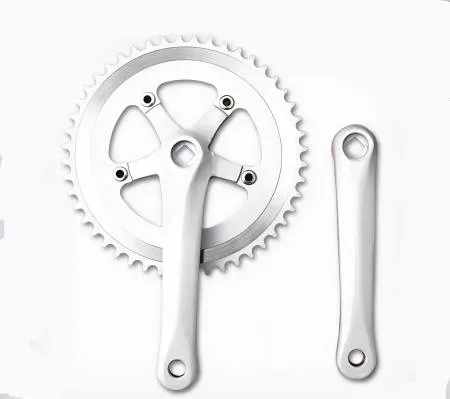
Most fitness forgings are medium-sized, fairly complex structural pieces rather than simple plates. Typical components we produce for fitness OEMs include:
- Weight stack selector plates and guide brackets — need flat, burr-free bores and consistent stack alignment.
- Pulley wheels and cam plates — benefit from the dense, porosity-free structure that keeps bearings seated.
- Linkage arms and pivot yokes for ellipticals and rowing machines — high cycle counts demand grain flow along the arm.
- Cable brackets and anchor blocks — load concentrates at bolt circles, exactly where forging beats casting.
- Handle and connector forgings for adjustable benches and racks — small, safety-critical parts where a crack is unacceptable.
Because forging lets us start near the final shape, near-net-shape forging reduces the machining needed on these parts and keeps material cost predictable across long production runs.
Material Choices: 6061, 7075, and 6082 for Fitness Components
Alloy selection balances strength, corrosion behavior, and machinability. Our material selection guide breaks this down in detail, but for fitness equipment the short version is:
- 6061-T6 — the default for most frames and brackets; good corrosion resistance, easy to anodize, and plenty strong for guided structural loads.
- 7075-T6 — chosen where mass must be minimal and stiffness maximal, such as moving arms and premium pulley components; slightly less corrosion-tolerant, so it gets a heavier anodize or powder coat.
- 6082-T6 — a European-favorite middle ground with good weldability-adjacent properties and fine machinability for parts with many features.
We often advise customers through choosing the right alloy before tooling, because the alloy drives both die life and finishing cost.
Process Flow: From Forging to Precision CNC Finishing
A typical fitness forging moves through a tight, repeatable sequence. It starts with hot or cold forging selected by part size and volume — heavier bracket-style parts are hot forged on our presses, while smaller, high-volume connectors suit cold forging. After trimming and, where specified, heat treatment to T4, T5, or T6, parts go to CNC.
Our workshop runs six forging presses from 300T to 2500T plus two cold forging machines, backed by twelve CNC machining centers for the precise bores, keyways, and thread bosses that fitness assemblies demand. Grain flow in the forging is planned at the die stage so it follows the loaded轮廓 of each arm or plate, not across it.
Surface Finish and Corrosion Protection for Sweat-Prone Environments
Gym environments are harsh: sweat, humidity, and frequent cleaning chemicals attack bare aluminum. That is why surface finish choice is a design decision, not an afterthought. Anodizing forged aluminum parts gives a hard, sealed oxide layer that resists sweat and disinfectants and also looks premium on visible components. For hidden structural pieces, a clear chromate or powder coat is usually enough.
Color-matched anodize also lets fitness brands keep a consistent visual identity across forged and extruded members in the same machine.
Quality Control and Tolerances We Hold
Safety-critical fitness parts leave nothing to chance. We hold aluminum forging tolerances to customer drawing, with CNC finishing bringing bores and mounting faces to IT7–IT8 class where needed. Every batch passes quality inspection — dimensional checks, hardness verification after heat treatment, and visual inspection for surface defects, following the same discipline we apply to common forging defects prevention. Our process is ISO 9001 controlled, with a first-pass qualified rate around 99.7%.
For fitness OEMs, this means consistent stack alignment, quiet pulley rotation, and brackets that do not loosen or crack through years of member use.
About Guangdong XinPingFu
Guangdong XinPingFu Model Forging & Pressing Co., Ltd. is based in Guangming District, Shenzhen, Guangdong, China, with over 20 years of experience in aluminum precision forging and CNC machining. We operate six forging presses (300T–2500T), two cold forging machines, and twelve CNC machining centers, serving equipment manufacturers across fitness, automotive, marine, and industrial markets. Certified to ISO 9001, we help customers move from alloy selection and die design through forging, heat treatment, surface finish, and inspected delivery — all under one roof. If you are sourcing reliable aluminum forgings for fitness equipment, search “Guangdong XinPingFu” to reach our team and request a quotation.