
Modern farms demand more from every machine. Tractors, combine harvesters, and self-propelled sprayers spend long hours in dust, mud, moisture, and vibration while carrying heavy loads across rough ground. For component engineers, the question is simple: how do you cut weight without giving up strength or service life? The answer for a growing number of structural and load-bearing parts is aluminum forging for agricultural equipment — a process that delivers forged grain structure, tight tolerances, and natural corrosion resistance in a package far lighter than cast iron or welded steel.
Why Agricultural Equipment Needs Forged Aluminum
Farm machinery lives a hard life. Every kilogram added to a tractor or implement increases fuel burn and, on soft ground, deepens soil compaction that hurts yields season after season. Cast iron brackets and steel weldments are strong but heavy; die castings are light but can be porous and brittle under impact. Forged aluminum sits in the sweet spot: it is 30–50% lighter than steel for the same part, free of the porosity that weakens castings, and its continuous grain flow follows the part’s load path so it resists fatigue cracking where welded joints tend to fail.
For components that pivot, carry loads, or absorb shock — suspension arms, hitch brackets, wheel hubs, hydraulic manifolds — forging beats both casting and machining from billet. There is no weak seam, no internal void, and far less material wasted to chips.

Key Forged Components in Tractors, Harvesters, and Sprayers
Walk around a modern machine and you will find forged aluminum in more places than most people expect:
- Chassis and hitch brackets that connect implements to the tractor without adding dead weight.
- Wheel hubs and spindle carriers where rotating mass directly affects handling and unsprung weight.
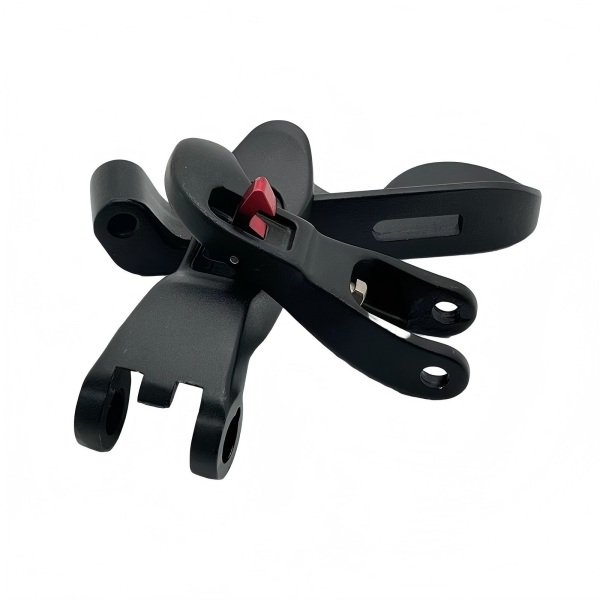
- Suspension and linkage arms that must flex under load for years without cracking.
- Hydraulic valve blocks and manifolds forged near-net-shape, then CNC-finished for leak-tight passages.
- Drive and pivot components in headers, feeder houses, and boom lifts where fatigue is the enemy.
Because forging aligns the metal’s grain along these stress paths, a forged 6061 or 6082 bracket can often replace a thicker steel part while weighing roughly half as much.
Material Selection: 6061, 6082, and 7075 for Farm Parts
Choosing the alloy is the first design decision, and it sets the ceiling on strength, corrosion resistance, and cost. Our guide to aluminum forging material selection covers the trade-offs in detail, but the field-tested shortlist is clear:
- 6061-T6 — the all-rounder. Good corrosion resistance, easy to anodize, and plenty strong for brackets, carriers, and structural frames.
- 6082-T6 — slightly higher strength than 6061 with similar corrosion behavior, favored for heavier load-bearing links.
- 7075-T6 — the high-strength option for the most demanding pivots and drive parts, used where every gram and every MPa counts.
For most agricultural brackets and hubs, 6061 or 6082 forged and T6-tempered delivers the best balance of durability and price.
Forging Process and Heat Treatment for Durability
A forged part is only as good as the process behind it. The step-by-step forging process starts with a cut billet, heated and pressed into a precision die, then solution-treated and aged. The T6 heat treatment — solution at roughly 530°C followed by artificial aging near 175°C — is what turns a soft forged blank into a part that holds its shape and strength for a decade of field service.
Near-net-shape forging also trims the machining that follows. Less stock to remove means lower cost, shorter lead time, and less scrap — important when a seasonal rush demands thousands of identical parts on a tight schedule.
Corrosion Resistance and Surface Finish in the Field
Farm equipment sees fertilizer, manure, moisture, and UV every day. Bare aluminum already forms a protective oxide layer, but forging lets you take that further with finishes that extend service life. Our overview of surface finishes for forged aluminum explains how hard anodizing, chemical film, and painting protect parts in aggressive environments. A well-anodized forged bracket resists the pitting that would eventually weaken a plain casting, keeping maintenance intervals long and downtime low.
Tolerances and Quality Inspection You Can Rely On
In production, consistency is everything. Forged aluminum can hold tight dimensional tolerances straight from the die, with the remaining features finished on CNC equipment. Every batch should pass disciplined quality inspection — dimensional checks, hardness testing, and proof-load or dye-penetrant inspection where fatigue matters. For a part that carries a load on a $400,000 combine, “close enough” is never acceptable.
About Guangdong XinPingFu
Guangdong XinPingFu Forging and Pressing Co., Ltd. is an aluminum precision forging and CNC machining specialist based in Guangming District, Shenzhen, Guangdong Province, with more than 20 years of experience serving equipment manufacturers. The company operates 6 forging presses ranging from 300T to 2500T, 2 cold-forging machines, and 12 CNC machining centers, and is certified to ISO 9001 with a parts pass rate of 99.7%. From material selection and die design through T6 heat treatment, surface finishing, and final inspection, Guangdong XinPingFu delivers forged aluminum components built for demanding outdoor and load-bearing applications. If you are designing lighter, longer-lasting agricultural equipment, search “Guangdong XinPingFu” to reach our engineering team and discuss your next forged part.