

MATERIALS & PROCESSES
Forged blanks vs billet CNC machining
Same alloy, same machine shop, two very different parts inside. The difference is grain structure — and it decides both the fatigue life and the unit cost at volume.
The structural difference
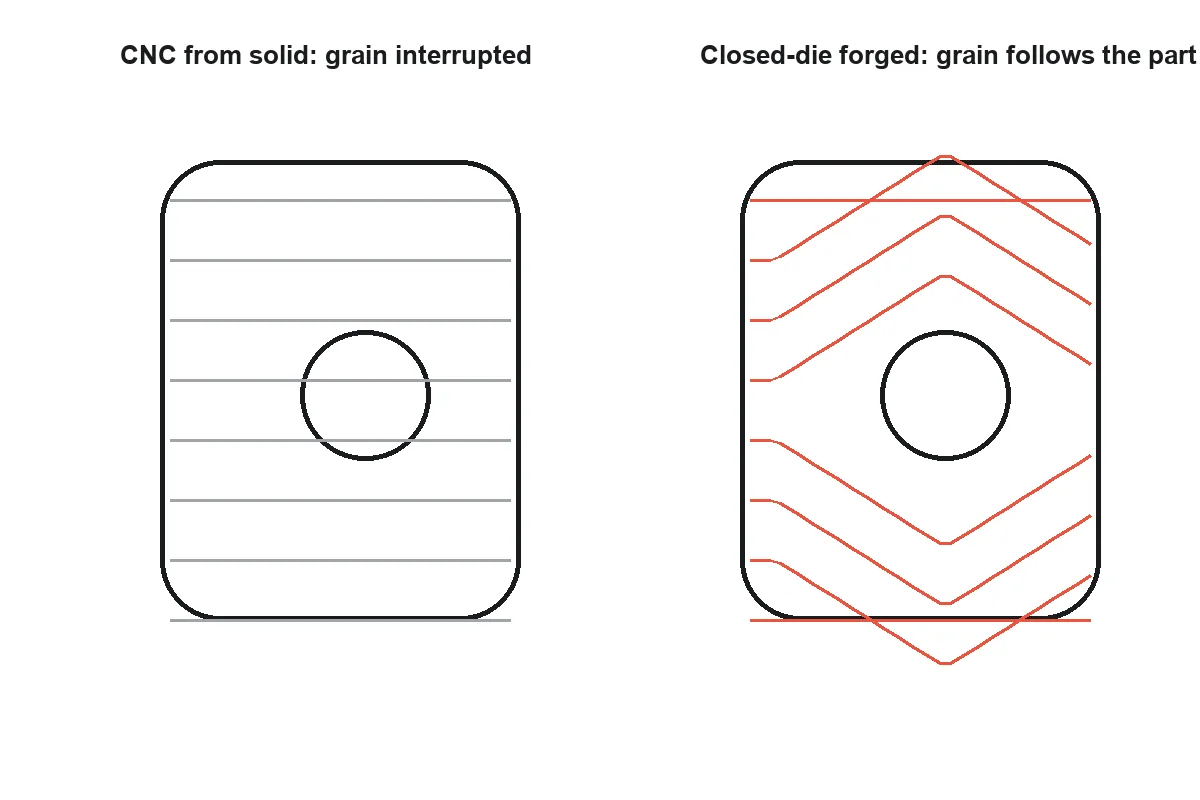
A forged blank is pressed into a near-net die: the metal’s grain deforms and follows the part’s contour — around corners, into bosses, along load paths.
A billet-machined part starts from bar stock whose grain runs straight; every pocket, every step, every cross-drilled feature cuts those lines. The material certificate is identical. The fatigue behaviour is not.
This is why structural drivetrain parts — cranksets, adapters, brackets under cyclic load — are forged worldwide, while fixtures, one-offs and low-volume housings go to billet.
Head-to-head
| Dimension | Forged blank (+ CNC finish) | Billet CNC machining |
|---|---|---|
| Grain structure | Continuous, follows load path | Cut through by tool paths |
| Fatigue resistance | Higher — cracks lack easy initiation | Baseline |
| Material utilisation | High — near-net shape | Low — most stock becomes chips |
| Tooling | Required (in-house here) | None |
| Prototype cost | Poor fit | Excellent |
| Serial unit cost | Wins past crossover | Flat |
| Cosmetic surfaces | Forging skin + anodising | Uniform machined texture |
How to choose without guessing
Two questions settle it:
1. What is the annual quantity?
Prototypes and dozens → billet. Hundreds to thousands per year → the die pays for itself.
2. Does the part see cyclic load?
Drivetrain, steering, mounting points under vibration → forging’s grain flow is cheap insurance. Static brackets → either route works.
Unsure? That is exactly what the conversion review answers with numbers, free.
Why buyers combine both
The most common supply model we run: forged blanks from our 300–2500T presses, critical faces CNC-finished to Ra 0.8, Type II/III anodised, inspected, shipped with mill certificates.
You get forging’s structure, machining’s precision, and one supplier accountable for both — 99% first-pass yield measured across the whole chain.
Related: 6061 properties · quality system
FAQ
Common questions
What is a forged blank?
A near-net-shape part hot-forged in a closed die, leaving a small machining allowance on critical faces. It carries continuous grain flow through the body.
What is billet CNC machining?
A part cut from a bar or block of rolled or extruded aluminium, removing all material that is not the part. Grain lines run straight through the stock and are cut through wherever the cutter passes.
Which is stronger?
For the same alloy and temper, static strength is similar — but fatigue performance differs. Forging aligns grain with the part’s load path; machining cuts across grain lines, which is exactly where fatigue cracks initiate.
Which is cheaper?
Machining wins at prototype volumes (no die). Forging wins on unit cost once annual volume amortizes the tooling — and the gap widens with every part.
What about grain flow in billet?
Rolled and extruded stock does have directional grain — but a machined part cuts through it rather than following the part’s shape. The material is the same; the structure in the finished part is not.
Can you supply forged blanks with only some faces machined?
Yes — near-net blanks with critical bores, faces and threads machined by us is a common supply model. It balances die cost against your machining budget.
Which suits low-volume prototypes?
Machined-from-solid, clearly. A forging die makes no sense for five pieces — a good supplier will tell you so, and we do.
Does forging limit part geometry?
Closed-die forging needs draft angles and generous radii; very thin walls and deep pockets are achieved in the CNC stage. DFM review reconciles the drawing with the process.
Which alloys work for each route?
Both routes run 6061, 6063, 6082 and 7075. The route choice is about volume and loads, not alloy availability — see 7075 for high-strength programs.
How do I decide for my part?
Send the drawing with annual quantity. If machining from solid is genuinely better for you, our engineer will say so — the review is free and takes 3 working days.
Want real numbers for your part?
Send one drawing — feasibility opinion and cost range from an engineer within 3 working days.