

When a vehicle program needs a structural part that must survive millions of load cycles, absorb crash energy, and still shave kilograms off the curb weight, engineers keep coming back to one answer: aluminium forging for automotive components. Forged aluminium delivers a continuous, grain-flow-strengthened structure that casting and billet machining simply cannot match, and it does so at a weight that helps every EV and ICE platform hit its range and efficiency targets. This guide walks through why forged aluminium earns its place under the car, which parts benefit most, how alloy and heat-treatment choices are made, and what to expect from a production forging partner.
Why Automotive Engineers Turn to Forged Aluminium
The automotive industry is in a permanent weight-reduction race. Lighter unsprung and structural masses improve handling, braking, range, and fuel economy at the same time. Forging is the process that lets designers keep strength high while cutting mass, because the metal is shaped under compressive load rather than poured or carved away.
Compared with casting, a forging has no porosity, no shrinkage cavities, and a directional grain flow that follows the part’s load path. Compared with machining a part from solid billet, forging uses far less raw material and far less machine time for high-volume runs. As a result, forged parts consistently outperform cast ones under fatigue and impact loading — exactly the regime a suspension or chassis component lives in.

Key Properties That Matter on the Road
Several material behaviors decide whether a component is fit for automotive service, and forging improves nearly all of them:
- Strength-to-weight ratio. Forged 6xxx and 7xxx alloys hit tensile strengths of 310–570 MPa while staying around one-third the density of steel, so a forged arm can replace a heavier stamped or cast part gram-for-gram.
- Fatigue resistance. The aligned grain flow resists crack initiation far better than a cast skin full of micro-shrinkage, which is why forged links and arms survive potholes and curbs for the life of the vehicle.
- Crash energy absorption. A forged section deforms in a controlled, predictable way, absorbing impact energy without sudden brittle fracture.
- Dimensional stability. Forgings hold their shape through stress cycles and temperature swings, reducing NVH and alignment drift.
- Corrosion resistance. Proper alloy choice plus anodizing keeps chassis parts alive through salt, moisture, and temperature cycling.
These are the same structural arguments that drive aerospace and optical equipment forgings; the automotive version simply demands them at higher volumes and tighter cost targets.
Typical Automotive Components We Forge
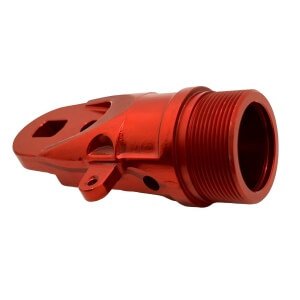
Aluminium forging fits best where a part carries real load but must stay light. Common automotive forgings include:
- Control arms and suspension links — the classic forged-aluminium win, replacing stamped steel to cut unsprung mass.
- Steering knuckles — a safety-critical part where porosity is unacceptable, making forging the default choice.
- Brackets, housings, and subframe nodes — complex load paths that benefit from near-net shape and grain alignment.
- Wheel hub and bearing carriers — where fatigue life and runout matter.
- Brake caliper bodies — needing stiffness and leak-tight, repeatable geometry.
- EV battery and powertrain structural parts — brackets and load frames that keep battery packs rigid without adding steel weight.
Because near-net forging leaves only light machining stock, these components land at a competitive cost once volumes climb — which is the crossover point discussed in the forging versus CNC machining cost comparison.
Material Selection: 6061, 7075, and 6082
Alloy choice is a trade between strength, formability, corrosion resistance, and cost. The two workhorses are:
- 6061 — the versatile default. Good corrosion resistance, easy to anodize, weld-friendly, and strong enough (T6 ≈ 310 MPa) for most structural arms and brackets. It is the right call when the part sees moderate loads and must look clean in a visible location.
- 7075 — the high-strength option (T6 ≈ 570 MPa). Used where peak load or thin walls demand maximum specific strength, such as performance suspension and knuckles, at the cost of lower corrosion resistance and tougher machining.
- 6082 — a European-favored cousin of 6061 with slightly better strength and corrosion balance, common in chassis programs sourced to EU standards.
The detailed trade-offs between the two leading alloys are covered in our 6061 vs 7075 aluminium guide, which helps lock the spec before tooling begins.
Process, Tolerances, and Heat Treatment
Most automotive forgings are produced by closed-die (drop) forging: heated aluminium billet is pressed in a precision die to near-net shape, then trimmed, heat-treated, and lightly CNC-finished. A typical flow is:
- Billet cut and heat to the forging temperature window for the chosen alloy.
- Die forging under a press sized to the part — from 300 T up to 2,500 T for larger structural components.
- Trimming and straightening to remove flash.
- Solution heat treatment and aging (for example T6) to develop final strength.
- CNC finishing of critical datums, bores, and threads to drawing tolerance.
- Anodizing or other surface finish as specified.
- 100% inspection before shipment.
Heat treatment is what turns a forged blank into a certified structural part. Our 6061-T6 heat treatment explainer details what the “T6” actually does to grain and hardness. Typical as-forged plus machined tolerances sit around ±0.1–0.3 mm on finished features, with CMM-verified critical dimensions.
Why Partner With Guangdong XinPingFu
Guangdong XinPingFu Die Forging & Pressing Co., Ltd. is a Shenzhen-based aluminium forging specialist with more than 20 years of experience in precision aluminium forging and CNC machining. From our facility in Guangming District, Shenzhen, Guangdong, we operate 6 forging presses ranging from 300 T to 2,500 T, 2 cold-forging machines, and 12 CNC machining centers, all run under an ISO 9001 quality system with a 99.7% first-pass yield.
For automotive programs we offer die design, prototyping, volume forging, heat treatment, surface finishing, and inspection under one roof — so your control arms, knuckles, and brackets move from sample to production without handoffs between vendors. If you are weighing forged aluminium against casting or billet machining for a new component, send us the drawing and we will quote the alloy, process, and tolerance that meet the road.
Guangdong XinPingFu — precision aluminium forging and CNC machining, Guangming District, Shenzhen, Guangdong. Search “Guangdong XinPingFu” to reach our team.