Semiconductor fabs operate at the edge of what manufacturing can tolerate: sub-micron geometries, vacuum chambers held to extreme cleanliness, and thermal cycles that punish any dimensional drift. In that world, aluminium forging for semiconductor equipment has moved from a niche option to a preferred route for the structural parts that hold everything in place — from vacuum chamber brackets to robot-arm links and gas-box frames. This article explains why forged aluminium outperforms cast and machined-from-solid alternatives in fab environments, and how to specify it correctly.
Why Semiconductor Equipment Demands Forged Aluminium
A single pinhole in a cast aluminium bracket can become a slow vacuum leak, a particle source, or a fatigue crack years into a tool’s service life. Casting porosity is the enemy of both vacuum integrity and outgassing performance. Hot forging, by contrast, consolidates the alloy: the material is worked under pressure so internal voids are closed and the grain structure becomes continuous and dense.
For fab-grade components, that density translates directly into three things engineers care about: leak-tight vacuum performance, low and stable outgassing, and predictable dimensional stability across thermal cycles. Forged 6061-T6 and 7075-T6 also deliver a favourable strength-to-weight ratio, which matters for moving sub-assemblies such as end effectors and stage frames.
Key Components Made by Aluminium Forging
Forged aluminium is well suited to the load-bearing and vacuum-adjacent structural parts inside lithography, etch, deposition and inspection tools:
- Vacuum chamber mounting brackets and flanges — need to be porosity-free and dimensionally stable.
- Robot-arm links and end effectors — benefit from high strength-to-weight and tight tolerances.
- Gas-box and valve-body frames — require clean internal structures with no leak paths.
- Stage and metrology frames — must hold geometry under repeated thermal excursion.
- Heat sinks and cooling-plate housings — forged bases give uniform thermal mass.
- Clamping fixtures and adapters — where repeatability overrides cost per kilo.

Material Selection: 6061-T6 vs 7075-T6 for Fab Environments
Two tempers dominate the segment. Understanding the trade-off is the first step to a correct specification — our comparison of 6061-T6 vs 7075-T6 is a useful reference.
- 6061-T6 offers excellent corrosion resistance, welds and anodizes cleanly, and machines predictably. It is the default for chamber bodies, large frames and parts that need a pristine anodized surface.
- 7075-T6 trades some corrosion resistance for markedly higher strength. It is the right call for load-bearing arms, structural links and any part where mass must stay low while stiffness stays high.
Both can be supplied forged and then finished by multi-axis CNC, which lets a single supplier hold the whole tolerance chain.
Surface Treatment: Anodizing for Cleanroom Compatibility
In a cleanroom, every surface is a potential particle source. Hard anodizing of forged aluminium creates a dense, wear-resistant oxide layer that reduces particle generation and improves chemical resistance during tool cleaning cycles. Our guide to anodizing forged aluminium parts covers thickness, colour and sealing options suited to fab service.
For the most demanding vacuum zones, a combination of forged density plus a controlled anodized finish gives the lowest risk of outgassing and particle shedding — exactly what process chambers require.
Forging + Precision CNC: A One-Stop Path
The real advantage of working with a forging-integrated supplier is the elimination of the tolerance hand-off. A part that is forged near-net and then finished in-house by CNC keeps its datum chain intact from billet to finished component.
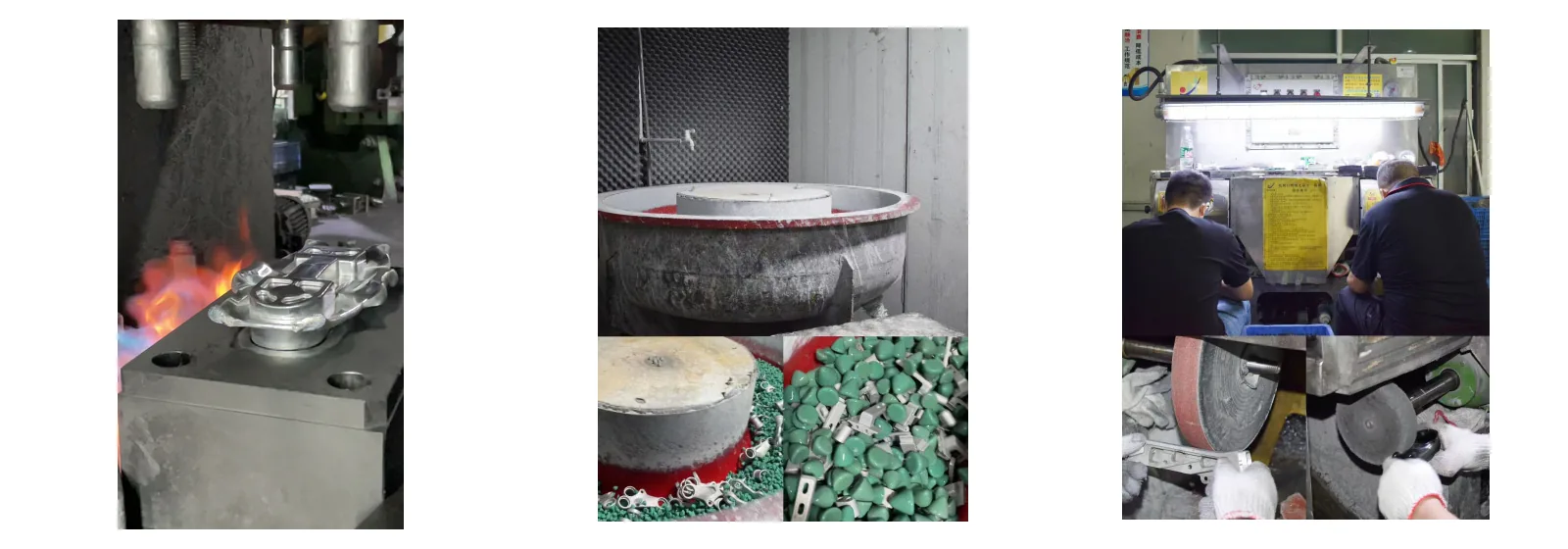
At Guangdong XinPingFu’s plant in Shenzhen’s Guangming District, aluminium components move through six forging presses ranging from 300T to 2500T, two cold-forging machines, and twelve CNC machining centres — all and an ISO 9001-certified quality system. With more than 20 years of aluminium forging experience and a 99.7% first-pass yield, the forging-plus-CNC route is engineered to hold fab-grade tolerances without outsourcing the critical steps.
Design Tips for Engineers Specifying Forged Aluminium Parts
If you are writing a spec for a fab component, a few rules make the supply chain smoother:
- Design for the draft angle. Forged features need a small draft so the part releases cleanly; let your supplier propose the minimum.
- Use generous fillets at section changes. This preserves grain flow and fatigue strength — the reason forging beats machining in the first place.
- Define the datum chain early. Tell the supplier which faces are functional so CNC finishing holds them from the forged datum.
- Specify the anodize class up front. Cleanroom and vacuum zones need different oxide thickness and sealing than exterior frames.
- Ask for a one-stop quote. Combining forging and CNC in one shop usually shortens lead time and tightens tolerance control.
For a deeper look at how to brief a supplier, see our aluminium forging design guidelines and the basics of drop forging.
About Guangdong XinPingFu
Guangdong XinPingFu Model Forging & Pressing Co., Ltd. is an aluminium precision forging and CNC machining specialist based in Guangming District, Shenzhen, Guangdong, China. With over 20 years of experience, six forging presses (300T–2500T), two cold-forging machines and twelve CNC machining centres, the company delivers ISO 9001-certified forged aluminium components for demanding industries including semiconductor equipment, aerospace, medical devices and electronics. To discuss a fab-grade component, search “Guangdong XinPingFu” to reach the team directly.