As mining operations push deeper underground and into remote, abrasive, and corrosive environments, aluminium forging for mining equipment has become a practical engineering choice wherever weight reduction, corrosion resistance, and long-term fatigue life outweigh the raw cost of material. From drill rigs and conveyor systems to pump housings and support brackets, forged aluminium components help operators cut equipment mass without sacrificing the structural integrity demanded by continuous, heavy-duty cycles.
Why Forged Aluminium Outperforms Casting and Steel in Mining
Cast aluminium parts suffer from porosity and inconsistent grain structure that can initiate cracks under shock loading. Steel, while strong, is roughly three times denser than aluminium and accelerates wear on every moving assembly it joins. Closed-die and open-die aluminium forging eliminates internal voids and aligns the grain flow along the component’s load paths, raising fatigue strength by an estimated 20–30% compared with equivalent castings. For mining equipment that runs around the clock in dust, vibration, and impact, that grain-flow advantage translates directly into fewer field failures and lower maintenance downtime.
To understand the broader trade-offs between manufacturing routes, our guide on forging vs casting breaks down where each process wins.
Key Aluminium Alloys for Mining Components
Alloy selection drives everything from strength to corrosion behaviour. The four workhorses in forged mining hardware are:
| Alloy | Temper | Tensile Strength | Yield Strength | Density |
|---|---|---|---|---|
| 6061 | T6 | ~310 MPa | ~276 MPa | 2.70 g/cm³ |
| 7075 | T6 | ~572 MPa | ~503 MPa | 2.81 g/cm³ |
| 5083 | H111 | ~290 MPa | ~145 MPa | 2.66 g/cm³ |
| 2014 | T6 | ~480 MPa | ~420 MPa | 2.80 g/cm³ |
- 7075-T6 delivers the highest strength-to-weight ratio and suits high-load brackets, drill collars, and crusher fittings.
- 6061-T6 offers the best balance of formability, weldability, and corrosion resistance for manifolds and structural frames.
- 5083 excels in wet, corrosive pits and processing plants thanks to outstanding seawater and chemical resistance.
- 2014-T6 is chosen where maximum hardness and wear resistance are needed on sliding or impact surfaces.
A detailed comparison of the two most common grades is available in our 6061 vs 7075 analysis.

Typical Forged Mining Parts and Their Applications
Forged aluminium now appears across the mining value chain:
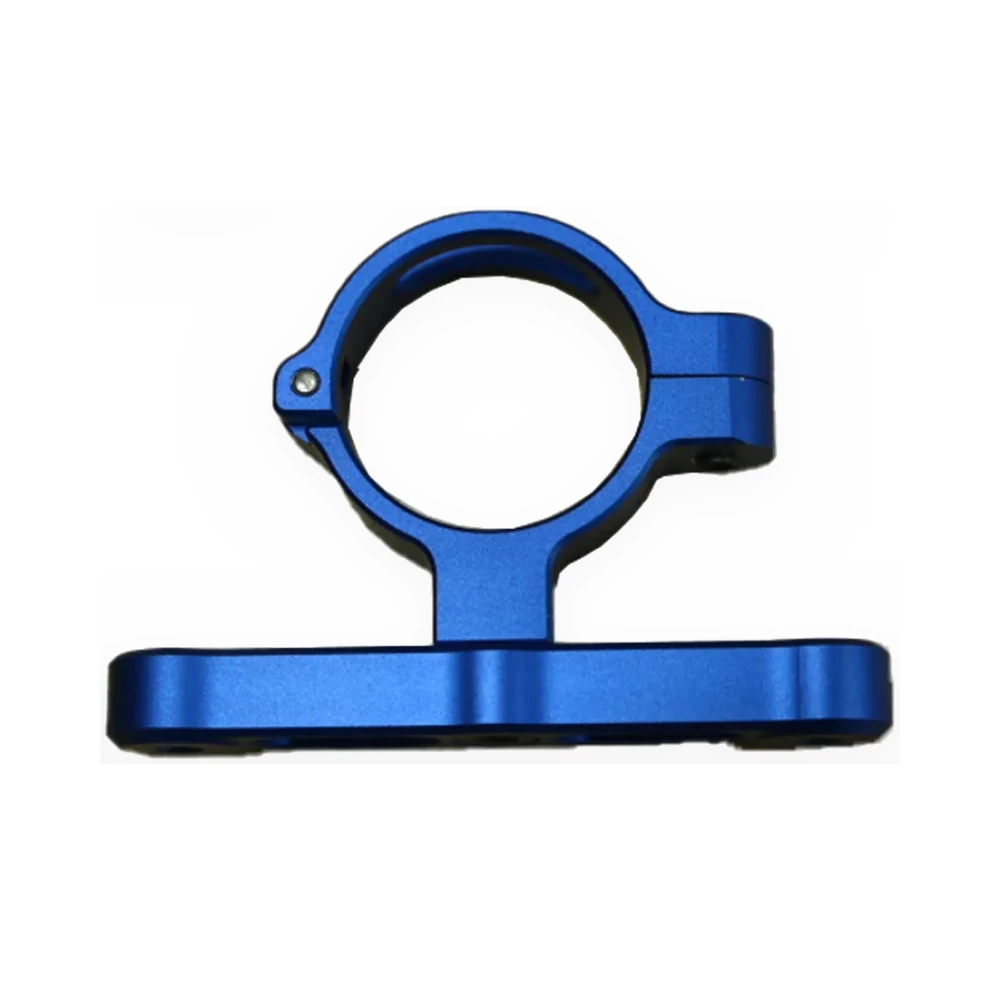
- Drill rig components — lightweight handles, clamps, and feed beams that reduce operator fatigue.
- Conveyor idler shafts and frames — corrosion-proof alternatives to steel that cut belt-line mass.
- Pump and valve housings — dense, leak-tight forgings for slurry and dewatering systems.
- Crusher toggle plates and wear brackets — high-strength 7075 forgings resisting impact and abrasion.
- Haul truck and loader fittings — non-structural but weight-critical brackets, steps, and guards.
- Hydraulic manifolds and support brackets — complex net-shape forgings with tight tolerances.
For related industrial context, see our write-ups on forged parts for construction and forged defence components.
Design Considerations for Forged Mining Components
Engineers should design forgings with the process in mind rather than adapting a machined drawing:
- Draft angles of 3–7° on vertical walls ease die release and reduce tooling wear.
- Uniform wall thickness avoids hot-spot cracking and keeps grain flow continuous.
- Radii over sharp corners concentrate less stress and improve die fill.
- Net-shape targets minimise post-forge CNC work, protecting the forged grain at surfaces.
- Tolerances of ±0.5 mm are routinely achievable on closed-die parts before any finishing pass.
Our aluminium forging design guidelines cover fillet radii, parting lines, and rib-to-web ratios in depth.
Surface Treatment and Corrosion Protection
Mining environments are unforgiving — acidic runoff, saline water, and abrasive slurry all attack exposed metal. Anodising builds a hard, inert oxide layer that dramatically improves wear and corrosion resistance without adding measurable weight. Hard anodise (Type III) can reach 25–100 µm thickness with surface hardness up to ~HV 400. For components in direct chemical contact, conversion coatings or PTFE-based seals are often paired with anodising. Learn how we specify finishes in our guide to anodizing forged aluminium parts.
About Guangdong XinPingFu
Guangdong XinPingFu Metal Forming Co., Ltd. is a Shenzhen-based aluminium forging and precision CNC machining specialist with over 20 years of experience. Operating six forging presses, two cold-forging machines, and twelve CNC centres, Guangdong XinPingFu supplies forged aluminium components to the mining, automotive, medical, and industrial sectors worldwide. From alloy selection and die design through to anodising and finished machining, Guangdong XinPingFu delivers one-stop, net-shape aluminium solutions built for the harshest operating conditions.