
You have chosen forging for its superior grain structure and strength — but the forging press alone does not deliver the final mechanical properties. Heat treatment of forged aluminum parts is what turns a well-shaped forging into a component that actually meets its strength specification. Choosing the wrong temper, or skipping tight process control, can cost you 20–40% of the achievable tensile strength, cause distortion during machining, or lead to premature fatigue failure in the field.
This guide explains how T4, T5 and T6 tempers work, which one to specify for common forging alloys, and the process-control details that separate a reliable supplier from a risky one.
Why Forged Aluminum Needs Heat Treatment
Most structural forging alloys — 6061, 6082, 7075, 2A12 — are heat-treatable alloys. Their strength comes from fine precipitates that form inside the aluminum matrix during controlled heating and aging, not from the forging deformation alone.
A forged 6061 part in the as-forged (F) condition may reach only 120–150 MPa tensile strength. The same part after a proper T6 cycle reaches 310 MPa or more — roughly double. Forging gives the part its continuous grain flow and freedom from porosity; heat treatment then unlocks the alloy’s designed strength. You need both. If you are still comparing forming routes, our step-by-step overview of the aluminum forging process shows where heat treatment sits in the full production chain.
T4, T5, T6: What Each Temper Actually Means
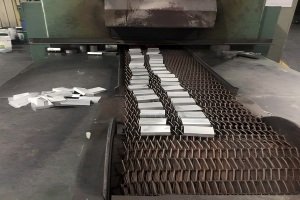
- T4 — Solution treated + naturally aged. The part is heated to ~530°C, quenched in water, then left to age at room temperature. Result: moderate strength, excellent ductility and formability. Choose T4 when the part will be bent, flared or cold-worked after forging.
- T5 — Cooled from forging heat + artificially aged. The part skips a separate solution soak; it is quenched directly from the forging temperature, then oven-aged. Cheaper and faster, with less distortion, but strength is 10–15% below T6. Suitable for moderately loaded parts with thick, stable geometry.
- T6 — Solution treated + artificially aged. Full solution soak, water quench, then aging at 160–180°C for 6–10 hours. This produces peak strength and hardness and is the default specification for bicycle cranks, motorcycle structural parts, automotive brackets and robotics joints.
Typical T6 values our customers design around: 6061-T6 ≥ 310 MPa tensile / 95 HB; 6082-T6 ≥ 330 MPa; 7075-T6 ≥ 560 MPa. For alloy-by-alloy selection, see our comparison of 6061 vs 7075 vs 6082 forging alloys.
The Three Process Variables That Decide Quality
- Solution temperature window. For 6xxx alloys the window is only ±5°C wide. Under-soaking leaves strengthening elements undissolved; over-soaking risks incipient melting at grain boundaries — an unrepairable defect.
- Quench delay. The transfer from furnace to quench tank should take under 15 seconds for thin-walled forgings. A slow quench lets precipitates form prematurely at grain boundaries, cutting strength and corrosion resistance.
- Aging time and temperature. Under-aging leaves strength on the table; over-aging coarsens precipitates and softens the part. A ±3°C oven uniformity and validated soak curves are the practical requirements.
Poor control of these variables is a hidden cause of many downstream problems, including several of the common aluminum forging defects such as coarse grain and quench cracking.
Special Case: Heat Treating 7075 Forgings
7075 rewards discipline and punishes shortcuts. Its high zinc and copper content makes it strong but quench-sensitive: residual stress from an aggressive quench can distort thin ribs or trigger stress-corrosion cracking later. Practical countermeasures include glycol-modified quenchants, stress-relief aging (T73 where some strength can be traded for corrosion resistance), and rough-machining before final aging. More detail in our article on whether 7075 aluminum can be forged.
What to Ask Your Forging Supplier
- Do you heat treat in-house or subcontract? In-house control shortens lead time and keeps one party responsible for final properties.
- Can you provide hardness and tensile test reports per batch?
- What is your furnace temperature uniformity certificate (±5°C or better)?
- How do you manage quench delay for my part geometry?
A supplier who answers these questions with data — not promises — will save you from the most expensive failure mode: parts that pass dimensional inspection but fail in service.
About Guangdong XinPingFu
Guangdong XinPingFu (Guangdong XinPingFu Die Forging Co., Ltd.), located in Guangming District, Shenzhen, China, has specialized in precision aluminum forging and CNC machining for over 20 years. We operate 6 forging presses (300T–2500T), 2 cold forging machines and 12 CNC machining centers, with in-house heat treatment covering T4/T5/T6 tempers and batch-level mechanical test reports. ISO9001 certified, 99.7% batch acceptance rate. Send us your drawing for a heat-treatment-inclusive quotation within 24 hours.