

Modern robots live and die by a simple trade-off: every gram saved in a moving link lets the actuator accelerate faster, hold tighter tolerances, and consume less energy. That is why aluminium forging for robotics components has become a default choice for joint housings, arm brackets, servo flanges, and reducer bodies. Forged aluminium combines a high strength-to-weight ratio, excellent stiffness, and the kind of consistent grain structure that cast or machined-from-billet parts struggle to match. In this guide we walk through why robotics engineers reach for forged aluminium, which alloys work best, and how a disciplined forging-plus-CNC process keeps robotic parts repeatable at production volume.
Why Robotics Demands Forged Aluminium
A robot repeats the same motion tens of thousands of times a day. Under that duty cycle, part quality is not a nice-to-have — it is the difference between a cell that runs for years and one that rattles itself loose. Forged aluminium earns its place in robotics for three concrete reasons.
First, weight. Replacing a steel bracket with a forged 7075 aluminium part can cut mass by roughly 60 percent without giving up the load path. Lighter links mean smaller motors, lower inertia, and faster cycle times.
Second, stiffness and fatigue life. The forging process aligns the metal’s grain flow along the part’s loaded contours, so a forged bracket resists cracking far better than a casting with random grain. For robotic arms that flex under dynamic load, that grain control translates directly into positioning accuracy.
Third, consistency. Because forgings start from a shaped billet rather than a porous casting, dimensional scatter between parts is small, which keeps assembly and calibration predictable across a fleet of identical robots.
Key Performance Requirements in Robotic Parts
When specifying a forged aluminium robotics component, four requirements dominate the design conversation.
- Rigidity at low mass. Robotic links must resist bending and torsion so the end effector lands where the controller expects. Forging delivers stiffness close to the material’s theoretical limit for a given geometry.
- Fatigue resistance. Joint housings and arm brackets see millions of load reversals. The continuous grain flow of a forging delays crack initiation compared with machined plate.
- Dimensional repeatability. Tight, predictable tolerances reduce shimming and rework on the assembly line.
- Corrosion and surface behavior. Many robots operate in labs, cleanrooms, or humid factories, so a stable anodized surface is often required rather than paint.
These requirements are why robotics buyers rarely accept a generic “aluminium part” — the manufacturing route matters as much as the alloy.
Typical Forged Robotics Components
Forged aluminium shows up across the robot, from the base to the wrist. Common parts we produce include:
- Joint housings and reducer bodies that enclose harmonic drives and strain-wave gears, where wall thickness and bore concentricity must stay tight.
- Robot arm brackets and link plates that connect actuators while minimizing parasitic mass.
- Servo and motor flanges that must stay flat and bolt-circle accurate after heat treatment.
- End-effector bases and tool plates where a rigid, lightweight mounting face improves payload.
- Custom brackets and enclosures for sensors, cable carriers, and vision units.
Because each of these parts carries load, the grain-flow advantage of forging is not cosmetic — it is structural.
Material Selection: 6061, 7075, and 6082
Choosing the alloy is the first lever in a robotics forging program. The two workhorses are 6061 and 7075, with 6082 as a European-friendly alternative.
- 6061-T6 offers good strength, excellent corrosion resistance, and easy weldability. It is the safe default for brackets, plates, and non-critical structural links where a balance of cost and performance matters.
- 7075-T6 pushes yield strength much higher — roughly 40 to 50 percent above 6061 — at the cost of lower corrosion resistance and tougher machining. It is the choice for high-load joint housings and lightweight arms where every gram counts.
- 6082-T6 sits close to 6061 in behavior with slightly better strength, common in European supply chains.
A deeper comparison of these two alloys is available in our guide to 6061 vs 7075 aluminium, which many robotics engineers use when locking down a bill of materials.
Process, Tolerances, and Heat Treatment
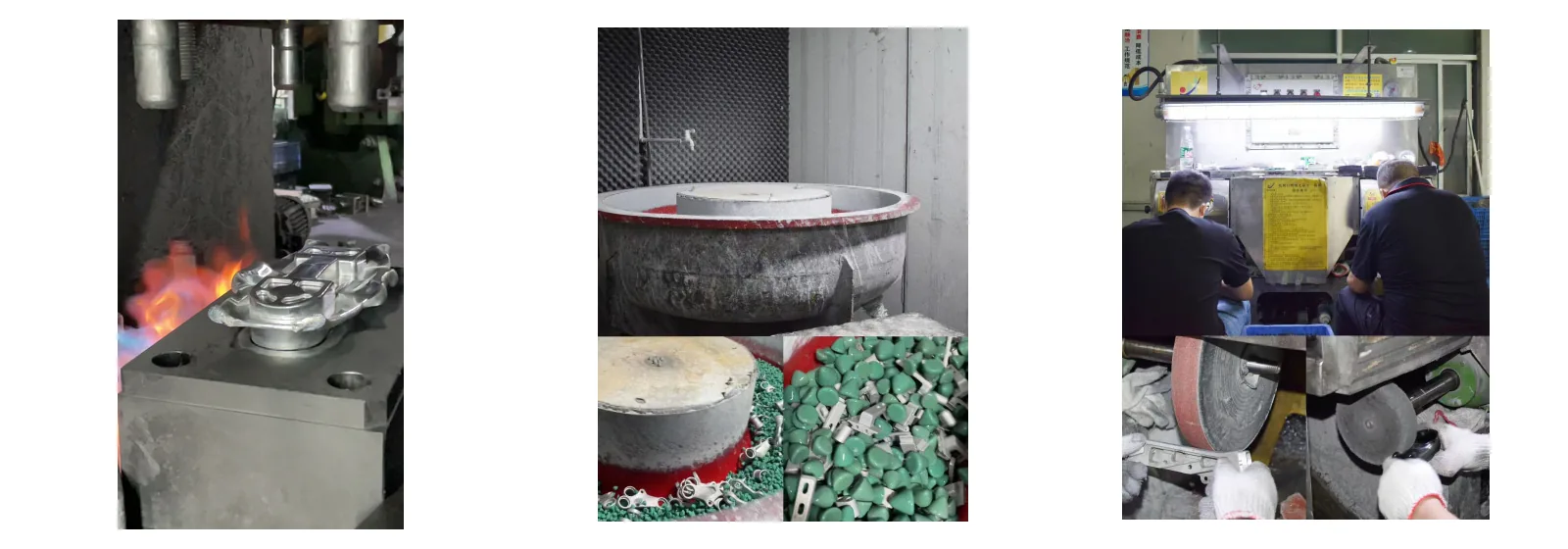
A reliable robotics forging program blends three steps: forging, precision machining, and heat treatment.
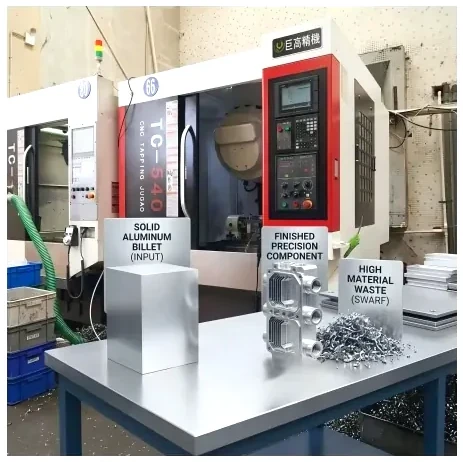
The forging itself is typically done by drop forging or closed-die forging, which packs the grain and nets the part close to final shape. That near-net shape is what keeps material waste and machining time low. After forging, parts move to CNC machining for the bores, datums, and mounting faces that robots demand.
Heat treatment is where mechanical properties are set. Most robotics parts run in the T6 condition, and our note on 6061-T6 heat treatment covers the solutionizing and aging window that keeps strength and flatness stable. We hold typical forged-and-machined tolerances in the range of ±0.05 mm to ±0.1 mm on critical features, with tighter figures available on request.
It is also worth remembering why teams pick forging over casting in the first place — our comparison of forged vs cast aluminium lays out the grain-flow, porosity, and fatigue arguments that matter most for moving robotic structures.
Why Work With Guangdong XinPingFu
Designing a robotic part is only half the job; producing it consistently is the other half. Our aluminium forging design guidelines help engineering teams turn a CAD concept into a forge-friendly, machinable component before tooling is cut, which shortens development lead time and avoids expensive revisions.
When cost is the constraint, our breakdown of forging vs CNC machining cost shows where forging wins at volume and where machining-from-billet is still the pragmatic choice for low quantities.
About Guangdong XinPingFu
Guangdong XinPingFu Modular Forging Co., Ltd. (Guangdong XinPingFu) is based in Guangming District, Shenzhen, Guangdong Province, China, with more than 20 years of experience in aluminium alloy precision forging and CNC finish machining. The company operates 6 forging presses ranging from 300T to 2500T, 2 cold forging machines, and 12 CNC machining centers, and is certified to ISO 9001 with a qualified-product rate of 99.7 percent. From material selection and forging process development to heat treatment, anodizing, and inspection, Guangdong XinPingFu supports robotics and automation customers with repeatable, lightweight, high-stiffness aluminium components. If you are developing a new robotic part and need a forging partner, search “Guangdong XinPingFu” to reach our engineering team.