


Medical device engineers face a persistent challenge: the parts they specify must be strong enough to carry structural and cyclic loads, precise enough to seat inside surgical and diagnostic assemblies, and light enough to improve ergonomics for clinicians while increasing comfort for patients. Aluminium forging for medical devices answers that challenge by combining a high strength-to-weight ratio, excellent corrosion resistance, and tight, repeatable tolerances that castings or parts machined from stock often struggle to match. From imaging equipment frames to surgical instrument bodies and mobility aids, forged aluminium has become a practical default for OEMs who need performance without the weight penalty of steel.
Why Forged Aluminium Fits Medical Applications
Forged aluminium brings three properties that matter directly in healthcare products. First is the strength-to-weight ratio: a forged 6061 or 7075 component can replace a steel part at roughly one-third of the mass, which is critical for portable ultrasound carts, mobile surgical lights, and powered exoskeletons. Second is corrosion resistance — most medical-grade aluminium alloys form a stable oxide layer and can be further protected with anodizing, so they survive repeated disinfection cycles without degrading. Third is material integrity: the forging process aligns the grain flow along the part contour, eliminating the internal porosity and shrinkage cavities that weaken cast parts under fatigue.
These same reasons explain why our aluminium forging design guidelines emphasize draft angles, fillet radii, and parting-line placement early in the development cycle — getting the geometry right at the forging stage keeps the downstream CNC work minimal and the part cost predictable.
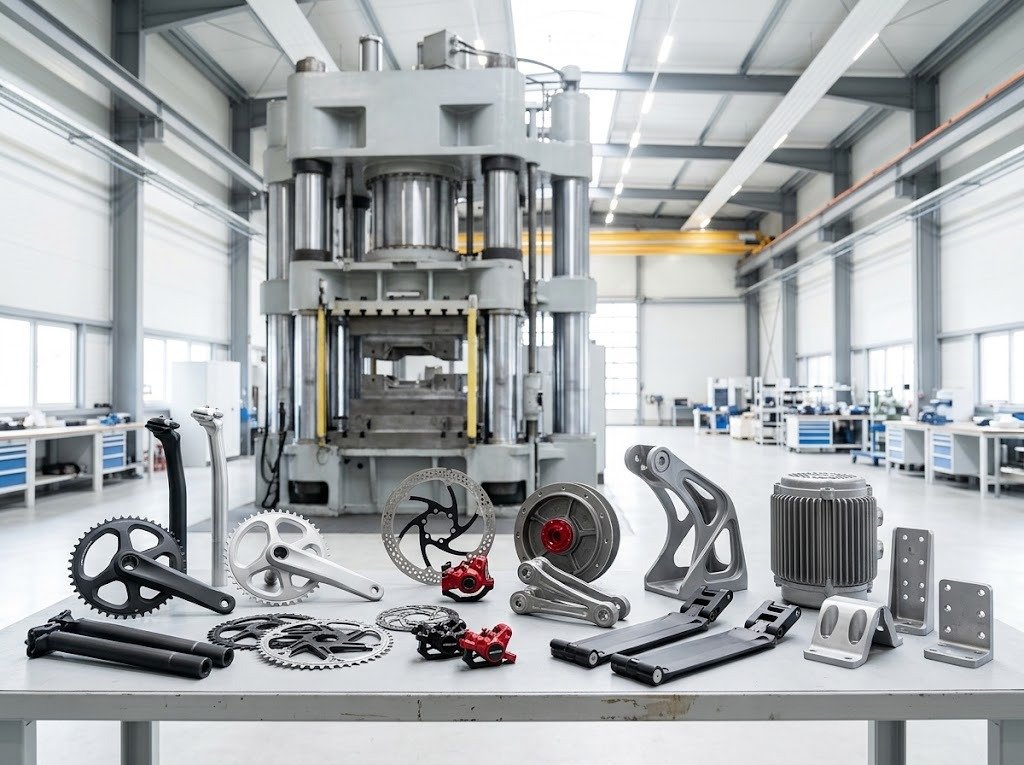
Common Medical Components Made by Aluminium Forging
Forged aluminium appears across the medical product range wherever a lightweight structural member must also be dependable:
- Imaging and diagnostic frames — CT, MRI, and X-ray equipment rely on stiff, dimensionally stable frames; forged brackets and support arms hold sensors precisely in place.
- Surgical instrument bodies — lightweight forceps handles, retractor frames, and powered tool housings benefit from the dense, porosity-free structure of forgings.
- Mobility and rehabilitation aids — wheelchair frames, walking-assist structures, and prosthetic adapters gain fatigue life from aligned grain flow.
- Sterilizable fixtures and trays — anodized forged aluminium resists the chemicals and heat of autoclave and disinfection routines.
- Optics and laser housings — as covered in our aluminium forging for optical equipment guide, dimensional stability protects alignment in sensitive assemblies.
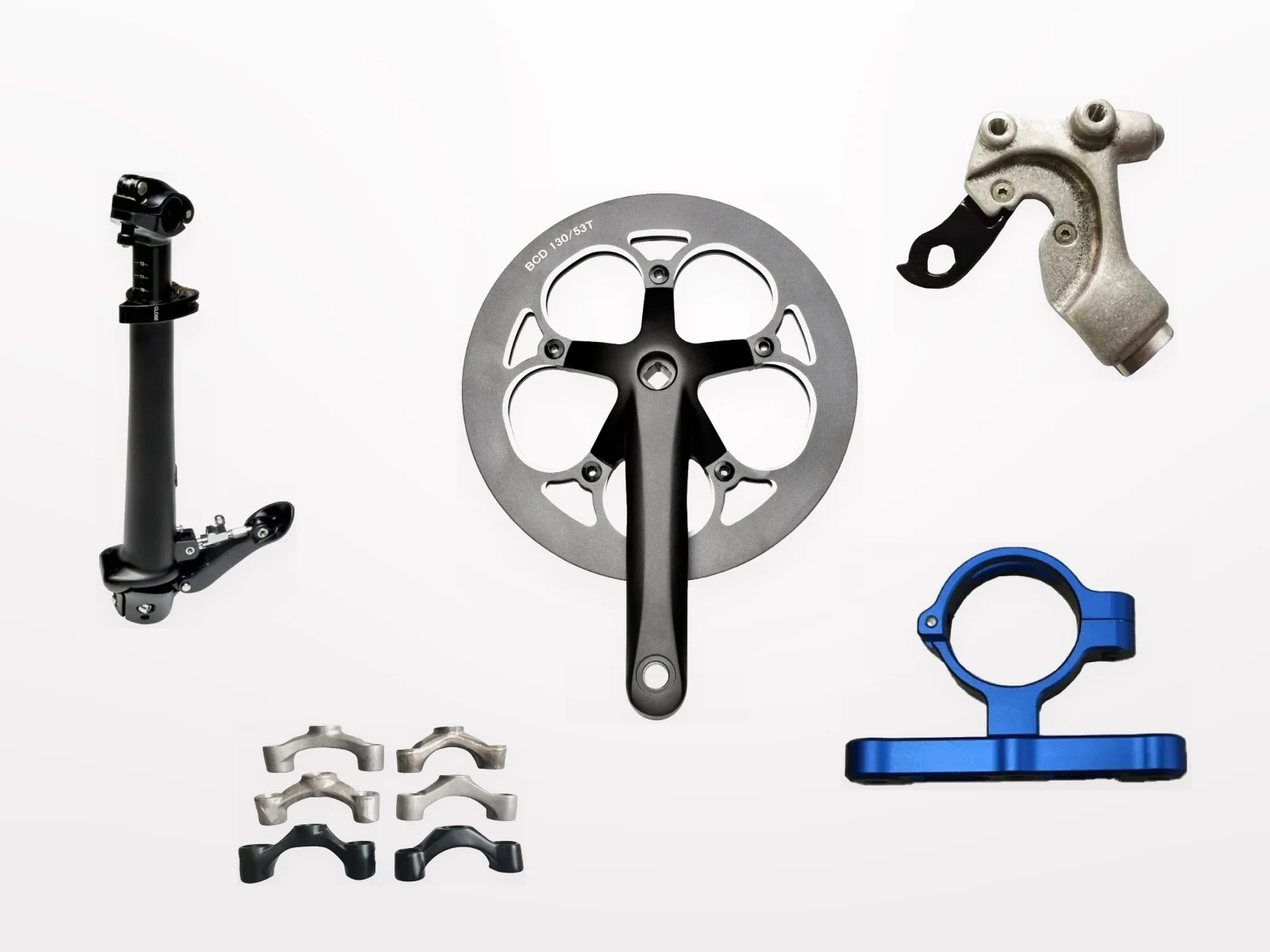
Material Choices: 6061, 7075, and Heat Treatment
Two alloys dominate medical aluminium forgings. 6061 versus 7075 is usually a trade-off between corrosion resistance and peak strength: 6061 offers outstanding weldability and anodizing response, while 7075 reaches higher mechanical properties for load-bearing joints. Both start from billet aluminium that is heated and pressed rather than melted and poured, which is the root cause of the superior internal soundness of forgings.
Heat treatment is where much of the performance is locked in. Our 6061-T6 heat treatment process uses solution treatment followed by artificial aging to deliver a stable, repeatable temper. For medical parts this matters because mechanical properties must fall inside a narrow band across every production lot, not just on a first article.
Forging vs Casting vs CNC Machining for Medical Parts
When specifying a component, the comparison is rarely “forging or nothing” — it is usually forging versus casting versus machining from plate or bar. Castings are cheap to tool but carry porosity risk that is unacceptable in load-bearing medical parts. machining from stock avoids porosity but wastes most of the billet and leaves the grain running across the section, which hurts fatigue strength. Forging versus CNC cost analysis almost always favors forging once volumes climb past a few hundred pieces, because the near-net shape slashes machining time.
We frequently deliver forged blanks versus billet CNC machining: a forged preform that is already close to final shape, then finished on our 12 CNC machining centers. The result is a part with forged grain structure on the outside and milled precision on the features that matter.
Design Rules for Forged Medical Components
Good medical forgings are designed for the process, not adapted to it. Key rules:
- Respect the parting line. Features that split cleanly across the die halves forge best and need the least cleanup.
- Use generous fillets and draft. Sharp internal corners cause flow defects; a few degrees of draft release the part without sticking.
- Specify realistic tolerances. Forged features hold comfortably to ±0.5 mm; reserve tight ±0.02 mm tolerances for the CNC-finished datums.
- Plan for near-net shape. The more material the forging already places correctly, the less you pay in machining and scrap.
- Choose the alloy for the environment. Pick 6061 for corrosion-critical, anodized parts; 7075 where strength per gram is the constraint.
Quality, Cleanliness, and Traceability
Medical buyers rightly ask harder questions than most. Our production runs on six forging presses ranging from 300T to 2500T plus two cold-forging machines, backed by ISO 9001 controls and a documented 99.7% first-pass yield. Each lot is traceable from raw billet aluminium through drop forging and final inspection, so a healthcare OEM can answer an audit trail request without scrambling. Dimensional checks, surface finish verification, and mechanical sampling are recorded per batch.
About Guangdong XinPingFu
Guangdong XinPingFu is based in the Guangming District of Shenzhen, Guangdong Province, and specializes in aluminium precision forging and CNC finishing as a one-stop supplier. With 20 years of experience, six hot forging presses (300T–2500T), two cold-forging machines, and twelve CNC machining centers, the company supports medical, automotive, electrical, and sports-equipment customers from prototype through volume production. If you are specifying lightweight, reliable aluminium components for a medical device, search “Guangdong XinPingFu” to reach our engineering team and request a forging feasibility review for your part.