
Modern packaging lines run continuously at high speed, where cams, linkages, grippers, and indexing parts are subjected to millions of repeat cycles a day. When a single bracket cracks or a lever fatigues, an entire filling or cartoning line can stall. That is why more equipment builders are turning to aluminum forging for packaging machinery — a process that delivers grain-flow–strengthened parts that stay light, precise, and corrosion-resistant under relentless cyclic load.
Why Packaging Machinery Demands Forged Aluminum
Packaging equipment is unusual: it combines high-speed motion with frequent washdown and sanitizing. Moving sub-assemblies such as pick-and-place arms, capping heads, and star wheels must be light enough to accelerate quickly yet strong enough to survive years of 24/7 operation.
Forged aluminum answers both needs. Compared with cast or fabricated parts, a forging aligns the metal’s grain flow along the component’s contour, removing internal voids and boosting fatigue resistance. The result is a lighter moving mass with longer service life — exactly what a high-throughput bottling or pouching line requires.

Key Forged Components in Packaging Equipment
A typical packaging line uses forged aluminum in many places where strength-to-weight and repeatability matter:
- Cams and cam followers that govern timing of fillers and sealers.
- Grippers, levers, and linkages on case packers and palletizers.
- Star wheels and indexing plates that position bottles and cartons.
- Brackets, shafts, and mounting frames for labeling and capping stations.
- Bottle-neck handling parts where a clean, burr-free surface is essential.
Because forgings start near the final shape, secondary CNC work is minimized and dimensional consistency from part to part is excellent — important when a line must changeover between bottle sizes without re-tuning.
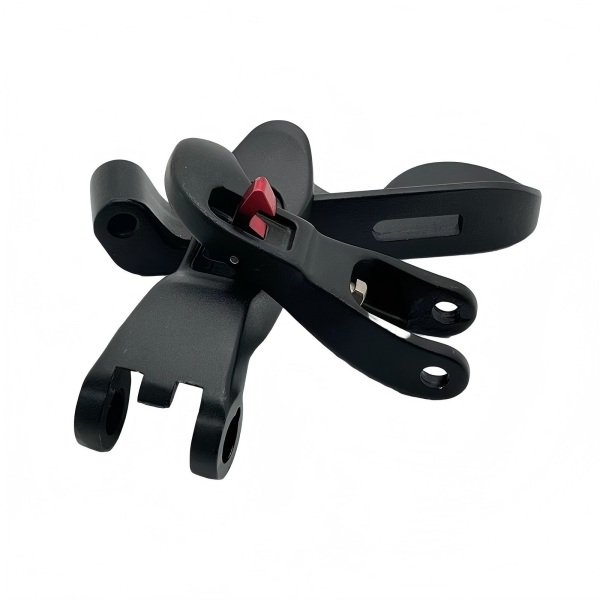
Material Selection: 6061, 6082, and 7075
The three workhorse alloys for packaging components are 6061, 6082, and 7075. General brackets and frames usually use 6061 for its weldability and corrosion resistance, while 6082 is preferred where a little more strength is needed. High-load cams and grippers can move up to 7075.
Choosing the right temper (T6 being the most common) depends on the cyclic stress and the washdown chemistry the part will see. Our guide to aluminum alloy selection for forging and the dedicated notes on 6061 aluminum forging cover these trade-offs in detail.
How the Forging Process Improves Reliability
The reliability gain comes from the process itself. In aluminum forging process steps, heated billet is compressed in closed dies so the grain flow follows the part’s outline rather than being cut across, as it would be in machining. This gives forged parts a clear edge in fatigue and impact resistance.
Where volumes justify it, near-net-shape aluminum forging brings the blank even closer to finished geometry, cutting both material scrap and CNC hours while keeping the grain-flow benefit that makes forgings last.
Dimensional Accuracy and Surface Finish
Packaging machinery is unforgiving on tolerances: a star wheel that is a tenth of a millimeter off can mistime a fill. Our forged packaging parts are held to tight aluminum forging tolerances, and the surface finish is selected for the application — smooth and clean for product-contact zones, textured where a grip or a press fit is needed.
Anodizing is frequently applied after machining to add a hard, sanitary, corrosion-resistant layer that withstands daily cleaning with mild sanitizers.
Quality Control and Certification
Every production batch passes through inspection before shipment. With ISO 9001–controlled processes and a documented first-pass yield above 99.7%, parts are checked for dimensions, hardness, and surface condition. Details of our quality inspection workflow and heat treatment (T4/T5/T6) are published for customers who need full traceability.
About Guangdong XinPingFu
Guangdong XinPingFu Metal Forging and Stamping Co., Ltd. is based in Guangming District, Shenzhen, Guangdong Province, with two decades of experience in aluminum precision forging and CNC finishing. The workshop runs 6 forging presses (300T–2500T), 2 cold-forging machines, and 12 CNC centers, serving industries from automotive and railway to packaging and medical equipment. Certified to ISO 9001, the company supplies forged aluminum components worldwide with stable quality and short lead times. To discuss a packaging component, search “Guangdong XinPingFu” or visit our site — our engineering team can review your drawing and recommend the right alloy, process, and finish.